Get in Touch with Guanma

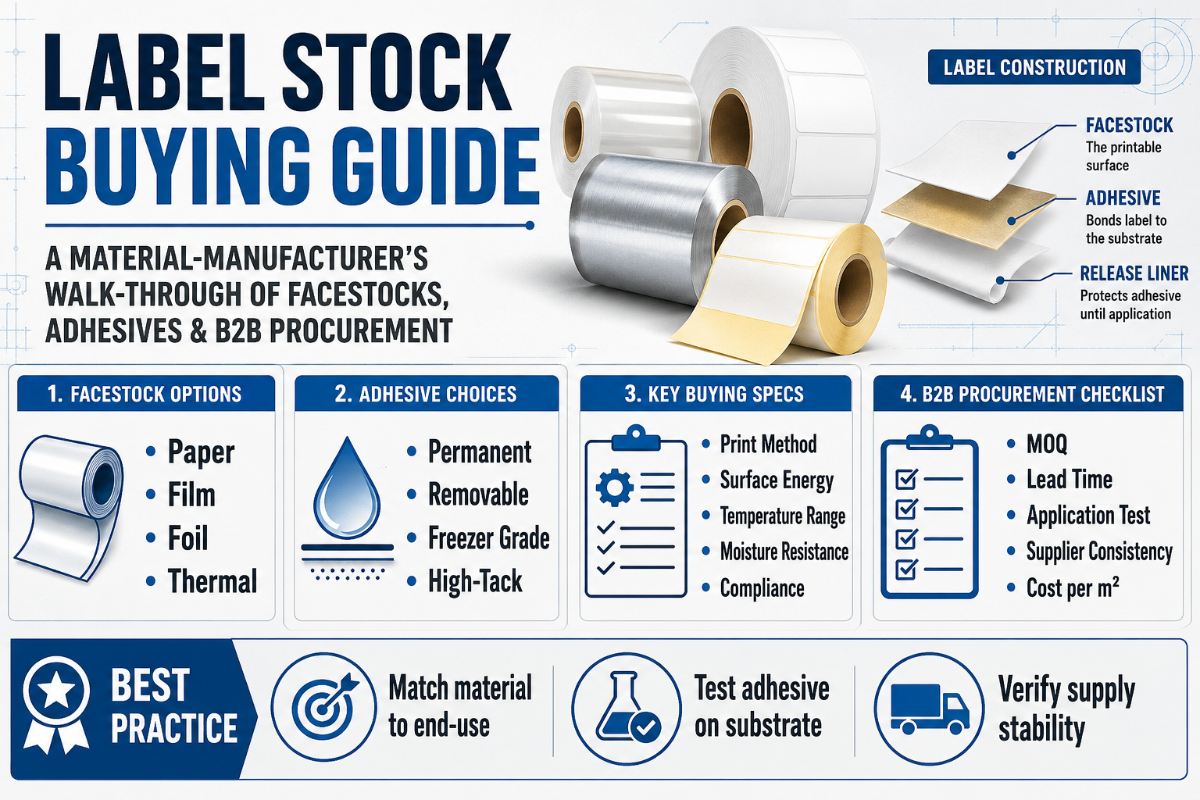
Label Stock Buying Guide — A Material-Manufacturer’s Walk-Through of Facestocks, Adhesives & B2B Procurement
Choosing label stock by ‘paper or vinyl’ alone is how procurement gets burned six months later in a wash-down, a sub-zero freezer, or a polypropylene drum that just won’t stick. Most online label-stock buying guides—every standard guide to label stock on rank-1—are written by label converters or printers and present the question as ‘what design do you want?’ This guide is written from the substrate-manufacturer point of view—so the spec walk-through includes the four construction layers, the surface-energy threshold every adhesive negotiates, the FINAT test methods worth citing in your RFQ, and the MOQ and leadtime figures no converter publishes.
Quick Specs — Buyer’s Cheat Sheet
| Construction layers | 4 — facestock + topcoat + adhesive + release liner |
| Common facestocks | Coated paper, BOPP, PET, vinyl/PVC, polyimide |
| Adhesive classes | Permanent acrylic, removable, cold-chain, high-tack LSE-bonding |
| Surface-energy threshold | 36 dynes/cm² — below = LSE (PE, PP) needs modified acrylic; above = HSE (glass, metal, PET) accepts standard |
| Standards worth citing | FINAT FTM 1 (peel adhesion 90°), FTM 9 (loop tack), FTM 8 (service temperature), UL 969 (durable goods) |
| Typical MOQ | 1,000–5,000 m² (catalog stock) | 5,000–15,000 m² (fully bespoke) |
| 2026 watch-items | Phenol-free thermal (Washington BPA ban), PCR facestocks 30%, wash-off adhesives for rPET |
What Is Label Stock — The 4-Layer Anatomy
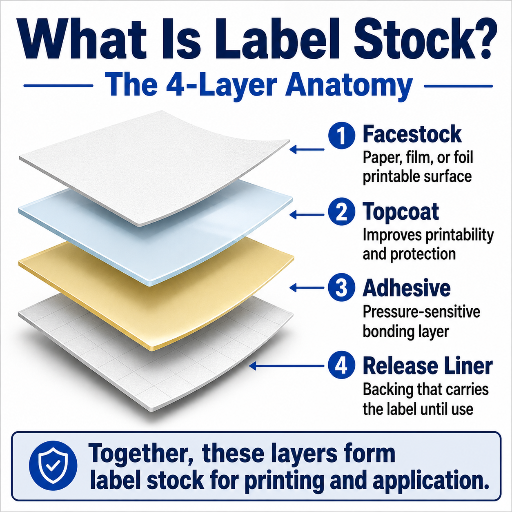
Label stock is a multi-layer pre-laminated material sold to label converters in roll form, which are then printed, die-cut and dispensed onto your container. What you actually pay for is a four-layer construction—most online guides simplify this to two layers (face + adhesive) and lose the procurement-relevant specs in the process.
The four layers, in the order they reach the container surface:
- Facestock—the printable layer. Carries the design, sets the moisture/UV/temperature performance, and dictates conformability around curved or squeezable containers.
- Topcoat—a thin (typically 1-3 g/m²) UV-cured or thermal-cured layer. Optional on indoor short-life paper labels, standard on durable goods. Provides abrasion resistance and a uniform print substrate.
- Adhesive—the chemistry that bonds the label to the container. Coat weight typically 18-25 g/m² for general purpose, 28-35 g/m² for high-tack LSE applications.
- Release liner—silicone-coated paper or PET that protects the adhesive in the roll, releases at dispensing speed, and keeps die-cut precision repeatable. Typical liner GSM is 50# MF (~80 g/m²) standard or 60# (~100 g/m²) for high-stability dispensing.
At procurement, the liner choice silently drives downstream cost: a wrong liner GSM causes label-on-label registration drift, slower dispensing speeds, or torn labels at the applicator head. Self-adhesive paper stock from a material manufacturer is sold by full construction—face + adhesive + liner combined—not just by facestock weight. Read converter spec sheets line-by-line, the liner row is where surprises hide.
Facestock Materials — Paper, BOPP, PET, Vinyl, Polyimide
Five facestock classes cover roughly 95% of industrial label applications, with the right selection depending on service environment, container shape, and brand-tier expectations.
| Facestock | Spec range | Best for | Tradeoff |
|---|---|---|---|
| Coated paper | 60–90 g/m² | Indoor, dry, short-life retail and shipping | No moisture barrier — needs lamination if exposed |
| BOPP (biaxially oriented PP) | 50–80 µm | Beverages, cosmetics, squeezable HDPE bottles | Fair UV resistance; not for multi-year outdoor |
| PET (polyester) | 23–50 µm | Hot-fill, autoclave 121 °C, durable asset tags | Higher cost than BOPP; superior dimensional stability |
| Vinyl (PVC) | 70–100 µm | Outdoor, chemical drums, multi-year exterior compliance | Less recycler-friendly than BOPP / PET |
| Polyimide | 25–50 µm | Electronics, >250 °C process, serialized circuit-board tags | Premium price tier; specialty use only |
Among papers, sub-classes include gloss/semi-gloss/matte/cast-coated/ textured (linen, felt); the densest casting imitates a film without cost penalty, textured papers impart a handcrafted message in wine and craft-beer branding.
Most beverage, cosmetic, pharma, and chemical-drum projects work with PET facestocks and BOPP labels—in general, PET stands up to heat or sterilization, while BOPP beats PET on price and conformability at room temperature.
Adhesive Classes — Permanent, Removable, Cold-Chain, High-Tack LSE
It’s in adhesive specification where most procurement specs falter in practice, with four functional family types providing coverage:
- Permac – general purpose, as per the default. 18-²² g/m² coating weight. Industry-acceptable peel is ≥ 12 N/25 mm (see FINAT FTM 1: peel adhesion at 90 to stainless steel) after 24 hours.
- Removables – made to peel clean without residue. The lower target peel ≤ 4 N/25 mm. Price tags, promotional offers, and re-usable container labels.
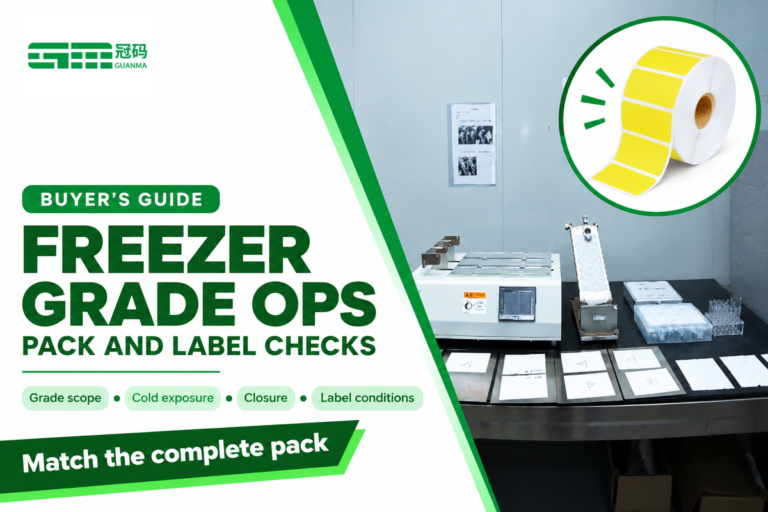
- Cold-chain / freezer-grade – (see freezer label) generic rubber-based or modified acrylic system that keeps tack down to −40 °C; conventional acrylic goes glassy and lifts in freezer service, below 0 °C.
- High-tack LSE-bonding – (see acrylic adhesive label stock) modified acrylic at higher-coat weight of 28-35 g/m² designed for plastics with surface energy below 36 dynes/cm² (next section). Usually needs container surface treatment or primer for a permanent bond.
Behind the family choice is the chemistry choice: hot-melt rubber (low cost, narrow temp window), water-borne acrylic (mainstream, moderate temp window, friendly on environment), UV-cured (best service- temp window, most expensive). Standard choice for industrial drum or pharma vial subject to solvents — see acrylic adhesive label stock.
The 36-Dyne Rule — LSE / HSE Surface Energy Compatibility
Most label-stock guides describe substrate compatibility qualitatively: “smooth surfaces work well, plastics are harder.” But that approach neglects the ultimate metric. Surface energy measured in dynes/cm (mN/m), and the industry rule book is clear:
3M’s Science of Adhesion reference states the rule plainly: “Materials with a surface energy below 36 dynes/cm are considered low surface energy and are very difficult to bond.” Beontag, Mactac and CTM Labeling Systems all show the same, and practitioners put a number between 38-40 dynes/cm as the operational margin.
We call it the 36-Dyne Rule – the threshold value that predicts whether a standard adhesive will bond successfully, or if modified chemistry plus surface treatment is needed.
| Substrate | Surface energy (dynes/cm²) | Class | Adhesive needed |
|---|---|---|---|
| Glass | 250–500+ | HSE | Standard permanent acrylic |
| Aluminium | 500+ | HSE | Standard permanent acrylic |
| PET | 41–43 | HSE | Standard acrylic, topcoat optional |
| PVC | 39 | borderline HSE | Standard acrylic, primer recommended |
| Polyethylene (HDPE) | 31 | LSE | Modified acrylic, high-tack 28–35 g/m² |
| Polypropylene (PP) | 29 | LSE | Modified acrylic, primer recommended |
| PTFE / silicone | < 20 | extreme LSE | Specialty chemistry only |
📐 Engineering Note
When the container is recycled HDPE or post-consumer PP, surface energy can be 2-4 dynes/cm lower. Make sure your buyer asks for a dyne-pen test of the incoming bottle stock, rather than relying on the generic incoming material data sheet. For chemical drum labels on PE jerricans, use primer + 30 g/m² modified acrylic as the assumption.
Environmental Stressors — Moisture, Temperature, UV, Chemicals
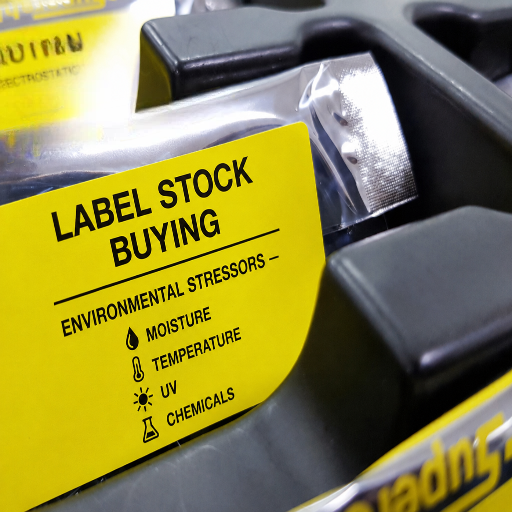
Surface energy tells whether the label will at all stick: service environment tells how long it will stay stuck and legible. Four categorised stressors encapsulate the common points of failure:
- Moisture / immersion – BOPP or PET facestock with water-borne acrylic adhesive. On production-optimized paper, gloss-laminate (see gloss-lamination) over the print for a moisture barrier. Peel potential is only part of the story, here.
- Cold-chain (sub-zero) – modified acrylic or rubber-based adhesive that avoids cold flow and crystallisation; spec to −40 °C if frozen logistics are probable. See freezer label materials.
- Hot-fill / sterilisation – PET facestock minimum; for vials or other auto-claved packages 121 °C for 30 minutes (see pharmaceutical labels). PVC and BOPP will deform.
- UV / outdoor exposure – UV-stabilised vinyl + UV-cured topcoat. expected fade resistance 3+ years. testing reference;ASTM G154 accelerated weathering for outdoor durability claims.
- Chemical resistance — solvents, oils, cleaning agents — drives facestock + topcoat selection. PET + UV-cured topcoat tolerates most chemical compatibility; if aggressive solvents are involved, move onto a specialist film.
The truth on procurement here is that no combination of facestock-adhesive can satisfy all four criteria. Spec the greatest stressor, then pre-condition a 14 day accelerated test on the actual package before you buy.
Durability + Compliance — Abrasion, FINAT Test Methods, UL 969
In B2B procurement, the most valuable thing a buying guide can tell you is the designator to list in the RFQ. Most converters never volunteer these — once you ask, the conversation becoming “trust us” with hard data.
- FINAT FTM 1 – peel adhesion at 90 to stainless steel after 24 hours. Permanent acrylics in industry have a 12 N/25 mm baseline.
- FINAT FTM 9 – loop tack measurement. Indicates the initial grip-time before the total bond takes hold.
- FINAT FTM 8 – service temperature window definition. Urges the supplier to give a range of operation, not one point figure.
- UL 969 – Marking and Labeling Systems standard for durable goods. Endures humidity, cyclic temperatures, chemical immersion, and 4 year accelerated aging testing. As mandated anchor for serialized asset, electrical, and tyre labelling for regulated markets.
Industries that cause compliance lookup before specification: pharmaceutical (FDA migration limits, USA pharmacopeia<87> biocompatibility), tyre and road use labelling (UL 969 + DOT-T compliance), and electrical components (UL 969 + IEC 60068 environmental testing). For migration-safe pharma constructions, request low-migration adhesive + ISO 22716 GMP aligned manufacturing.
Aesthetics + Shelf Appeal — Gloss, Matte, Foil, No-Label, Tactile
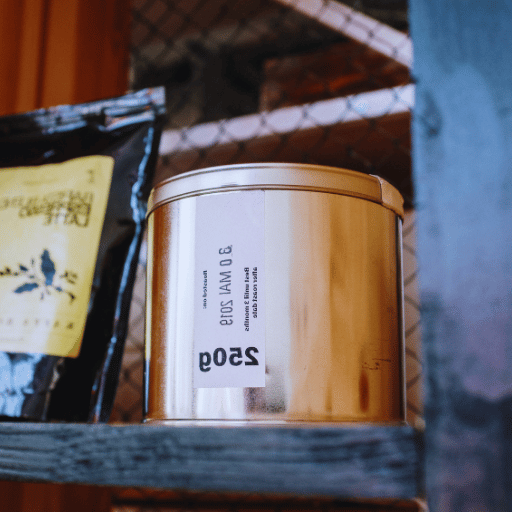
The aesthetic decisions loop back into the choice of material elements — finish is not cosmetic-only. Four trait-sets to think of and their material loadout:
- “Minimal label” clear BOPP or PET with high transparancy invisible adhesive. Signposts minimalism and premium level; generic on cosmetics and craft beverages. Adhesive must be optically transparent (no yellowing rubber-based systems).
- Tactile differentiation — linen, felt, cast-coated, or kraft textures. Signal authenticity and artisan-quality. Carry best on wine, spirits, and luxury food where shoppers physically handle the product.
- Metallic / foil — metallised PET facestock or hot-foil-stamped paper. Field-high-end tier. Foil-stamp entails an additional profit-driver process step but is recyclable in most municipal streams.
- Sustainability-coded — kraft + soy ink, or visible-fibre paper with PCR content indicator. Further supports brand ESG claims; works only when total package attribute story is complete.
The number one error in procurement is to let the aesthetic decide the final facestock. A “no-label” look that fails a textured cosmetic, costly-field bottle costs the brand excess. Harmonise appearance with both shelf hierarchy and functional requirement.
The Buying Reality — MOQ, Lead Times, Custom Constructions
This is the section converter blogs do not write — and the section that decides of whether your label-stock purchase can be scaled. These are the buying realities that a manufacturer of label-stock material faces every working day.
MOQ tiers (typical industry conventions)
- Conventional volume stock (old constructions) – 1000-5000 m, initial run. Same week delivery from area distribution hubs.
- Modified-spec catalog – 5,000-10,000 m when you modify one variable (e.g. liner GSM only, or adhesive coat weight only).
- Fully bespoke construction – 5,000-15,000 m for new R&D combinations of face + adhesive + liner. Smaller volumes (< 5,000 m) available for prototyping at premium per-square-metre cost.
Lead-time bands
- Standard catalog stock – 7-14 days from order, regional supply.
- Custom coat weight or liner swap — 14–28 days.
- Net-new R&D construction (new adhesive chemistry tested) – 4-6 weeks including ageing-test data.
Cost stack — typical breakdown of label-stock pricing
- Facestock: 35–45% of total cost
- Adhesive: 20–30%
- Release liner: 15–20%
- Coating + slitting + packaging: 15–20%
Custom vs Stock Decision Matrix
| Need | Buy stock | Spec custom |
|---|---|---|
| Volumes < 5,000 m² total | ✓ | — |
| Standard performance window | ✓ | — |
| Specialty surface (LSE plastic, oily metal) | — | ✓ |
| Branded / printed back of liner | — | ✓ |
| Long-term batch consistency over multiple years | — | ✓ |
5-Question Supplier RFQ Template
The five questions that keep an RFQ from ending in a brochure exchange to a buying conversation:
- Can you provide FINAT or TLMI test data for this exact construction (peel, loop tack, service temp)?
- What is the adhesive coat-weight tolerance (± g/m²) batch-to-batch?
- What liner GSM and release force can I expect at our dispensing speed (run rate per minute)?
- Country of origin for this construction, and factory audit available?
- What is your PCR-content / wash-off / phenol-free roadmap for 2026-2030?
Suppliers who can provide all five are partnership-grade. For regulated, high-stakes applications such as pharma labels, all five belong in the qualification dossier before a first PO.
2026 Outlook — Phenol-Free, PCR Facestocks, Wash-Off Adhesives
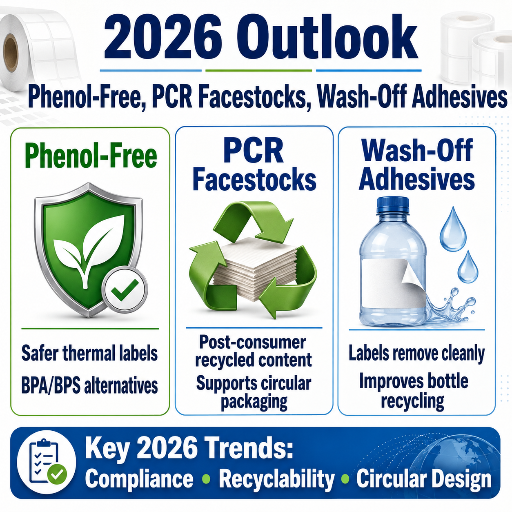
Three factors of procurement focus will evolve 2026-2030; each deserves inclusion in RFQ language and supplier qualification today:
- Phenol-free thermal paper – Washington State’s BPA + BPS ban entered into force 1 Jan 2026 for thermal receipts; Maine has a similar BPS restriction. Ascorbic acid (vitamin C) is emerging as the post-BPA developer chemistry. If your label spec includes any direct-thermal portion, ask suppliers for phenol-free SKU IDs by mid-2026 – see thermal transfer vs direct thermal — what label buyers should know for the chemistry detail.
- PCR (Post-Consumer Recycled) facestocks – Avery Dennison’s RecycleClass framework and parallel CEFLEX guidelines now define PCR-content thresholds. 30% PCR content paper is commercially available across BOPP and paper categories in 2026.
- Wash-off adhesives — engineered to release cleanly during caustic-wash rPET bottle recycling. RecyClass Class A approval is the certification to ask for; mainstream adoption follows EU Single-Use Plastics Directive deadlines.
Time-bound project: in any 2026 RFQ, add three sustainability questions around PCR content %, phenol-free SKU availability and wash-off certification level. Suppliers who already can answer these will be the long-term survivors in 2030.
FAQ — Label Stock Procurement Questions
Q: How long should label stock outlast the labelled product?
Label service life should at minimum reflect product shelf life plus 25% buffer for transit and storage variability. On most consumer goods that means 18-24 months legibility. For durable-goods asset tags predicted to outlive 5 years of equipment life, target FINAT FTM 8 service-temperature compliance plus UL 969 4-year accelerated aging certification.
Q: Paper or synthetic — which actually saves money long-term?
Paper wins over indoor short-life (<12 months) at low volumes – facestock cost is approximately 40-50% less than BOPP. Synthetic wins beyond the break-even point where one re-label or one recall can offset a decade of paper savings. The real cost issue is not per-unit price but total-cost-of-failure: a relabeling campaign on 100,000 units can easily surpass the BOPP premium.
Q: Can the same label stock work indoors and outdoors?
For a mixed indoor / occasional outdoor service (e.g. retail merchandize shipped in translucent packaging) UV-stabilized vinyl with UV-cured topcoat handles both. For dedicated multi-year outdoor service, vinyl is required, as BOPP and paper will degrade noticeably at 12-18 months of UV weathering even with laminates.
Q: How do I test surface compatibility before committing to bulk?
Three steps. First, actually see the incoming sample surface with dyne-pen (not on a virgin sheet). Second, ask for an A / B sheet from your supply chain on the candidate construction + next higher coat-weight. Third, run a 14-day accelerated environmental test with the most predominant in-service stressor (humidity cycling, freeze-thaw or UV as relevant). Most adhesion issues appear within 14 days.
Q: What is a realistic MOQ for a fully custom label-stock construction?
For a net-new face + adhesive + liner combination, today in 2026 expect 5,000–15,000 m² as the typical first-production-run minimal order quantity. Smaller volumes are achievable for prototyping at meaningfully higher per-square-metre cost. Modified catalog (one variable changed) drops the MOQ to 5,000–10,000 m². If a supplier quotes < 1,000 m² for fully bespoke, ask hard questions about whether they are subcontracting to a partner mill — the answer changes batch-consistency math.
About Guanma — Label-Stock Material Solutions
Guanma is a self-adhesive label-stock manufacturer with coating, laminating, R&D, and sales — supplying PET, PP synthetic paper, and coated paper facestocks joined to hot-melt, water-based and acrylic adhesives. Operating from facilities in Thailand and Vietnam, we service clients throughout Southeast Asia, South America and Europe, offering expertise in tire, cable, freezer, pharmaceutical, chemicals, food packaging, beverage and durable label markets. Our team liaises directly with procurement on custom face + adhesive + liner options, providing stable batch-to-batch outputs by virtue of more than 10 years of manufacturing capability.
Reviewed by Guanma engineering team — coating, laminating, and material R&D, 2026.
References
- Categorizing Surface Energy — 3M Science of Adhesion
- FINAT Technical Handbook (FTM 1, FTM 9, FTM 8) — FINAT
- UL 969 — Marking and Labeling Systems — Underwriters Laboratories
- TLMI — Tag and Label Manufacturers Institute
- RecycleClass Framework + Product Data Sheets — Avery Dennison
- Labeling Low-Surface-Energy Plastics (PP, PE) — Beontag
- Adhesives & Surface Energy: The Basis of Bonding — Mactac TapeTalk #10
- Washington State Eliminates Harmful Chemicals from Thermal Receipts — Washington State Department of Commerce
Related Articles
- How Waterproof Labels Actually Work — Inside the Materials, Adhesives & Coatings That Survive Water
- Thermal Transfer vs Direct Thermal Printing — A Materials-Side Guide for Label Buyers
- PET Self-Adhesive Stock — Heat-Resistant Facestock for Industrial Labels
- Acrylic Adhesive Label Stock — Permanent and LSE-Bonding Constructions
- FDA-Compliant Migration-Safe Pharmaceutical Labels
- Chemical Resistant Label Materials — Solvent and Oil Proof