Get in Touch with Guanma


Defining a label for outdoor or industrial use is a different matter from choosing one off the shelf. The face-stock, the adhesive, the method of printing and testing standards all interact – and one dead wrong choice can turn a five-year label into twelve months in the field. This discussion walks through what makes a label “outdoor durable”, why outdoor labels “fail”, reading the test standards on your vendor’s spec sheet, and converting a QUV hours number into a field life projection.
Quick Specs — Durable & Outdoor Label Targets
| UV exposure target (Tier-1 outdoor) | ≥1500 hr ASTM G154 cycle 1 (UV-A 340) |
| Service temperature (acrylic permanent) | −40 °C to +120 °C continuous |
| Salt fog resistance (marine / coastal) | ≥500 hr ASTM B117 (industry minimum) |
| Compliance baseline | UL 969 component recognition |
| Realistic field life (top-coated PET) | 3–7 years, climate-dependent (see H2.5) |
What Counts as a “Durable & Outdoor” Label? Definitions, Tiers, and the Difference from Standard Labels

A standard PSA label is designed for about 12 months indoor usage: paper face-stock, water-based or hot-melt adhesive, no over-coating. A durable label uses synthetics (Polyester, Polypropylene, Vinyl) with chemistry-optimized adhesives, with an over-laminate or coat to handle whatever life throws at it. An outdoor-rated label is the section of durable labels that also meets specific accelerated weathering tests according to a published cycle.
Three durability tiers are practical to plan around in specification work:
| Tier | Service Window | Typical Build | Test Floor |
|---|---|---|---|
| Standard | ≤12 months indoor | Coated paper + acrylic emulsion | None |
| Durable | 2–5 years sheltered or indoor industrial | PP / PET + acrylic permanent | UL 969 component recognition |
| Outdoor-rated | 3–10 years direct-exposure | Top-coated PET + acrylic + UV laminate | ≥1500 hr ASTM G154 + ≥500 hr ASTM B117 |
Notice that “outdoor-rated” is a process claim (the label has passed a defined accelerated test) rather than a calendar guarantee. Together, the tier and the published test cycle set the upper bound on what a vendor can honestly promise.
Why Outdoor Labels Fail: Five Failure Modes Engineers Should Test For
Most outdoor label failures fall into one of five physical failure modes. Knowing which mode occurred in your application tells you which material or adhesive to change. Jumping to conclusions about what change needs to be made can mean repeatedly replacing the wrong component over the label’s true field life.
📐 The 5-FM Outdoor Label Failure Diagnostic
An on the ground summary of 5 failure modes: UV photodegradation, adhesive cold flow, face-stock embrittlement, print fade and edge lift, with cause and the specific material change each one requires.
FM-1: UV photodegradation
Ultraviolet light will cleave the chemical bonds in chromophores and in the face-stock polymer. Visibly the effects are discoloration and fade with reds, yellows and oranges fading first because of their proximity to the ultraviolet absorbers. The Library of Congress photodegradation primer walks through the mechanism in detail. The solution: UV-blocking over coats or laminates in combination with pigment-based inks.
FM-2: Adhesive cold flow and edge lift
At low temperatures, hot melt adhesives act more viscoelastic: they creep at the bond line, the edge of the label begins to lift as dirt wedges into the gap, a snowball effect causes the label to delam in a season’s time. Cold-chain freezer applications below −20 °C require acrylic-permanent or specifically formulated cold-chain hot-melt adhesives. Standard general-purpose hot-melt is the wrong call below 0 °C continuous service.
FM-3: Face-stock embrittlement
Repeated UV exposure crosslinks polymer chains in the face-stock, raising glass transition temperature and reducing elongation. After 18–24 months in direct sun, an unprotected polypropylene label becomes brittle enough that a fingernail catch can tear it. Top-coated polyester (PET) holds elongation far longer than uncoated PP for the same UV dose, which is why most outdoor-rated specs land on PET as the face-stock baseline.
FM-4: Print fade and ink incompatibility
Different print processes deposit different ink chemistries – and not all inks will photodegrade equally in the field. Resin thermal transfer ribbons outperform wax-resin ribbons under exterior UV; UV-cured flexo inks outperform flexo water-based inks; digital pigmented inkjet inks outperform digital dye-based inks. Improper selection of face-stock (“make sure you choose the face-stock before you decide which press to print it on”) is a common procurement error. See H2.6.
FM-5: Edge lift on low-energy substrates
Polyethylene drums, HDPE totes, PE-coated cartons, and similar low-energy plastic containers present low surface-energy substrates where a conventional permanent acrylic may not fully wet out. Initially the label appears bonded for the first thirty days, then crescents of edge lift form as adhesive stress relaxes. Low-surface-energy-compatible adhesives (specifically formulated for low-surface-energy face-stocks) and corona-pretreated face-stocks address the actual chemistry – surface preparation alone seldom does.
Material Decision Framework: Face-Stock × Adhesive × Print Method
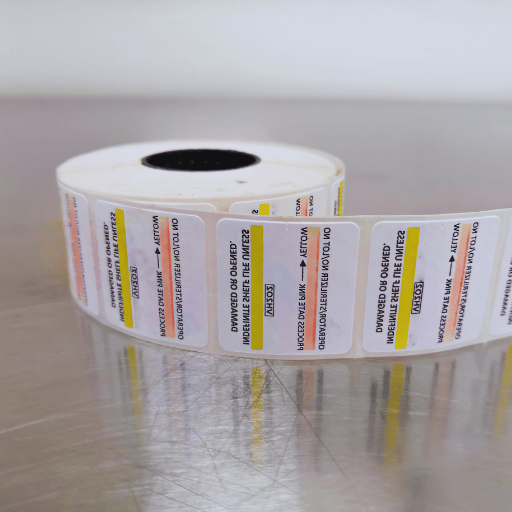
An outdoor label specification defensible to the marketplace names three things: a face-stock, an adhesive, and a print process compatible with both. Leaving out any one of those leaves a gap a supplier can walk through with a custom substitution.
Face-stock comparison
| Face-stock | UV / Outdoor | Service Temp | Best for |
|---|---|---|---|
| Top-coated PET (polyester) | Excellent | −40 °C to +150 °C | Asset tags, equipment ID, solar, marine |
| Top-coated PP synthetic paper | Good (with laminate) | −40 °C to +90 °C | Drums, totes, freezer, mid-life outdoor |
| Premium coated paper | Limited (sheltered only) | +5 °C to +60 °C | Indoor industrial, short-cycle outdoor with overprint |
Adhesive selection by environment
| Adhesive | Service Temp | Surface Strength |
|---|---|---|
| Acrylic permanent | −40 °C to +120 °C continuous | Glass, metal, rigid plastic, painted steel |
| Hot-melt aggressive | −10 °C to +70 °C | Cardboard, low-energy plastic, irregular surface |
| Water-based permanent | +5 °C to +80 °C | Glass, ceramics, food packaging |
What is the most weather-resistant label material for long-term outdoor use?
For outdoor service of three years or longer in direct UV exposure, top-coated polyester (PET) face-stock with an acrylic permanent adhesive and an additional UV-blocking over-laminate is the industry baseline. Top-coated PET resists chromophore breakdown longer than vinyl or PP, holds dimensional stability across thermal cycling from −40 °C to +150 °C, and accepts the resin thermal-transfer print chemistry that itself survives outdoor UV best. Vinyl is multidimensionally flexible — useful on curved or expanding substrates — but its plasticizers migrate over time, which limits long-life outdoor performance compared with PET. Top-coated PP with a UV laminate is a viable mid-tier choice when the deployment is sheltered or shaded but still exposed to humidity and temperature swings.
For the full Guanma matrix — three face-stocks, three adhesives, ten environments with a per-cell recommendation and per-combination performance data — see Guanma’s complete durable & outdoor label material catalog, which lists the test data per recommended combination.
Outdoor Performance Standards Decoded: ASTM G154, UL 969, ASTM B117, IEC 60068, IEC 61215
A vendor’s material specification that says “meets industry standards” without including the test method, exposure cycle, and pass criteria on it, is not a specification – it is marketing language. Five standards cover most legitimate outdoor and durable labeling claims. Understanding what each tests allows the buying engineer to evaluate whether a citied number is relevant to their application.
| Standard | What it tests | Cycle | When to require it |
|---|---|---|---|
| ASTM G154 | UV photodegradation under fluorescent lamp | UV-A 340 lamp, alternating UV / condensation phases | Any direct outdoor exposure |
| UL 969 | Marking and labeling system component recognition | Adhesion, abrasion, exposure aging by use class | Equipment nameplates and warning labels |
| ASTM B117 | Salt fog corrosion resistance | Continuous 5 % NaCl fog at +35 °C | Marine, coastal, road salt environments |
| IEC 60068-2-30 | Damp heat cyclic test (Db) | Cyclic 25 °C / 55 °C at 95 % RH | Tropical or high-humidity service |
| IEC 61215 | PV module qualification (label sub-clause) | Combined UV, thermal cycling, damp-heat | Solar panel and renewable-energy asset labels |
📐 Engineering Note
A label that passes UL 969 is recognized by the safety body — not a separate “UL listed label.” Procurement teams sometimes ask suppliers for a “UL label,” when what they need is documentation that the construction (face-stock + adhesive + print method) appears on the supplier’s UL component recognition file. Ask for the file number and the specific use class.
Predicting Field Lifetime: Translating QUV Hours into Real-World Years by Climate Zone
Procurement teams want a single number: “your 1500-hour QUV label equals X years in the field.” Every label vendor would also like to give that number. The problem is that the math does not exist.
Q-Lab — the leading manufacturer of accelerated weathering test equipment — is unusually direct about this in its technical FAQ on QUV-to-outdoor correlation: “It is theoretically impossible to have a single magic number that you can multiply by weathering tester exposure hours to compute years of outdoor exposure.” The reason is that the correlation depends on the material chemistry (PE, PP, PET, ink pigment), the wavelength of UV used in the test (UV-A 340 vs UV-B), and the geography of the deployment.
NIST’s accelerated UV weathering correlation study of polyethylene film as an outdoor analog revealed that 14 days of accelerated UV cycling approximated 90 days of Florida outdoor exposure — a roughly 6.4× compression. That ratio holds for PE film under that particular cycle, but does not generalize to PET face-stocks or to pigmented inks, nor to cooler or less-UV-harried climates.
An honest, climate-corrected range is more useful than a false calculator. Using NREL solar resource data as the climate input and assuming top-coated PET with an over-laminate as the typical outdoor-rated build:
| Climate Zone | Example Cities | 1500 hr QUV ≈ Field Years |
|---|---|---|
| Tropical / High-UV | Singapore, Phoenix, Riyadh | ~3 years |
| Sub-tropical / Coastal | Miami, Sydney, São Paulo | ~4 years |
| Temperate | London, Hamburg, Seattle | ~5–7 years |
| Cold / Northern | Stockholm, Anchorage | ~7+ years (cold-flow risk dominates) |
Use this as a planning range, not a warranty. An honest conclusion: QUV hours rank-order materials reliably (a 1500-hour label outperforms a 500-hour label), but they do not translate into a calendar field-life with one decimal of precision. If a vendor offers a precise field-life claim with no climate qualification, ask for the math behind it.
Print Method × Outdoor Material Compatibility
Choosing the right outdoor face-stock and then printing it on an incompatible press is a routine procurement mistake. Each print method (and the printer hardware behind it) determines ink chemistry, ink penetration, and how well the printed surface resists outdoor fade:
| Print Method | Top-coated PET | Top-coated PP | Coated paper |
|---|---|---|---|
| Resin thermal transfer | ✅ Best — outdoor durable | ✅ Good — outdoor durable | ⚠ Marginal — sheltered only |
| UV-cured flexo | ✅ Best — outdoor durable | ✅ Good | ✅ Good — sheltered |
| Water-based flexo | ⚠ Conditional — laminate required | ⚠ Conditional | ✅ Acceptable — sheltered |
| Pigment digital inkjet | ✅ Good with overlaminate | ✅ Good with overlaminate | ⚠ Sheltered short-life |
Resin thermal transfer remains the workhorse for outdoor barcode and asset-tag applications because the resin ribbon is fused into the top-coat under heat, creating a print layer that resists both abrasion and UV at the same time. Wax-resin and full-wax ribbons are not outdoor durable and should not be specified for outdoor use, regardless of how durable the underlying face-stock is.
Specification & Procurement Checklist: How to RFQ Durable & Outdoor Labels Without Surprise Failures
Most “we failed in twelve months” customer complaints originate in the RFQ, not during production. A complete RFQ demands that the vendor commit to particular test data; a vague RFQ allows the vendor to substitute a less expensive construction that hits the bid but misses the lifetime requirement.
12-Point Durable & Outdoor Label RFQ Checklist
- Service environment (full-time outdoor / sheltered / freezer / chemical splash)
- Required field-life in years and target climate zone
- Surface to be labeled (substrate type, surface energy, geometry)
- Required test cycles (ASTM G154 hours, ASTM B117 hours, UL 969 use class)
- Service temperature range (continuous and peak)
- Print method available in-house (resin TT, UV flexo, water flexo, digital inkjet)
- Compliance documentation needed (TDS, SDS, RoHS, REACH, CoC)
- Roll format for roll labels (slit width, core size, max OD)
- Volume estimate and reorder cadence
- Lead time tolerance (and whether regional supply is required)
- Free sample policy (qualification roll length, included documentation)
- Change-control commitment (notification SLA when material formulation changes)
A reasonable sample-to-decision flow runs about four weeks: Day 0 the RFQ goes out; Day 7 the qualification sample roll arrives with TDS / SDS / CoC; Day 14 the converter runs print qualification on the production press; Day 21 accelerated-aging report comes back; Day 28 the production order is placed.
For build-to-spec material requirements that combine a face-stock, an adhesive, a top-coat, and a regional supply preference (Thailand or Vietnam plant), request a custom durable label material spec with the requirements above attached.
Download the 12-Point RFQ Checklist (PDF) →
Industry Outlook: What’s Changing in Durable & Outdoor Label Materials (2026 Onward)

Three trends are worth tracking over the next twelve to twenty-four months because each one will likely change a procurement decision being made today.
Climate-resilient resin chemistry
Newer top-coat and laminate systems entering the market in 2025 and 2026 are extending field life by roughly 1.5× to 2× compared with conventional UV-stabilizer packages from a decade ago. Action this quarter: ask your label vendor whether the construction quoted uses 2025-or-later top-coat formulations, especially for any SKU planned for more than five years of outdoor service.
Regulatory shift toward mono-material recyclability
The EU Packaging and Packaging Waste Regulation (PPWR) and parallel brand sustainability scorecards are pushing toward mono-material PE or PP face-stocks paired with recyclable adhesives. Action this quarter: if you launch a new SKU in 2027, ask suppliers about mono-material durable label lines now — the qualification cycle for the substrate change typically runs three to six months.
Regional supply chain re-balancing
Southeast Asia and Latin America converter capacity has expanded materially since 2023, reducing dependency on US and EU primaries for high-volume durable label SKUs. Action this quarter: dual-source qualifications for any high-volume SKU to mitigate FX, duty, and lead-time risk — particularly for buyers serving customers across two or more continents.
Frequently Asked Questions
Q: What are the most durable label materials for outdoor use?
View Answer
Top-coated polyester (PET) face-stock with an acrylic permanent adhesive and a UV-blocking over-laminate is the industry baseline for outdoor service of three years or longer. Top-coated polypropylene (PP) is acceptable for sheltered or shorter-cycle outdoor use; vinyl is multidimensionally flexible but loses long-term performance to plasticizer migration; and uncoated paper face-stocks are not appropriate for any outdoor application.
Q: How long do UV-resistant labels last in direct sunlight?
Show Answer
A label rated to ≥1500 hours ASTM G154 cycle 1 typically delivers about three years of legible service in tropical or high-UV climates such as Phoenix or Singapore, four to five years in sub-tropical or temperate regions such as Miami or Hamburg, and seven or more years in cold or northern climates where cold-flow risk in the adhesive becomes the limiting factor before UV does. The QUV-hours number rank-orders materials reliably but does not translate into a single-decimal calendar warranty — see the climate-zone table in this guide.
Q: What is the difference between weatherproof and waterproof labels?
Read Answer
Waterproof refers narrowly to resistance against direct water contact and immersion. Weatherproof is a broader claim covering UV exposure, temperature swings, humidity cycling, and abrasion in addition to water. A label can be waterproof without being weatherproof — for example, a vinyl label survives water immersion well but fades quickly in direct UV.
Q: How are durable labels manufactured?
View Answer
A durable label is assembled in three steps. First the adhesive is coated onto a release liner. Second, the face-stock of choice (top-coated PET, PP or coated paper) is laminated to the adhesive coated liner. Third, the face-stock coating is printed (by one or several print methods), optionally followed by an over-laminate or top-coat for outdoor service. material choices interact with other material choices – the adhesive must be compatible with the liner and face-stock chemistries and the print method must be compatible with the face-stock surface treatment.
Q: Can durable outdoor labels be recycled?
View Answer
Durable outdoor labels that use a mixed PET face-stock plus acrylic adhesive plus polyethylene coated release liner are not recyclable through current mixed waste streams. Mono-material durable label constructions — PE face-stock with a PE-compatible adhesive — are a developing market answer to this problem and are likely to become specification options for 2026 and 2027 SKU launches.
Q: Which test standards should be in a vendor’s spec sheet for outdoor labels?
View Answer
A defensible outdoor label spec sheet names ASTM G154 (UV exposure with cycle and hour count), UL 969 (component recognition with use class and file number), and at least one (1) environmental cycle relevant to the deployment – ASTM B117 for marine & coastal, IEC 60068-2-30 for tropical or high-humidity and IEC 61215 for solar & renewable-energy assets. A spec sheet that says “passes industry standards” without naming the test method, the cycle, and the pass criterion is marketing language, not engineering data.
Related Resources
- Guanma Durable & Outdoor Label Material Solutions – full 3 × 3 × 10 decision matrix with per-cell test data
- Chemical-Resistant Label Materials – for splash, solvent and aggressive-chemical environments
- Pharmaceutical Labels (FDA-Compliant, Migration-Safe) – sibling line for regulated industries
- CCK Release Paper for Durable Labels – clay-coated kraft liner for high-temperature lamination
How We Researched This Guide
Standards descriptions in this guide draw directly from the published ASTM, UL, and IEC reference pages. For the QUV-to-outdoor correlation discussion in the field-lifetime section, NIST and Q-Lab technical literature served as the primary source — neither of which is a label vendor, which is why their honest “no single magic number” framing made it into the analysis. Reviewed by the Guanma engineering team for face-stock and adhesive specifications.
Specifying a Durable or Outdoor Label?
Send the 12-point RFQ checklist above with your service environment and field-life target – Guanma’s engineering team will return a face-stock + adhesive + print-method recommendation with the test cycles supporting it.