Entre em Contato com Guanma

Atualizado em julho de 2026
Especificações rápidas
| Filme PET facestock | Espessura de 36-75 µm |
| Frontal de filme sintético de PP | Espessura de 70-90 µm |
| Facestock de papel revestido (semi-brilho) | 80-90 gsm |
| Facestock de papel térmico | 80g/m² |
| Força de descascamento | 3-18 N por 25 mm, por FINAT FTM1 |
| Temperatura de operação | -40 °C a +150 °C, varia de acordo com a química adesiva |
3-18N/25mmfaixa de força de descascamento entre pares adesivos de material frontal
-40° a +150°Cfaixa total de temperatura de operação, por química
4principais famílias de materiais de facestock
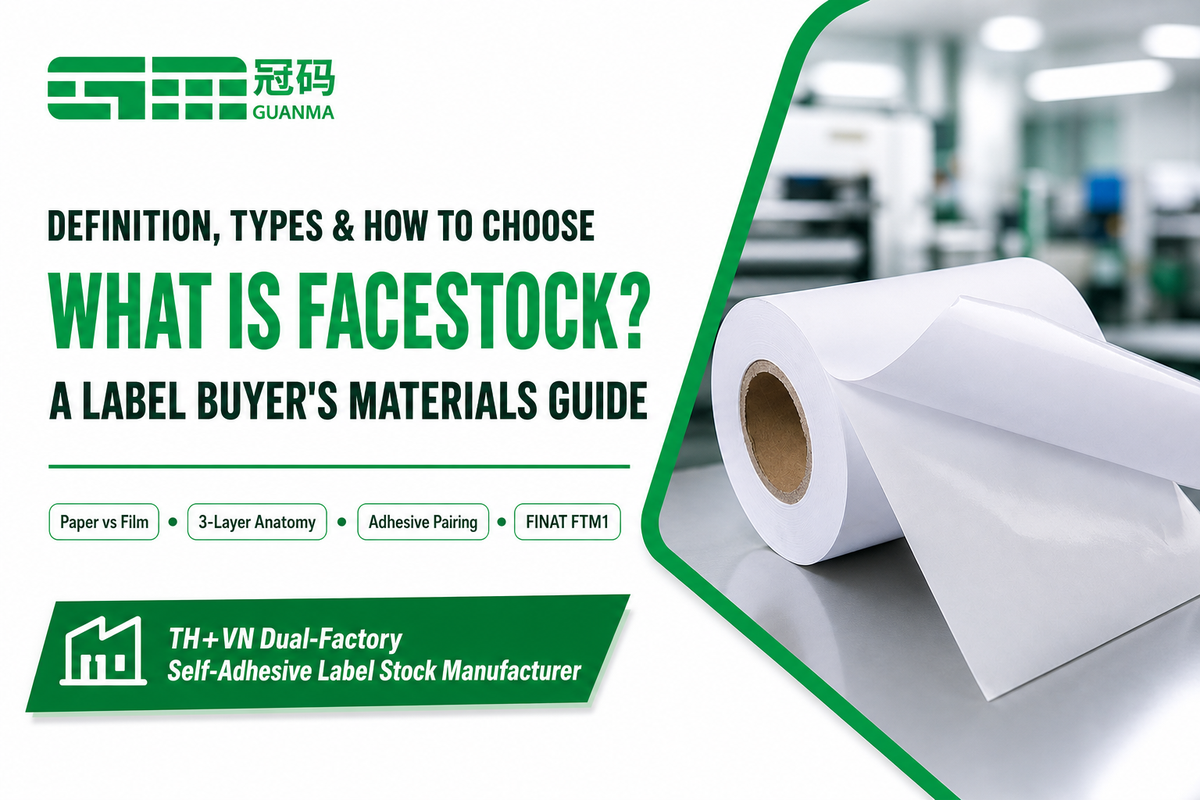
O frontal é a camada superior imprimível de um rótulo sensível à pressão – a superfície que contém seu logotipo, código de barras e texto, situada acima do adesivo e do liner de liberação em uma estrutura de três camadas que uma fabricante de filme autoadesivo produz sob encomenda. Se você já especificou um rótulo e recebeu uma cotação que lista “frontal” como item separado de “adesivo” e “liner,” este guia explica exatamente o significado dessa palavra, qual família de materiais se adequa à sua aplicação e como orientar um convertedor em uma decisão sobre o frontal sem adivinhar. Alguns compradores simplesmente a chamam de camada imprimível do rótulo, embora essa forma abreviada omita o adesivo e o liner abaixo.
O frontal é a camada superior visível e imprimível de um rótulo sensível à pressão, laminada sobre um adesivo sensível à pressão e um liner de liberação. Ele está disponível em duas famílias amplas, papel e filme, sendo o filme dividido em graus de poliéster (PET), polipropileno (BOPP) e polietileno (PE), com espessura aproximada de 36 a 90 µm, dependendo da aplicação.
Fatos principais
- A espessura do facestock não prevê a resistência ao calor; a química do polímero, não o medidor, governa quanta temperatura um facestock sobrevive.
- “facestock” e “label stock” são usados vagamente como sinônimos na indústria, mas não são termos perfeitamente intercambiáveis.
- Uma estrutura de rótulo sensível à pressão de três camadas (frontal, adesivo, liner de liberação) está explicitamente documentada na literatura de processos da U.S. EPA, não apenas em textos de marketing do setor.
- Os valores de aderência ao descascamento para emparelhamentos adesivos de face-estoque normalmente variam de 3 a 18 N/25 mm, dependendo da química; um único número de“ de força de ”peel sem um contexto químico é quase sem sentido.
O que é Facestock? (Definição + Terminologia)

Material frontal é a camada superior de uma construção de rótulo sensível à pressão — o material que recebe a impressão e fica voltado ao cliente. Ele fica sobre uma camada de adesivo sensível à pressão e um liner de liberação; as três camadas juntas formam o que os convertedores chamam de “material para rótulos”. Em resumo, o material frontal é a base do rótulo – a camada que todo o restante da construção sustenta.
A U.S. National Archives and Records Administration descreve diretamente a montagem em uma especificação federal de compras: material de frontal contendo um adesivo com um liner de liberação abaixo dele — a mesma anatomia usada em todo o setor de rótulos.[1] A própria documentação de processo da EPA dos EUA para fabricação de rótulos descreve a mesma estrutura: um substrato revestido com adesivo laminado sob pressão ao “material frontal” para criar uma laminação de três camadas de material frontal, adesivo e liner.[2]
Na prática, convertedores e compradores costumam usar “material frontal” e “material para rótulos” de modo intercambiável. Isso não é exatamente errado, mas esconde uma distinção real: material frontal refere-se especificamente à camada imprimível, enquanto material para rótulos costuma referir-se ao laminado acabado — material frontal mais adesivo mais liner — pedido, convertido e especificado como produto único. Quando uma ficha técnica lista “composição do material para rótulos”, normalmente descreve as três camadas, não somente a superior. A diferença importa quando um convertedor pergunta se você deseja alterar o “material frontal” ou o “material” – são duas perguntas diferentes.
O que significa material para rótulos?
Material para rótulos é todo o laminado sensível à pressão – material frontal, adesivo e liner de liberação, todos unidos – vendido aos convertedores, sem corte por faca, como matéria-prima intermediária da qual os rótulos serão cortados. Os compradores o pedem como produto combinado, embora a ficha técnica ainda separe o laminado em suas três camadas nomeadas.
As especificações internas de materiais da Library of Congress para rótulos adesivos sensíveis à pressão listam os critérios de ensaio e qualidade exigidos para esse laminado em um único documento, combinando requisitos de brilho do frontal, desempenho do adesivo e liberação do liner, em vez de documentos de requisitos separados para os três laminados individualmente.[3] As orientações da Organização Internacional de Padronização sobre o pedido de etiquetas autoadesivas referem-se de forma semelhante ao material do “label,”, que denota todo o laminado quando se refere às informações que os compradores devem especificar ao solicitar ou comparar diferentes construções de revestimento adesivo.[4]
💡 Dica profissional
Ao elaborar uma RFQ, se você estiver solicitando apenas a camada superior imprimível do laminado (como se substituísse apenas o frontal mantendo o adesivo), peça “frontal”; caso contrário, peça “a estrutura completa” ou “material autoadesivo para rótulos”. Esses materiais são estocados e precificados de maneira diferente pelos convertedores.
Key takeaway: facestock refere-se especificamente à camada superior imprimível; “a construção completa” ou “label stock” refere-se ao laminado completo.
Tipos de materiais de estoque facial, estoques de papel versus estoques de filme (BOPP, PET, PP)

Os materiais de Facestock se enquadram em duas categorias gerais, papel e filme. O filme se divide em três categorias principais: filmes de poliéster, polipropileno e polietileno.
Cada categoria varia em custo, durabilidade e adequação à impressão, e as páginas individuais de materiais dos convertedores servem, em muitos casos, como um bom indicador do espectro de opções, muito melhor do que uma única ficha de especificações. A maioria dos fabricantes independentes de frontal classifica seus produtos de filme em mais de seis graus distintos de filme, abrangendo policarbonato, vinil, poliéster, polipropileno, poliimida e até alguns papéis, o que é consideravelmente mais específico do que a classificação “papel ou filme” normalmente apresentada em explicações básicas. Alguns poucos convertedores especializados também oferecem um frontal de filme de poliéster ou vinil fora da linha padrão PET/BOPP/PE, embora continuem sendo um pequeno nicho na rotulagem industrial sensível à pressão.
Papelão
- Nível de custo mais baixo, faixa de cor/acabamento mais ampla
- Melhor para etiquetas de curta duração, internas e de ambiente seco (varejo, transporte, logística)
- Má umidade, produto químico, e resistência à abrasão sem laminação
- Guanma semibrilho de papel revestido varia de 80-90 gsm; o papel térmico varia de 80 gsm
Facestocks de filme (BOPP, PET, PE)
- Custo mais alto, resiste à água, produtos químicos, e abrasão
- BOPP (polipropileno orientado biaxialmente): rígido, de alta clareza, comum na rotulagem de alimentos e bebidas
- PET (poliéster): alta resistência ao calor e química, dimensionalmente estável
- O filme de PET Guanma varia de 36-75 µm; o papel sintético de PP varia de 70-90 µm
Muitos fabricantes independentes e fornecedores de frontais de filme e frontais para rótulos empregam uma combinação de revestimento metalizado ou outra camada de filme flexível sobre a camada padrão de BOPP ou PET para elevar o impacto estético em ambientes de embalagens de marcas e varejo, onde o apelo visual é o principal fator de compra, um efeito impossível de reproduzir com frontais de papel; embora um pouco mais caros, os frontais sintéticos costumam ter apelo suficiente para justificar o aumento de custo. O papel não revestido permanece comprovadamente menos durável do que qualquer opção de filme quando há umidade ou manuseio repetido, o que é uma das razões pelas quais os convertedores destinam trabalhos para uso externo ao filme, apesar do maior custo por peça.
O impacto dos lançamentos reais de produtos na indústria de etiquetas oferece uma aproximação das espessuras típicas de filmes. Por exemplo, um lançamento recente (2024) de produto de estoque frontal BOPP foi especificado em 58 µm, incluindo o revestimento superior imprimível,[5] e outro lançamento de produto para um filme transparente revestido com brilho em um dos lados foi especificado em 46 µm, descrito como sendo 10% mais fino do que a maioria dos filmes de material facial no mercado.[6] Nossas linhas de filme Guanma PET e PP variam de 36-90µm dependendo do grau, dentro dos limites que o setor reconhece como uma faixa padrão de espessuras para frontais de filme. Um registro de processo do governo dos EUA para fabricação de rótulos confirma de forma independente essa divisão entre papel e filme no nível do material, descrevendo o frontal como a camada de substrato que recebe impressão antes da laminação com adesivo e liner.[2]
As faixas de catálogo para fabricantes independentes de filmes de facestock geralmente se estendem de 12 µm a cerca de 100 µm.
Qual filme é usado para Facestock?
Para a maioria dos rótulos sensíveis à pressão, PET (poliéster) e BOPP (polipropileno orientado biaxialmente) são os materiais de contato de filme selecionados com mais frequência; PE (polietileno) é geralmente especificado para aplicações de rótulos mais flexíveis ou compressíveis. Se o rótulo precisar de calor, resistência química ou de longo prazo, PET é a escolha apropriada; como etiquetas de identificação para eletrônicos e produtos duros.
Se, no entanto, o custo e a clareza forem mais importantes do que a resistência absoluta do rótulo e um rótulo de alimentos e bebidas exigirá apenas uma durabilidade moderada do rótulo, o BOPP é normalmente usado. PE, o mais conformável dos três filmes, é ideal para rótulos redondos, contornados ou espremíveis nos quais o PET e o BOPP mais rígidos rachariam ou enrugariam. Como o filme mais flexível da linha, o PE tolera que a flexão repetida sem a rachadura da superfície que os facestocks mais rígidos mostram.
⚠️ Conceito errôneo comum
Um facestock mais espesso não torna automaticamente um facestock mais resistente. Na família de produtos de polipropileno, os materiais mais espessos têm limites de temperatura de cerca de 93 °C, enquanto as versões mais finas de poliéster e poliimida nas mesmas famílias de produtos suportam temperaturas contínuas significativamente mais altas. A resistência do rótulo e o desempenho térmico geralmente aumentam com o comprimento da cadeia de polímero em vez da espessura, portanto, em uma aplicação quente, o poliéster mais fino pode realmente ter um desempenho melhor do que um facestock de polipropileno mais espesso.
Só porque um facestock é mais fraco sob um conjunto de condições de exposição não significa que não será o facestock certo para outro conjunto; por exemplo, um facestock de etiqueta de papel revestido com uma camada de aumento de resistência de etiqueta pode ser adequado para uma aplicação interna, mas não externa É importante identificar quais fatores são mais importantes para a aplicação do rótulo e selecionar o filme mais adequado para ser executado nessas condições específicas.
Takeaway chave: combine a química do filme com o seu perfil de exposição, então preocupe-se com a espessura primeiro um facestock mais espesso na química errada ainda falhará cedo.
Acabamentos revestidos de papel facial, fosco, brilhante e semibrilhante

Os facestocks de papel revestido podem ter um dos três acabamentos: fosco, brilhante ou semi-brilho. Isso determina o quão bem o rótulo aceita tinta e o desempenho em presença na prateleira; a melhor escolha depende muito da aplicação específica do produto. Para a maioria dos propósitos, o semi-brilho fornece um equilíbrio: é nítido o suficiente para reproduzir detalhes finos e, no entanto, manchado o suficiente para rejeitar impressões digitais, ao contrário do brilho total.
Revestimentos de qualidade vão além das aparências. Este padrão de material de etiqueta adesiva da Biblioteca do Congresso especifica que um facestock pigmentado branco deve ter um brilho mínimo de 82%.[3]Isso é do padrão oficial de compras do governo (ainda ativo a partir de 2016), não de alguma penugem publicitária, e representa um dos únicos benchmarks verdadeiramente numéricos que aparecem nas páginas de muitos concorrentes da SERP Um peso de revestimento mais pesado também pode oferecer maior durabilidade contra arranhões e umidade durante o trânsito, não apenas uma imagem impressa mais nítida.
Finalmente, a capacidade de um revestimento de executar com diferentes métodos de impressão – como impressão flexográfica, digital ou de transferência térmica – deve ser levada em consideração. Um revestimento desenvolvido para excelente adesão de tinta flexo provavelmente terá um desempenho ruim ao usar uma fita de transferência térmica. Se a etiqueta for para uma impressora que usa vários métodos diferentes (comum para embalagem por contrato), certifique-se de que o revestimento foi testado e qualificado para todos os processos de impressão envolvidos. Os compradores que padronizam várias tecnologias de impressão devem solicitar um revestimento qualificado para o conjunto completo, em vez de fornecer um grau de face de estoque diferente por prensa.
💡 Dica profissional
As especificações do papel couché variam por fornecedor — os números exatos de brilho e gramatura do revestimento dependerão do grau e do nível de acabamento; portanto, considere qualquer número publicado por um concorrente apenas um ponto de partida para discussão com seu convertedor.
Os compradores de atualizações de revestimento estão realmente pagando pela capacidade de impressão – uma etiqueta semi-brilhante de boa qualidade, capaz de detalhes finos de código de barras e cores saturadas, tem um apelo de prateleira muito melhor do que um grau inferior de revestimento, mesmo que o substrato de papel subjacente seja idêntico.
A linha semi-brilho do papel revestido da própria Guanma é oferecida em 80-90 g/m² na camada de acabamento listada acima.
Takeaway chave: o papel revestido semi-brilho é o cavalo de batalha de aplicações internas sensíveis à qualidade de impressão – confirme que seu revestimento é aprovado para seu modelo de impressora específico.
Facestock vs Adesivo vs Release Liner, The 3-Layer Label Anatomy

Material frontal ≠ material para rótulos: a diferença de uma camada. Um rótulo sensível à pressão consiste em exatamente três camadas — o frontal, o adesivo e o liner de liberação. Confundir o frontal com o liner de liberação está entre os erros mais comuns cometidos por compradores ao aprenderem a interpretar uma ficha de especificações.
A EPA dos EUA descreve claramente o processo de fabricação de um rótulo: um substrato revestido com adesivo é laminado ao frontal por meio de rolos de calor e pressão para produzir um filme de três camadas: frontal, adesivo e liner de liberação (ou vapor de água, no caso da fabricação de rótulos à base de solvente).[2]
Os convertedores às vezes descrevem o frontal como a “base do rótulo” porque o frontal é selecionado e as outras camadas — a química do adesivo e o liner de liberação — são escolhidas para complementá-lo, e não o contrário. Essa confusão é compreensível porque, à distância, o frontal e o liner de liberação parecem bastante semelhantes (como papel ou plástico). No entanto, sua função é muito diferente.
O frontal é permanente – permanecerá no produto durante toda a vida útil do rótulo. Em contraste, o liner de liberação é temporário – protege o adesivo durante o armazenamento e o transporte e é removido antes de o rótulo ser aplicado a um produto. Alterar o liner de liberação e chamá-lo equivocadamente de um “frontal” diferente não mudará a aparência nem o desempenho do rótulo na aplicação, mas afetará os registros do convertedor e quaisquer pedidos subsequentes.
Qual é a diferença entre Facestock e um Release Liner?
O frontal é a camada permanente, visível e imprimível que permanece no produto. Sua contraparte, o liner de liberação, é a folha de liner temporária e descartável que protege o adesivo até a aplicação e depois é descartada. Embora o frontal e o liner de liberação sejam laminados juntos durante a fabricação do rótulo, eles têm finalidades opostas: um é projetado para permanecer, o outro para ser removido.
Se você tiver curiosidade sobre os diversos materiais usados para liner de liberação, consulte nosso guia sobre o que exatamente é um liner de liberação ou comprar liner de liberação glassine e CCK.
| Camada | Função | Permanece no produto? |
|---|---|---|
| Frontal | Superfície visível imprimível | Sim, permanente |
| Adesivo | Liga o facestock à superfície de aplicação | Sim, permanente |
| Liner de liberação | Protege o adesivo durante o armazenamento/manuseio | Não há descarte e descarte na aplicação |
A própria especificação de qualidade deste produto fornece mínimos numéricos para a pilha de três camadas: uma Biblioteca do Congresso manteve a especificação do material da etiqueta adesiva sensível à pressão define critérios de brilho, adesão e liberação do revestimento como um único documento combinado e não três documentos individuais com facetock pigmentado branco atendendo pelo menos ao valor de brilho 82%.[3]
Conclusão: se um termo descreve um material que é removido durante o uso, ele se refere ao liner, não ao frontal.
Como Facestock emparelha com química adesiva

Faixa de força de descolamento: 3–18 N/25mm em toda a matriz frontal-adesivo da Guanma. A força de descascamento, que define a quantidade de força necessária para remover um rótulo de um substrato, depende de uma combinação da química do material facial e da química adesiva escolhida. Simplesmente listar um número de força de descascamento não tem sentido, a menos que indique qual combinação ele representa.
Em toda a matriz adesiva de face-estoque da Guanma, a força de descascamento medida por FINAT FTM1 (Método de Teste FINAT No. 1, um teste padrão da indústria para determinar a força de descascamento) varia de 3 N/25mm até 18 N/25mm, dependendo de qual emparelhamento de face-estoque/adesivo você selecionar. Nota: esta é uma faixa de medição de fonte única e deve ser interpretada como direcional para este produto específico, não como um padrão de medição em toda a indústria. Como a química de face-estoque e adesivo interage, alterar qualquer camada pode mudar o desempenho geral de uma etiqueta, mesmo quando a outra camada permanece idêntica.
Um padrão ASTM D3330 define como as fitas sensíveis à pressão são testadas quanto à sua adesão de força de descascamento ao substrato sob condições especificadas.[7] Uma norma análoga ASTM D6252 define testes de adesão de descascamento para estoques de etiquetas sensíveis à pressão, mas afirma claramente que tanto as variações de material facial quanto de adesivo afetam a leitura da força de descascamento de um determinado produto, o que significa que este teste não pode isolar a camada que influenciou a força de descascamento medida. leitura.[8] Além disso, o Pressure Sensitive Tape Council oferece orientações alternativas de teste para avaliar esse tipo de adesão.[9]
Há quatro químicas distintas para produzir adesivo compatível com material frontal: hot-melt – menor preço, maior velocidade, baixa adesão em substratos frios ou curvos; acrílico permanente – maior força de descolamento, excelente resistência a UV/envelhecimento; acrílico removível – excelente liberação limpa sem resíduo; adesivo à base de água – ambientalmente favorável, força de descolamento moderada. Uma quinta química menos comum, à base de borracha, ocorre em aplicações removíveis sensíveis a custo. Para aplicações permanentes ou de longo prazo, porém, o acrílico removível substituiu a borracha. Uma especificação federal dos EUA para material para rótulos de transferência térmica (documento NARA de 2015, ainda ativo) descreve uma formulação com adesivo polímero-acrílico capaz de sustentar um peso de 200 gramas em um corpo de prova de 1 por 2,5 polegadas, usando ensaio de descolamento a 90 graus durante dez minutos. Embora não defina padrão aceito para todos os casos, mostra o formato de especificações quantitativas em vez de alegação geral de “adesão forte.” [1]
“Dados de adesão ao descolamento em material para rótulos sensível à pressão podem indicar a força relativa de ligação a uma ou mais superfícies de materiais e texturas variados, em comparação com painel padrão de aço inoxidável; porém, variações no próprio material frontal e no adesivo podem afetar a resposta, de modo que o ensaio isolado não identifica qual camada é responsável por determinado resultado.”
parafraseado da orientação do método de teste ASTM D6252/D6252M para estoques de etiquetas sensíveis à pressão
Fazer
- Peça ao seu convertedor o valor da força de descolamento associado ao seu par específico de frontal e adesivo, não uma faixa genérica de ficha de especificações
- Compatibilize a química do adesivo com a temperatura de aplicação e a energia superficial antes de definir o frontal
- Solicite dados de teste referenciando FINAT FTM1 ou ASTM D3330/D6252 para que os resultados sejam comparáveis entre fornecedores
Não
- Suponha que um adesivo termofusível que funcione em um painel de metal plano seja mantido em uma superfície curva ou fria
- Trate um único número de força de descascamento como válido em cada combinação de adesivo facial que um fornecedor oferece
- Ignorar uma impressão de teste ao trocar o material facial ou a química adesiva, mesmo que a outra camada permaneça a mesma
Para uma visão mais ampla de como compatibilizar material para rótulos com uma especificação de compras, e não apenas a camada adesiva, consulte nosso guia de compra de material de etiqueta.
Key takeaway: número de força de descascamento apenas algo quando está amarrado a um par facestock-adesivo nomeado e um método de teste declarado (peak-adesive pairing) para ambos.
Escolhendo Facestock por Aplicação, Conformidade, Durabilidade e Temperatura

A seleção de estoque facial para aplicações de exposição extrema é uma decisão de conformidade e uma decisão de materiais em segundo lugar regulamentada ou o requisito de conformidade errado e as especificações param de importar. Aplicações externas, etiquetas logísticas de cadeia de frio e outros perfis de exposição a elementos agressivos exigem, cada um, uma resposta adesiva de estoque frontal diferente de um ambiente de varejo seco e climatizado. Tratar cada rótulo de produto da mesma maneira é como os compradores acabam reordenando. Especificando uma etiqueta durável para um desses perfis começa com a estrutura de conformidade, não com o catálogo de materiais. Três estruturas de conformidade separadas tocam a escolha da facetack dependendo do que você está rotulando: O Padrão de Comunicação de Perigos da OSHA define pictograma, palavra-sinal e requisitos de declaração de perigo para rótulos químicos que ditam durabilidade e legibilidade mínimas da etiqueta;[10] a Lei Federal de Substâncias Perigosas da Comissão de Segurança de Produtos de Consumo dos EUA exige rotulagem preventiva durável o suficiente para permanecer legível durante a vida útil de manuseio de um produto;[11] e a BS 5609 – a edição atual de 2024 da Norma Britânica que abrange rótulos impressos sensíveis à pressão para uso marítimo – estabelece requisitos ambientais e de durabilidade especificamente para rótulos de tambores que podem ser expostos à água do mar.[12] Uma via de certificação separada, o programa Marking and Labeling Systems da UL, abrange materiais autoadesivos para rótulos em branco testados segundo ANSI/UL 969 para aplicações elétricas e de marcação de produtos fora do segmento de materiais perigosos/marítimo.[13]
| Tipo de aplicação | Facestock típico | Gravidade exposição | Driver de conformidade/durabilidade | Limitações/não adequado para |
|---|---|---|---|---|
| Hazmat/tambor químico | Filme (PET), adesivo acrílico permanente | Alto (High) + exposição ao clima | Pictogramas OSHA GHS; BS 5609 para trânsito marítimo | Não para papel não revestido, falha nos testes de imersão em água do mar BS 5609 |
| Etiquetas logísticas do congelador/cadeia fria | Filme (PP ou PE), adesivo freezer | Ciclismo alto-zero + condensação | Adesão de baixa temperatura, resistência à condensação | Não para armazenamento ambiente quente (freezer-grade adesivo) tem um desempenho inferior à temperatura ambiente; obtenha a gama testada do fornecedor |
| Alimentos e bebidas | Filme (BOPP) ou papel revestido | Moderar o contato da umidade/óleo | Resistência à umidade/óleo; Contato adesivo aprovado pela FDA | Não para contato direto com alimentos sem sistema adesivo certificado |
| Para uso externo / bens de alta durabilidade | Filme (PET), adesivo UV-estável | Alto + intemperismo, multi-ano | Exposição UV, intemperismo, abrasão | Não indicado para vida útil prolongada de vários anos para uso externo sem uma sobreposição laminada; solicite a classificação de vida útil UV testada pelo fornecedor |
| Marcação elétrica/produto | Filme (PET ou poliimida) | Calor elevado perto de componentes | Reconhecimento ANSI/UL 969 | A classe PET não adequada na poliimida de calor contínuo mais alta é classificada para confirmar a classificação específica da série com seu fornecedor |
| Pneu/substrato de borracha | Filme (PP), adesivo agressivo à base de borracha ou acrílico | Moderado-alto, baixo nível de energia superficial, curvo | Adesão à borracha curva de baixa energia superficial | Não para zonas de parede lateral altamente flexíveis sem uma película adaptável |
| Cabo e fio | Filme (PET), envoltório-compatível | Moderar + ciclagem térmica | Flexibilidade para envolver o cabo de pequeno diâmetro sem rachar | Não para diâmetros de cabo muito pequenos sem um filme de calibre thinner, confirme o raio mínimo de envolvimento do fornecedor com o seu |
| Farmacêutico | Filme (PET) ou papel revestido, opções invioláveis | Moderado, mas longa vida útil | Legibilidade para a vida útil do produto; compatibilidade de processos de esterilização | Não para esterilização em ciclo de autoclave sem um grau de estoque validado |
| Bebida e vinho (garrafa de vidro) | Filme conformável ou papel revestido premium | Moderar a condensação, contato gelo-bucket | Sem rótulo-olhar clareza; resistência à condensação/umidade | Não para imersão prolongada em balde de gelo sem adesivo resistente à umidade |
Manuseio frequente, resistência à umidade e embalagem de produtos sensíveis ao calor empurram os compradores em direção ao papel quando um rótulo deixa um ambiente climatizado. As aplicações de saúde e laboratório adicionam processos a essa lista um facestock que sobrevive à autoclavagem ou ao wipe-downs químicos precisa de uma química fundamentalmente diferente de um rótulo de varejo estável em prateleira, e os sistemas adesivos aprovados pela FDA tornam-se um requisito difícil, em vez de um bom-ter uma vez que o contato com alimentos ou produtos diretos está envolvido. Desempenho duradouro sob exposição UV, condições desafiadoras e extremos de temperatura é onde o facestock de papel constantemente fica aquém. Uma etiqueta de papel pode ter um bom desempenho em um armazém seco ou em uma adega, mas falha rapidamente uma vez exposta à umidade, óleos ou temperaturas extremas (um padrão conversor vê com frequência suficiente que molda como eles padronizam novos trabalhos externos em direção ao filme. Para aplicações pesadas em UV especificamente, nosso guia de etiquetas duráveis e externas aprofunda-se na estabilização UV do lado adesivo. A impressão por transferência térmica adiciona outra restrição: uma especificação federal de etiqueta-estoque de transferência térmica exige explicitamente facestock compatível com fitas de tinta de transferência térmica de resina dura e afirma que fitas de cera ou resina de cera não são aceitáveis para essa aplicação. um detalhe que vale a pena conhecer antes de assumir qualquer facestock imprimível por transferência térmica funciona com qualquer fita à mão. Código de barras e outras informações variáveis impressas em etiquetas de produtos depende dessa correspondência fita-facestock segurando-se consistentemente, não apenas na primeira tiragem parecendo limpa. Para um lado a lado de transferência térmica versus impressão térmica direta, consulte nosso dedicado. transferência térmica vs. comparação térmica direta.
Nota de Engenharia
As reivindicações de resistência química e durabilidade externa devem incluir tempo de exposição e meio, não apenas resistente a “.” Um material facial classificado para exposição a respingos a um solvente de limpeza não é automaticamente classificado para imersão total; um material facial avaliado para seis meses de exposição UV externa não cobre automaticamente uma exposição de dois anos.
Quando o Facestock Padrão não é suficiente, os Modos de Falha Comuns
Convertedores que atendem trabalhos para uso externo e de rastreamento de ativos relatam de forma consistente: um frontal térmico ou de papel comum dura algum tempo, depois se autodestrói inesperadamente devido à exposição UV e aos agentes de intempérie muito antes de uma opção de filme estável a UV apresentar efeitos semelhantes. Sabe-se que falhas de adesão podem se propagar a partir de problemas de compatibilidade entre substrato e frontal, não necessariamente apenas do adesivo.
a seleção de durabilidade e os testes de durabilidade ou documentação do ambiente das instalações estão classificados entre as duas etiquetas mais comuns na automação de impressão industrial,[14] juntamente com a notificação total de não conformidade de perigos corretamente ignorados.[15] Se uma etiqueta estiver se soltando no campo, verifique a relação face-a-face antes de culpar o adesivo. Um face-estoque qualificado para condições adversas em uma dimensão, como a exposição UV, não é automaticamente qualificado para condições adversas em outra, como respingos químicos.
Ponto importante: primeiro determine qual estrutura de conformidade está sendo abordada: GHS, BS 5609, UL 969, nenhuma; em seguida, escolha a combinação frontal-adesivo que atende a isso – o inverso do que é mais comum.
Como escolher o estoque facial certo, uma estrutura de decisão de 4 fatores

O teste de ajuste de estoque facial de 4 fatores. Quatro fatores impulsionam o facestock certo: superfície, adesivo, processo de impressão e passando pelos fatores na ordem listada, em vez de começar “qual é o custo,” é o que impede os compradores de terem que reordenar o papel errado uma segunda vez. Obter o fator ambiente certo significa combinar a química do facestock com o ambiente pretendido antes de travar o adesivo. Esta sequência não é mera acaso: uma especificação técnica ISO para colocação de pedidos e especificação de etiquetas autoadesivas fornece as mesmas categorias de informações que você precisa especificar consistentemente para obter cotações comparáveis de diferentes fornecedores (ambiente de superfície, ambiente, adesão e manuseio de uso final).[4] Nomear na RFQ o tipo exato de adesivo desejado (hot-melt, acrílico permanente, acrílico removível ou à base de água) evita que o convertedor use por padrão a química disponível, especialmente fora da faixa de serviço padrão de -40°C a +150°C abordada neste guia. Como a orientação ISO limita-se explicitamente a 36 páginas, ela não menciona requisitos regulatórios (GHS, BS 5609, UL 969) – trate-os como primeiro filtro separado – consulte a seção anterior e, em seguida, analise os quatro fatores abaixo.
Nominalmente, a compatibilidade do processo de impressão é muito mais importante do que os compradores permitem. Linhas-guia aprovadas pela indústria para compatibilidade do processo de impressão de substrato, absorção de resistência, resistência à fricção, características de superfície e resistências químicas, pois os padrões primários de seleção de papel base não são detalhes secundários de produção a serem abordados depois que o material já estiver selecionado.[16] O que fica plano no papel nem sempre se traduz em uma aplicação lisa no pistão se o frontal não tiver sido previamente definido como compatível com a impressora e o sistema de ribbon/tinta que o convertedor utiliza.
Lista de verificação RFQ, copie-os em sua solicitação de orçamento:
| Parâmetro | Gama recomendada | Por que isso importa | Como verificar |
|---|---|---|---|
| Energia de superfície de aplicação | Alta energia (metal, vidro) vs. baixa energia (PP, PE) | A adesão é mais fácil em substratos de alta energia; superfícies de baixa energia precisam de adesivo agressivo | Peça ao convertedor um ensaio de nível de dina no seu recipiente real |
| Forma/flexão do recipiente | Plano/rígido vs. curvo/espremível | Filmes rígidos racham em embalagens flexionadas ou espremíveis | Solicite uma amostra de aplicação na geometria real do recipiente |
| Faixa de temperatura em serviço | envelope de -40 °C a +150 °C, dependente da química | A química da matéria-prima e do adesivo tem limites de temperatura rígidos | Solicite a faixa de temperatura de operação testada pelo fornecedor, não uma faixa de marketing |
| Método de impressão | Flexo/digital /transferência térmica/térmica direta | O revestimento deve ser qualificado para a fita específica ou sistema de tinta utilizado | Execute uma impressão de teste antes de se comprometer com uma ordem de produção |
| Requisito de conformidade | GHS/BS 5609/UL 969/nenhum | Define uma combinação de piso duro em adesivo de facetock antes mesmo de o custo ser discutido | Solicite a certificação específica ou o relatório do teste, não uma garantia verbal |
Copie isto para sua próxima RFQ e um convertedor poderá preparar um conjunto de opções adequadas, em vez de precisar fazer cinco perguntas primeiro — esta exata ordem de quatro fatores se aplica a pedidos individuais de rótulos personalizados, para um único SKU ou para vários esquemas de SKU. Para versões de comparação interativas, consulte o da Guanma assistente de decisão adesiva Facestock.
Levantamento chave
Execute a superfície de aplicação, exposição ao ambiente, compatibilidade adesiva, método de impressão em que a conformidade do ambiente de ordem seja um filtro separado aplicado primeiro, não dobrado nos quatro.
Perspectivas da indústria, por que a demanda por ações está aumentando

A reetiquetagem orientada pela conformidade e a mudança para a impressão de rótulos sob demanda, em tiragens curtas, estão elevando a demanda por facestock mais rapidamente do que o mercado geral de rótulos – e isso tem uma implicação real de prazo para os compradores, não apenas uma nota de rodapé sobre o tamanho do mercado. O volume de buscas no Google pela própria palavra-chave “facestock” aumentou cerca de 30.2% em uma janela histórica de 24-59 meses, enquanto o volume de busca por “adesivo sensível à pressão” subiu ainda mais rápido, quase 76.9%, e o de “papel revestido” quase 38.9% no mesmo período, segundo dados históricos de volume de palavras-chave. O crescimento do volume de buscas é um indicador substituto da atividade de pesquisa dos compradores, não uma medida direta do tamanho do mercado ou do volume de remessas – trate-o como um indicador antecedente, não como uma previsão de remessas. Janelas históricas de vários anos para o volume de buscas também trazem mais incerteza de estimativa do que uma fotografia de um único mês, sobretudo para um termo de nicho com uma base de buscas pequena como “facestock,” portanto, interprete as porcentagens específicas como direcionais, e não como precisas até a casa decimal. Os compradores que fecham acordos de fornecimento agora evitam as oscilações de prazo de entrega que já aparecem à medida que a demanda por adesivo sensível à pressão e papel revestido supera o crescimento geral do mercado de rótulos.
Duas tendências estruturais explicam essa lacuna melhor do que um número genérico de tamanho de mercado explicaria: as atualizações de classificação GHS e de materiais perigosos continuam levando o estoque químico existente por ciclos de reetiquetagem, e a preferência do comércio eletrônico pela impressão de rótulos sob demanda e de tiragens curtas favorece convertedores e compradores que conseguem obter frontal com flexibilidade em vez de se comprometer com uma única tiragem massiva. Estimativas independentes de pesquisa de mercado para a categoria mais ampla de rótulos sensíveis à pressão colocam o crescimento anual composto na faixa de 3,9% a 6,5%, dependendo da empresa de pesquisa, com estimativas de tamanho total de mercado variando de aproximadamente $78 bilhões a mais de $100 bilhões em 2025 – úteis como contexto direcional de mercado, embora nenhum dos cinco relatórios verificados para este artigo nomeie um fator específico mais preciso do que a linguagem geral de “avanço tecnológico”, razão pela qual os fatores de conformidade e comércio eletrônico acima têm mais peso do que a porcentagem bruta de crescimento isoladamente.
A reciclabilidade é a outra tendência que vale a pena rastrear, e é mais do que linguagem de marketing neste momento: a inovação patenteada está visando ativamente construções adesivas recicláveis de facetock, incluindo etiquetas adesivas sensíveis à pressão de fusão a quente projetadas especificamente para reciclabilidade[17] e construções de etiquetas projetadas para serem compatíveis com fluxos de reciclagem padrão.[18] O Serviço dos EUA publicou pesquisas especificamente sobre a reciclagem de rótulos sensíveis à pressão e a separação do material facial do processo de reciclagem. Ângulo de pesquisa do governo florestal quase nenhuma página de fornecedor de estoque atualmente faz referência.[19] Se os compromissos de sustentabilidade forem assumidos no roteiro de 2026, pergunte diretamente ao seu fornecedor de estoque se sua construção foi avaliada em relação a esses métodos de separação, em vez de aceitar um rótulo geral de “recycl” pelo valor nominal. As alegações de desempenho são apenas tão boas quanto os dados de teste por trás deles.
Principais conclusões: acordos de fornecimento de ações com ciclos de nova rotulagem do GHS para 2026 e demanda de impressão de curto prazo em mente, não apenas o preço à vista atual, que o consenso de pesquisa de mercado trata como uma variável secundária por trás desses dois impulsionadores estruturais.
Perguntas frequentes
Q: Quais são os 4 tipos de etiquetas?
Os quatro tipos amplos de rótulos são sensíveis à pressão, aplicados com adesivo, sleeve retrátil e rótulos in-mold, diferenciados pela forma como se fixam a um produto. Frontal, como termo, aplica-se apenas à categoria sensível à pressão, já que os outros três tipos usam adesivo, termorretração ou fusão no molde em vez de uma camada de adesivo pré-revestida.
Os rótulos sensíveis à pressão baseiam-se em uma estrutura de frontal-adesivo-liner e são aplicados sob leve pressão. Os rótulos aplicados com cola são fixados com cola úmida ou adesivo hot-melt no ponto de aplicação, em vez de um adesivo pré-revestido. Os rótulos tipo sleeve retrátil envolvem completamente o recipiente e são então encolhidos no lugar pela aplicação de calor. Os rótulos in-mold são pré-colocados em um molde e fundidos termicamente ao recipiente durante o próprio processo de moldagem. O frontal, conforme definido neste guia, aplica-se apenas aos tipos de rótulos sensíveis à pressão.
P: O que significa material frontal?
Material frontal é a camada superior imprimível de um rótulo sensível à pressão, a superfície que recebe a tinta e fica voltada para fora após a aplicação. Convertedores e especificações federais usam a forma hifenizada face-stock quando precisam deixar claro que o requisito abrange apenas essa camada imprimível, não o laminado acabado.
“Face stock” e “facestock” são o mesmo termo, grafado com ou sem espaço conforme a fonte ou a região. As duas formas designam a camada superior, e não o adesivo e o liner abaixo dela, embora todos sejam laminados no produto final e fornecidos como uma unidade cortada por faca. Essa é a forma mais usada em documentos federais de compras e normas nacionais. Por exemplo, o documento dos Arquivos Nacionais dos EUA para material para rótulos exige a forma hifenizada “face-stock” para deixar claro que o requisito se refere apenas à camada imprimível, não ao material para rótulos completo. Variantes como “label face stock,” “face stock label,” “face stock paper,” “facestock label,” ou “facestock sticker” referem-se a essa mesma camada imprimível.
P: De que é feito o material para rótulos?
Material para rótulos é composto por três camadas laminadas: material frontal (papel ou filme), adesivo sensível à pressão e liner de liberação. Os compradores normalmente o pedem como produto combinado, e a ficha técnica só o divide nessas três camadas quando os critérios de qualidade variam por camada.
O material do frontal geralmente é um produto de papel ou um de três filmes plásticos (PET – poliéster; BOPP – polipropileno; ou polietileno). A química do adesivo geralmente é hot-melt, acrílica (permanente ou removível) ou à base de água. Seu liner de liberação geralmente é um papel glassine ou CCK revestido de silicone. Depois que o rótulo é aplicado, o liner de liberação é removido de forma limpa, descartado e nunca faz parte do rótulo final aplicado. Todas as três camadas são selecionadas juntas e não podem ser consideradas individualmente, pois suas interações em um ambiente quente e frio podem afetar o desempenho do rótulo (por exemplo, uma combinação inadequada entre frontal e adesivo pode levar ao levantamento das bordas em uso em campo, mesmo que cada camada atenda a seus próprios requisitos). Como a Guanma fabrica internamente todas as três camadas em suas fábricas na TH e VN, as faixas de força de descolamento e espessura citadas neste guia derivam de uma única matriz de produtos.
Q: Quão espesso é o material do facestock?
O frontal de filme varia tipicamente de 36-90µm de espessura; o papel couché varia aproximadamente de 80-90 gsm. A espessura varia conforme a família de materiais e o grau, e um frontal mais espesso não significa automaticamente melhor resistência ao calor ou a produtos químicos – o papel couché, por exemplo, ainda deve atender ao mínimo de 82% de brilho conforme a norma citada acima, independentemente da espessura.
A espessura por si só não pode ser usada como preditor de durabilidade (veja acima).
P: O facestock é a mesma coisa que um rótulo?
Não, o frontal é apenas um componente de um rótulo acabado, não o rótulo inteiro. Um rótulo acabado também precisa da camada de adesivo para fixá-lo e de um liner de liberação para proteger esse adesivo até que o rótulo seja aplicado.
Um rótulo, em sua forma convertida, consiste no frontal junto com o adesivo e é fornecido a um convertedor (isto é, uma entidade que o corta e prepara para aplicação) sobre o liner de liberação. O “frontal” é apenas a própria camada imprimível, antes de sua laminação com o adesivo. Portanto, se você compra “rótulos” de um convertedor, ele comprou o “frontal” de um fabricante de matéria-prima.
Q: O facestock pode ser reciclado?
Algumas construções de facestock podem ser recicladas, mas a reciclabilidade depende da combinação específica de facestock-adesivo-forro e do fluxo de reciclagem envolvido. As construções de papel sobre papel são geralmente as mais fáceis de reciclar, enquanto os facestocks de filme precisam de uma instalação especializada capaz de deslaminar as camadas primeiro.
Um frontal de papel em um recipiente de papel representa uma das combinações de produtos mais simples de reciclar. Frontais de filme exigem instalações especiais de reciclagem e, às vezes, processos de deslaminação para remover o frontal do liner ou do recipiente que serve de substrato. Avanços proprietários em formulações de adesivos e estruturas de produtos buscaram desenvolver combinações mais fáceis de reciclar. Consulte seu fornecedor de rótulos para verificar se determinado produto foi avaliado para o fluxo específico de reciclagem aplicável em sua região.
Por que escrevemos isso
Nossas fábricas na Tailândia e no Vietnã produzem material frontal autoadesivo, adesivo e liner de liberação em nossa linha de 18 configurações; por isso, todos os números de força de descolamento, espessura e faixa de temperatura deste guia vêm diretamente de nossas especificações de fabricação, não de suposições de terceiros. Priorizamos guias como este porque, em quase toda RFQ, alguém pergunta “qual filme devo comprar?” ou “material frontal vs. material para rótulos?”.
Referências e fontes
- Especificação de material para rótulos com adesivo sensível à pressão para impressoras de transferência térmica Administração Nacional de Arquivos e Registros dos EUA
- Retrofit de substrato revestido com adesivo à base de solvente para à base de água Agência de Proteção Ambiental dos EUA
- Especificações para etiquetas adesivas sensíveis à pressão (700-713) Biblioteca do Congresso
- ISO/TS 18614:2016, Informações necessárias para solicitar e especificar etiquetas autoadesivas Organização Internacional de Normalização
- Innovia Films revela estoque de rosto premium branco BOPP Estratégias Embalagem
- Novo filme transparente de material facial revestido com brilho de um lado Estratégias Embalagem
- ASTM D3330/D3330 M, Método de teste padrão para adesão de casca de fita sensível à pressão ASTM Internacional
- ASTM D6252/D6252 M, Método de Teste Padrão para Adesão de Descascamento de Estoques de Etiquetas Sensíveis à Pressão em um Ângulo de 90° ASTM Internacional
- Métodos de teste alternativos para avaliação de títulos PSA Conselho de Fita Sensível à Pressão
- Padrão de comunicação de perigos: rótulos e pictogramas Administração de Segurança e Saúde Ocupacional dos EUA
- Requisitos da Lei Federal de Substâncias Perigosas (FHSA) Comissão de Segurança de Produtos de Consumo dos EUA
- BS 5609:2024, Etiquetas revestidas com adesivo sensíveis à pressão impressas para uso marítimo Instituição Britânica de Padrões
- Programa de Sistemas de Marcação e Rotulagem Soluções UL
- 12 Erros comuns a evitar ao projetar rótulos industriais Grupo Fortis Soluções
- Falhas de adesão ao rótulo: 5 fatores a serem examinados Tecnologias Butler
- Etiquetas sensíveis à pressão, Academia de Etiquetas Etiquetas e Rotulagem
- Etiqueta adesiva sensível à pressão de fusão a quente à base de olefina reciclável Patentes do Google
- Etiquetas compatíveis com reciclagem Patentes do Google
- Reciclagem de Produtos Sensíveis à Pressão Serviço Florestal dos EUA, USDA
Artigos Relacionados
- Guia de materiais de rótulos de vinhos seleção de Facestock e adesivo para rotulagem de garrafas de vidro
- Guia de papel térmico detalhes do estoque facial térmico direto além do que este guia cobre
- Soluções de etiquetas por aplicação mapeamento completo de aplicação para material em toda a gama de produtos da Guanma