Entre em Contato com Guanma

Um guia prático para marcas de alimentos, fabricantes e equipes de compras. Atualizado em janeiro de 2026.
Os rótulos das embalagens dos alimentos são etiquetas imprimíveis, autoadesivas, aplicadas na embalagem de um produto alimentar, comunicam as suas informações obrigatórias e sobrevivem ao ambiente da embalagem. Tecnicamente é um rótulo Pressure Sensitive; o material compreende três partes: o facestock (o material da cara da etiqueta, por exemplo, papel, BOPP ou filme PET), o adesivo, e o liner de liberação isso se afasta durante a aplicação.
A arte impressa no facestock precisa do substrato certo e adesivo aderir adequadamente e permanecer legível, por exemplo, em refrigeração, umidade, óleo ou calor. Este documento descreve ambos os “jobs” que um rótulo alimentar deve fazer, descreve os requisitos legais e explica os tipos de materiais e adesivos.
P. O que é um rótulo de embalagem de alimentos, em poucas palavras?
A. Uma etiqueta sensível à pressão (autoadesiva) composta de material frontal (face imprimível), adesivo e liner de liberação, aderida à embalagem de alimentos para transmitir informações legalmente exigidas (p. ex., identidade, ingredientes, alérgenos, quantidade líquida, nutrição) e suportar as condições de armazenamento. U.S.
O 21 CFR 101 da FDA define o conteúdo necessário; 21 CFR 175.105 define propriedades adesivas para indireto contato alimentar.
Principais conclusões
- recalls de alérgenos não declarados: a causa #1 de 2024 dos recalls de alimentos nos EUA.
- O termo “food-grade label” pode ser confuso; quase todos os rótulos dos alimentos são “indireto contato com alimentos,”, o que significa que apenas a camada adesiva está sujeita aos regulamentos da FDA.
- EUA identificam 9 alérgenos.
A UE exige 14. o mesmo item alimentar pode precisar de rotulagem diferente, dependendo do mercado.
- Existem dois trabalhos principais de etiqueta de embalagem de alimentos e a escolha do material afeta ambos, mesmo antes do início da impressão.
Rótulo Alimentar à primeira vista
| O que é | Laminado autoadesivo = frontal + adesivo + liner de liberação |
| Os dois empregos | Comunicar (diga o que a lei exige) + Sobreviver (suportar seu ambiente) |
| 3 camadas de conformidade | Lei de conteúdo · Segurança de materiais · Sobrevivência ambiental |
| Regras primárias dos EUA | FDA 21 CFR 101 (conteúdo) · 21 CFR 175.105 (adesivo, contato indireto) |
| Regras primárias da UE | Reg (UE) 1169/2011 (conteúdo) · (CE) 1935/2004 + (UE) 10/2011 (material) |
Quais são os rótulos das embalagens de alimentos? Os dois empregos que cada rótulo deve fazer
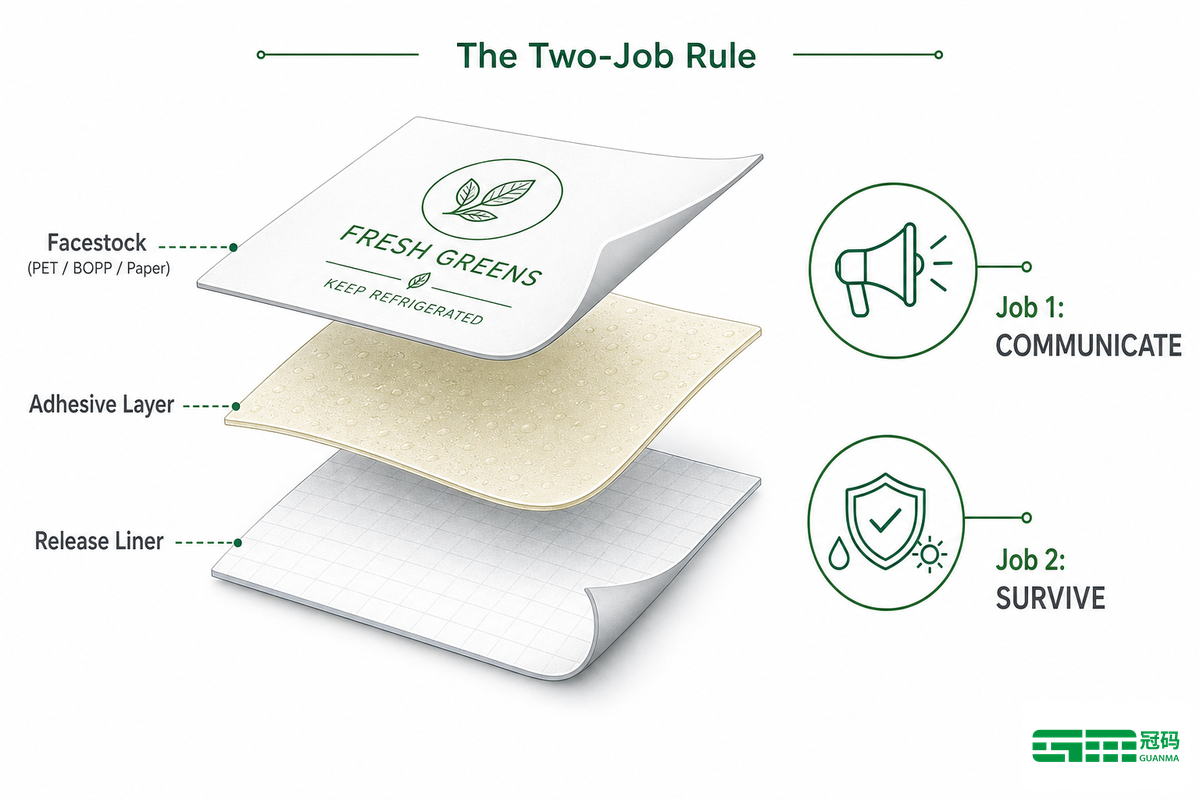
Um rótulo para embalagens de alimentos é um rótulo sensível à pressão (também conhecido como rótulo autoadesivo) aderido à superfície externa do recipiente ou da embalagem de um produto alimentício. Sua estrutura básica é composta por três camadas projetadas: um frontal, um adesivo e um liner de liberação.
Seu frontal é a camada de face na qual a impressão aparece — pode ser papel, filme como BOPP ou PET. O adesivo fixa o rótulo à embalagem, e um liner de liberação o sustenta, sendo removido durante a aplicação. O design impresso no frontal é importante, é claro, mas é a combinação do material e do adesivo abaixo dele que determina a eficácia do rótulo.
A Regra de Dois Trabalhos para Rótulos de Alimentos. Os rótulos das embalagens de alimentos, por necessidade, são solicitados a realizar duas tarefas simultâneas simultaneamente.
Primeiro, eles são responsáveis por comunicar informações obrigatórias – detalhes como identidade do produto, listas de ingredientes, substâncias alergênicas, quantidade líquida e valor nutricional – que os consumidores e órgãos reguladores esperam encontrar Este é o “comunicar” job, e para a maioria dos produtos alimentícios preparados, incluindo cereais, assados, enlatados, itens congelados, lanches e bebidas, é uma exigência legal aplicada por órgãos como o Administração de Alimentos e Medicamentos dos EUA.
O segundo trabalho, igualmente importante, é o “sobreviver” trabalho. Isto significa que o rótulo deve manter a sua adesão, legibilidade, e integridade, apesar de uma série de desafios ambientais, desde as temperaturas frias de um frigorífico para as condições húmidas e oleosas de uma cozinha a vapor ou mesmo calor elevado. Um rótulo brilhantemente concebido que se desprende ou se torna ilegível em um refrigerador, por exemplo, deixa de fazer o seu trabalho, não importa quão atraente a impressão.
Por que a escolha do material do rótulo é primordial e uma decisão upstream não negociável Escolhendo o material certo do rótulo da embalagem do alimento é uma das primeiras e mais críticas decisões que uma marca, fabricante ou equipe de compras de alimentos pode tomar.
A seleção de materiais não é um mero detalhe da gráfica; é uma decisão estratégica que impacta todas as fases da vida da gravadora. Este guia percorre cada um dos dois trabalhos principais que uma etiqueta de embalagem de alimentos deve realizar: o trabalho de ‘comunicar’ e o trabalho de ‘sobreviver’.
Os 9 Tipos de Etiquetas de Embalagem de Alimentos (por Função)
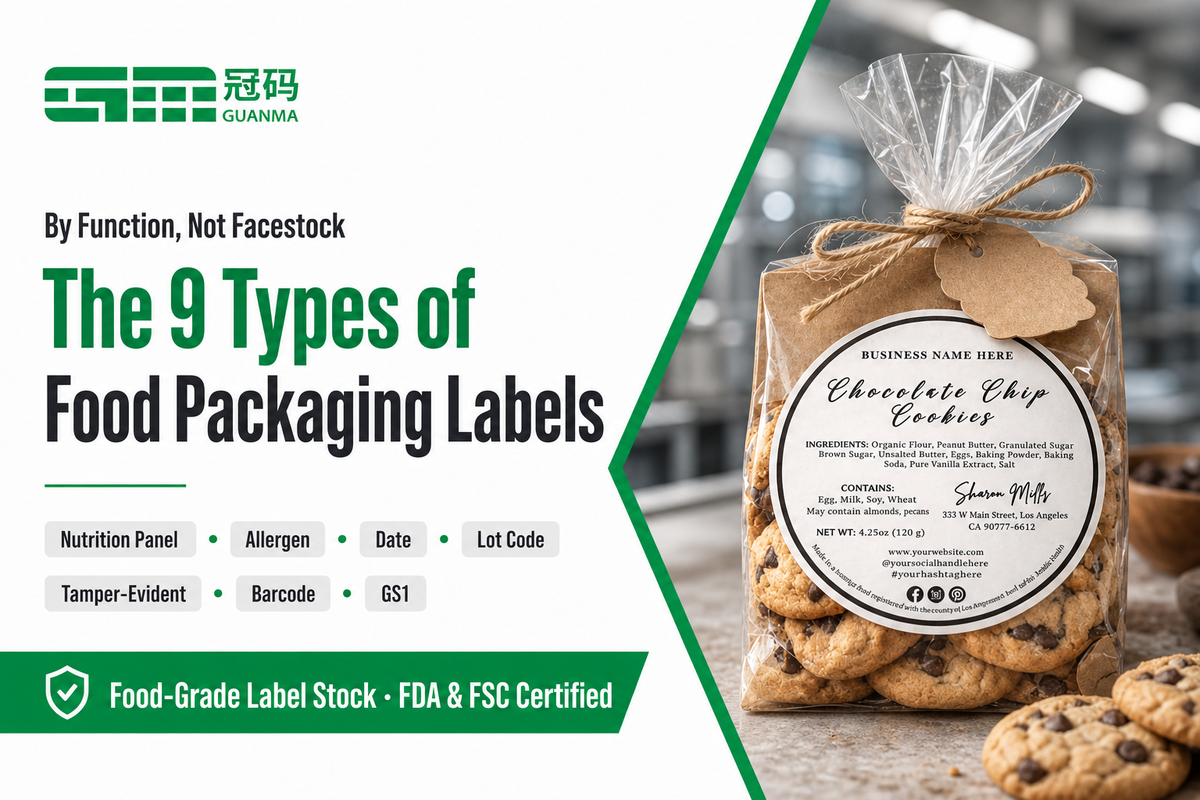
A maioria dos guias de rótulos organiza os itens por material ou por tipo de alimento É muito mais útil organizar os rótulos dos produtos alimentícios por seus função 0 job cada rótulo executar e a regra que o rege Aqui está o Tipo de rótulo alimentar × Job × Regra Governante mapa, nossa lista do nove diferentes tipos de rótulos de produtos alimentícios, para que serve cada um e qual agência governamental o regula.
| Tipo de etiqueta | Seu trabalho | Governado por |
|---|---|---|
| Branding/primário | Identifique o produto e a marca | Declaração de identidade, FDA 21 CFR 101 |
| Painel de informações nutricionais | Declarar o tamanho da porção, calorias, nutrientes | FDA 21 CFR 101,9 |
| Ingrediente e alérgeno | Lista ingredientes + bandeira alérgenos principais | FALCPA /Lei MAIS RÁPIDA (EUA) · Reg 1169/2011 (UE) |
| Código da data e do lote | Melhor antes/uso + lote de rastreabilidade | Marca + regras de marcação de data da UE |
| Código de barras/GS1 | Digitalização de varejo (GTIN) | Padrões GS1 |
| Inviolável | Mostrar se um pacote foi aberto | Política de segurança da marca/varejista |
| Peso-preço | Peso variável + preço à escala retalhista | Regras de quantidade líquida (FPLA) |
| Promocional/na embalagem | Reivindicações, códigos QR, campanhas | Regras de fundamentação de reclamações |
| Sustentabilidade/reciclagem | Eliminação de guias (por exemplo, How2Recycle) | PPWR da UE · regimes voluntários |
Mapeamento tipo a regra compilado a partir de Regulamentos de rotulagem de alimentos da FDA (21 CFR 101) e Regras da UE em matéria de informação alimentar (Reg 1169/2011).
Um rótulo físico geralmente cumprirá várias funções simultaneamente; por exemplo, um único rótulo primário pode conter um painel de fatos nutricionais, o lista ingredientes, um código de data. Simplesmente saber qual é a função permitirá identificar a regra necessária para cumprir esta é a primeira consideração antes de escolher seus materiais ou processo de impressão.
O que deve aparecer legalmente em um rótulo de embalagem de alimentos (EUA e UE)
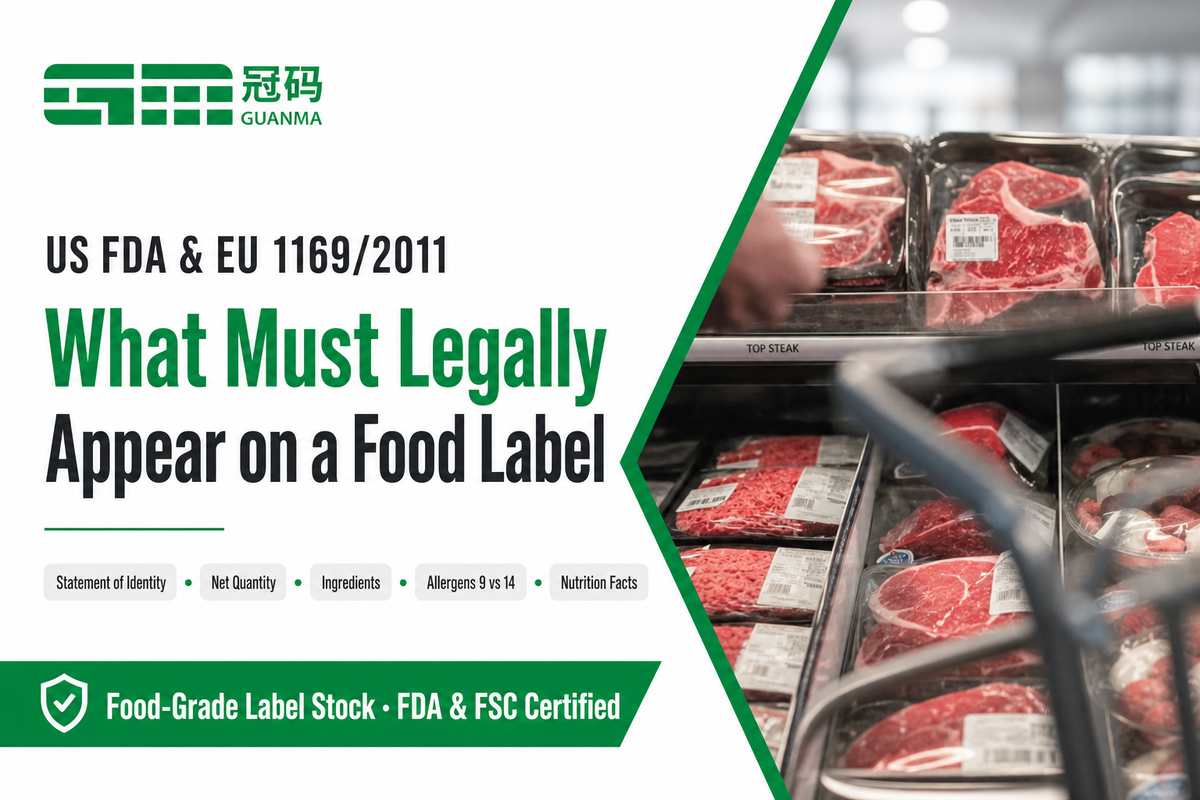
Os produtores de alimentos na maioria das vezes procuram exatamente isso Um rótulo de alimentos embalados nos Estados Unidos precisará incluir os seguintes itens obrigatórios de acordo com Regras de rotulagem de alimentos da Food and Drug Administration dos EUA (21 CFR 101): uma declaração da identidade do alimento, quantidade líquida de conteúdo, ingredientes listados em ordem decrescente de peso, Painel de informações nutricionais, declaração da presença de alérgenos, e nome e local de negócios do fabricante, embalador ou distribuidor.
O que devo colocar no rótulo de um alimento?
Um rótulo de varejo de alimentos nos EUA precisa de no mínimo seis elementos: (1) a declaração de identidade, (2) uma declaração de peso ou volume líquido, (3) uma lista completa de ingredientes por peso descendente, (4) declaração de alérgenos, (5) o painel de Informações Nutricionais e (6) a identidade e endereço do fabricante, embalador ou distribuidor.
Os produtos de carne e aves estão sob a jurisdição do Serviço de Inspeção e Segurança Alimentar do Departamento de Agricultura dos EUA (USDA), que exige um sexto elemento obrigatório, uma lenda de inspeção e, muitas vezes, mandatos padrões adicionais de identidade“ entre os recursos obrigatórios do rótulo. As operações domiciliares (comida caseira) podem se surpreender com o fato de que as leis de rotulagem de seu estado provavelmente exigirão o nome, endereço e número de telefone da empresa diretamente na lista de ingredientes.
As declarações de alergénios são uma fonte comum de problemas de rotulagem.
A falha em declarar alérgenos (um problema de rotulagem, não um problema de deterioração ou contaminação) é responsável pela maioria dos recalls de alimentos da FDA, de acordo com Índice de recall de 2024 de Sedgwick, que identificou alérgenos não declarados como a principal causa de recalls de alimentos da FDA. A lei dos EUA reconhece atualmente nove alérgenos principais: leite, ovo, peixe, crustáceos, nozes, amendoim, trigo, soja e gergelim, que o A Lei FASTER tornou-se o nono alérgeno principal, com rotulagem exigida em 1o de janeiro de 2023.
⚠️ Importante: EUA ^ UE
Se você está planejando comercializar na Europa, precisará de um rótulo diferente.
Regulamento da UE 1169/2011 relativo à informação alimentar aos consumidores exige a declaração de 14 alérgenos principais (não nove), destaca os alérgenos nos ingredientes e requer QUID (declaração quantitativa de ingredientes), marcação obrigatória de data e um painel de Informações Nutricionais no verso da embalagem. Uma única receita frequentemente exige um rótulo diferente para cada mercado.
Embora sem glamour e com apostas altas, existem dois erros mais comumente sinalizados do FSIS do USDA rotulagem: falha em nomear ingredientes pelo nome comum, e falha em encomendar ingredientes por peso descendente Se você vender para mais de um mercado ou exportar, use nosso verificador da região de conformidade do rótulo alimentar para mapear sua aplicação para as vias FDA, UE e GB.
O Pilha de conformidade de rótulo alimentar de 3 camadas
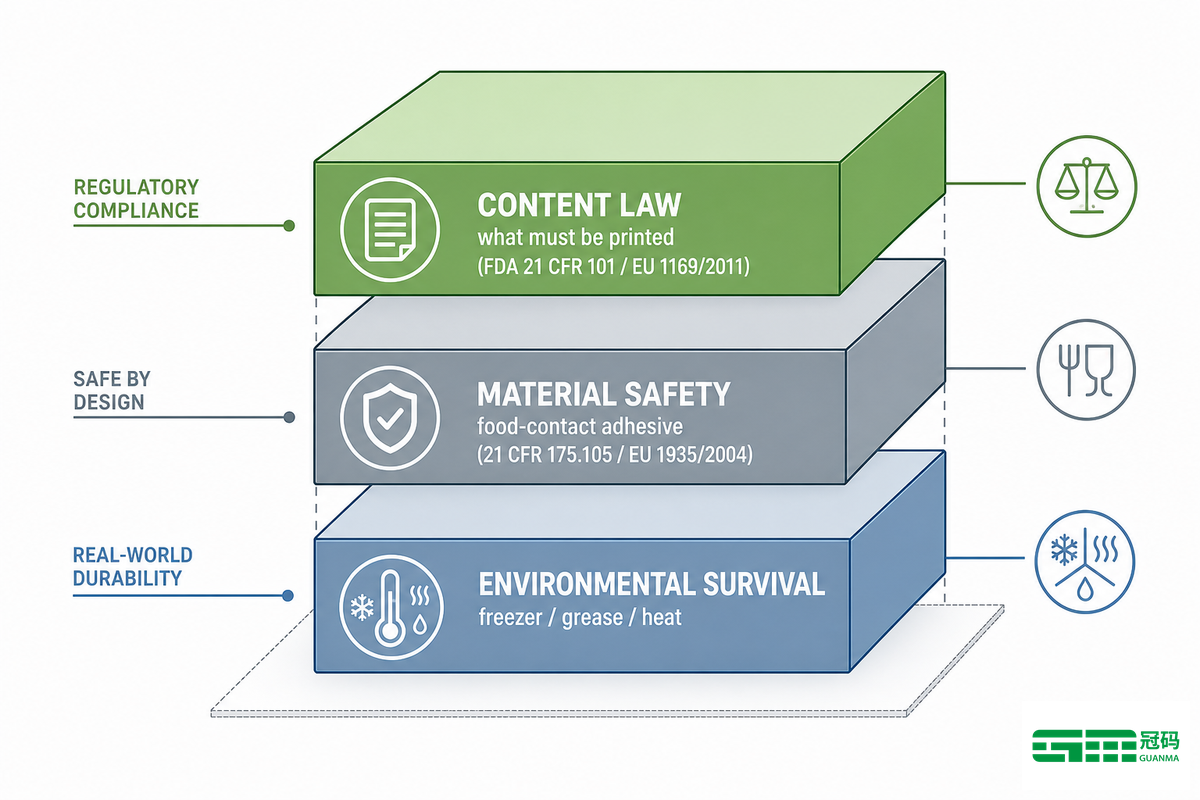
A confusão sobre a rotulagem de alimentos realmente começa ao responder a uma pergunta que parece simples, mas que na verdade são três perguntas: “Meu rótulo é seguro para alimentos?”. Como você verá abaixo, a estrutura de conformidade de rótulos para alimentos em 3 camadas deixa claro que a conformidade depende de atender aos três requisitos simultaneamente.
A pilha de conformidade do rótulo alimentar de 3 camadas
- Direito de conteúdo (conforme coberto anteriormente).
- Segurança material.
- Sobrevivência ambiental.
Os rótulos das embalagens de alimentos são seguros para contato direto com alimentos?
A maior parte do contato com a etiqueta é indireta (não um invólucro), mas essa distinção faz uma grande diferença Não é o adesivo em si que os reguladores se preocupam, mas o adesivo, particularmente FDA 21 CFR 175.105 para os EUA e o Regulamento (CE) 1935/2004 e (UE) 10/2011 para plásticos, para garantir que nenhum contaminante seja transferido para os alimentos. Os adesivos diretos com rótulo de contato com alimentos são ainda mais regulamentados devido à via de migração da substância.
💡 Myth-buster: “food-grade” não é uma coisa
O termo “food-grade label” pode significar várias coisas. Os fornecedores muitas vezes implicam que um material é adequado para contato direto com alimentos quando o que eles significam é indireto, o que é o caso da maioria dos rótulos de alimentos. Portanto, a questão correta é se o adesivo é apropriado para a aplicação especificada, atendendo a 21 CFR 175.105 ou o equivalente UE/GB para contato indireto.
“A maioria das perguntas ‘isso é seguro para alimentos?’ que colocamos em campo são realmente perguntas adesivas. Para um rótulo de frasco ou bolsa o alimento nunca toca o adesivo diretamente, o que importa é que o adesivo seja qualificado para contato indireto e corresponda à superfície e temperatura que tem que segurar.”
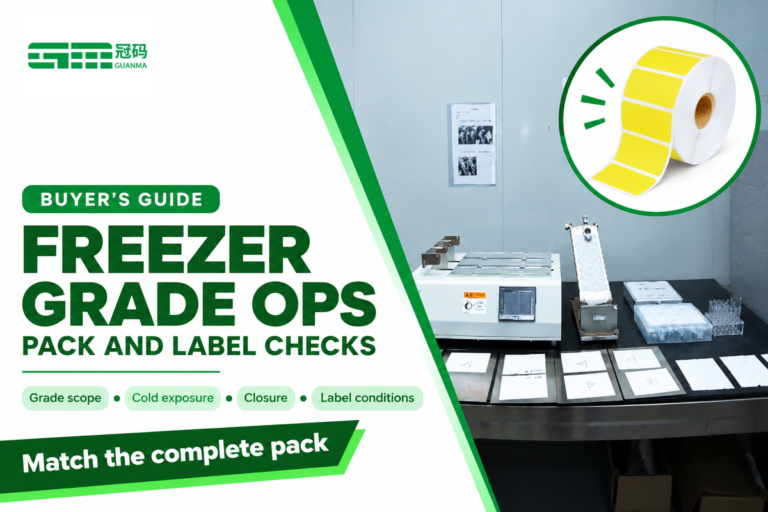
Por que os rótulos dos alimentos falham: freezer, umidade, graxa e calor
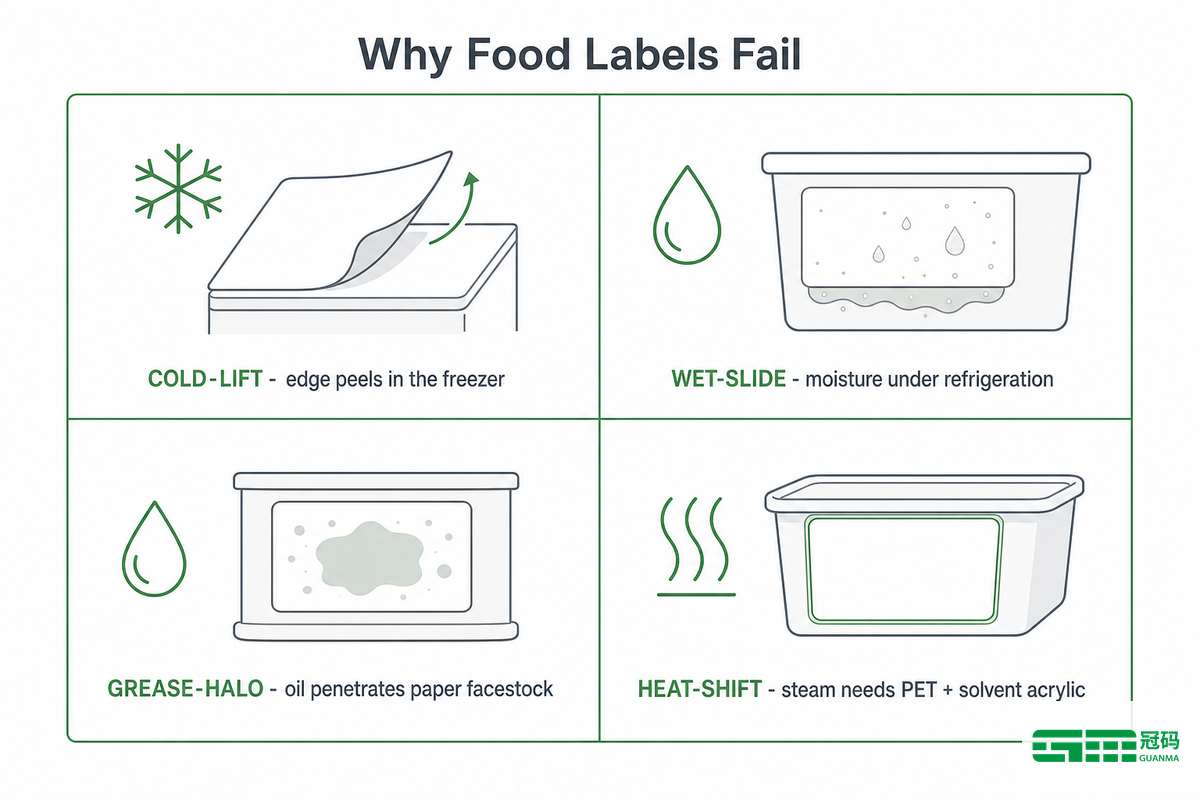
Quando os rótulos falham em campo, geralmente é na Camada 3, sobrevivência ambiental — o rótulo manteve seu conteúdo e passou nas verificações de material, mas o freezer, a fritadeira ou a lavagem o venceram. Diagnosticar as condições ambientais específicas às quais um rótulo estará exposto é fundamental para determinar seus requisitos de material, porque cada modo de falha corresponde a um ambiente diferente e a uma causa material diferente.
| Falha | Meio Ambiente | Causa material |
|---|---|---|
| Elevador de borda/elevador a frio | Congelador, corrente fria | O facestock de papel absorve a umidade; o acrílico de uso geral perde aderência abaixo de cerca de +5 °C |
| Deslizamento úmido/esfregaço | Condensação, banho de gelo, lavagem | Facestock não impermeável; tinta não resistente à umidade |
| Graxa-halo | Padaria, fritos & alimentos oleosos | O óleo penetra na matéria-prima de papel não revestido |
| Mudança de calor | Pasteurização a vapor, enchimento a quente | Facestock/adesivo não classificado para a temperatura; precisa de filme + adesivo de alta temperatura |
Quer se trate de um congelador ou de uma graxa, os problemas nesta camada são normalmente devidos a problemas de material, não de impressão. Por exemplo, produtos frios, laticínios, bebidas costumam usar etiquetas BOPP ou PET com adesivos projetados para o ambiente, estes resistem aos danos que uma etiqueta de papel revestido incorreria, enquanto as etiquetas destinadas ao armazenamento normal podem delaminar sob refrigeração ou em uma bolsa flexível e falhar completamente. As bolsas de pé e outros filmes de baixa energia são especialmente implacáveis do adesivo errado. Alinhar suas escolhas de material com o ambiente de aplicação pretendido, superfície, temperatura e processo de fabricação do seu produto é o objetivo principal de um matriz de decisão Facestock-and-Adhesive, e nosso calculadora TCO material da etiqueta pode ajudar a quantificar o custo real de uma seleção inadequada.
Como os rótulos das embalagens de alimentos são impressos e aplicados
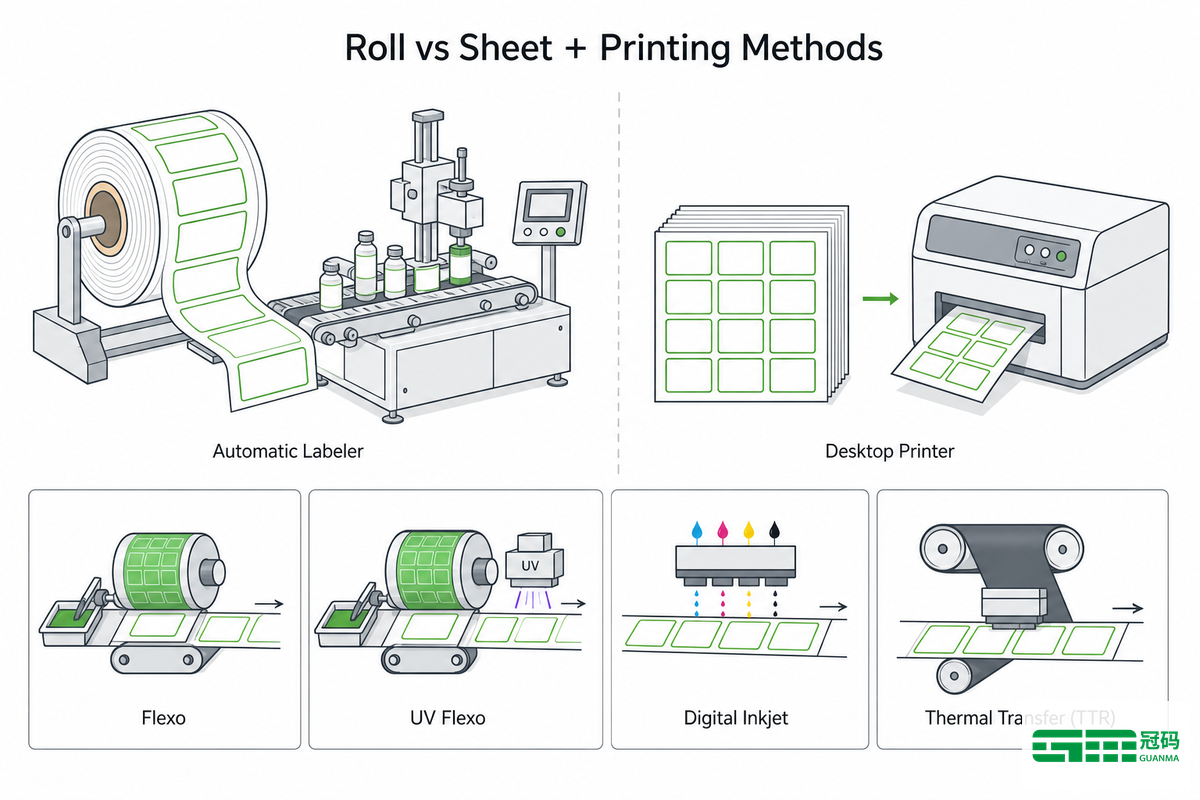
Depois de obter o material para baixo, duas escolhas práticas permanecem: fator de forma e processo de impressão. Ambos têm mais impacto no custo e tempo de resposta do que os compradores de primeira viagem adivinhariam, e ambos devem ser resolvidos antes que a obra de arte seja finalizada, porque o revestimento que uma prensa precisa é escolhido no momento da ordem (não na máquina).
Qual é a diferença entre etiquetas de rolo e etiquetas de folha?
Os rótulos em bobina vêm sobre um liner contínuo e são projetados para passar por equipamentos automáticos de rotulagem de alta velocidade — a solução principal para a fabricação de alimentos em alto volume. Os rótulos em folha vêm pré-cortados sobre uma folha de suporte e destinam-se a impressoras jato de tinta ou laser de mesa — uma ótima opção para tiragens curtas, startups e quem imprime internamente. Em resumo: bobina é produtividade; folha é flexibilidade e baixos mínimos.
A Guanma pode fornecer material de etiqueta em formas de rolo e folha, cortadas do mesmo material-mãe.
O processo de impressão vem em seguida, após o facestock e o revestimento.
Para produção de rolos e máxima compatibilidade, a impressão flexográfica (incluindo flexografia UV) é o seu padrão. Jato de tinta digital, seja aquosa ou UV, é uma escolha inteligente para tiragens curtas e aplicações de dados variáveis devido ao baixo desperdício; use material com revestimento digital para que a tinta adira. Se precisar de etiqueta para códigos de data ou códigos de barras, a melhor opção é transferência térmica (TTR), que requer material frontal revestido.
Cada processo de impressão exige um revestimento específico, portanto a escolha do revestimento deve ser feita quando você faz seu pedido, não na impressora. (Leia mais em nosso guia do filme BOPP para rótulos).
Algumas últimas considerações práticas.
Um aspecto é a arte-final e o design do rótulo: a maioria dos convertedores de impressão de rótulos para alimentos deseja um arquivo PDF pronto para impressão, com fontes convertidas em contornos e qualquer logotipo em vetor, e uma produção de alta qualidade começa com a escolha do material correto para rótulos e de arquivos limpos. Normalmente, eles oferecem modelos gratuitos para ajudar compradores de primeira viagem a ajustar o texto ao formato do recorte. Independentemente de você imprimir rótulos personalizados para alimentos ou usar um modelo, deixe espaço suficiente para todos aqueles detalhes importantes discutidos anteriormente — listas de ingredientes e blocos de alérgenos ocupam muito mais espaço do que as marcas costumam reservar.
O segundo aspecto é personalizado versus material de estoque: muitos novos produtores que estão testando uma nova receita começarão com material para rótulos em branco, pronto para uso, antes de migrar para uma rotulagem totalmente personalizada. Convertedores que imprimem rótulos em formato de bobina oferecem um retorno rápido, mas o trabalho impresso personalizado ainda depende de um material durável e do revestimento correto — isso importa muito mais do que a impressora. Em todo o setor alimentício, de marcas de varejo à operação de alimentos, as melhores soluções de rótulos começam pelo material, não pela tiragem de impressão.
Como escolher o rótulo certo de embalagem de alimentos: uma lista restrita de 5 perguntas
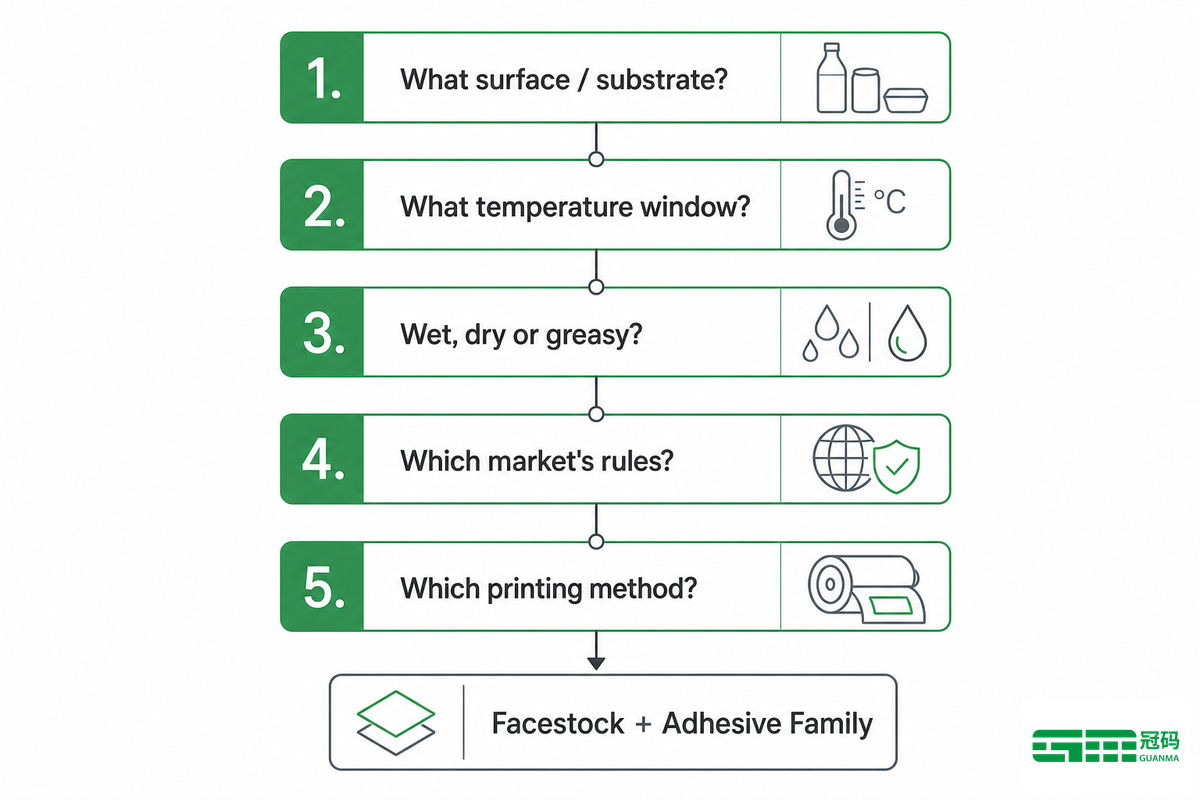
Você não precisa obter um diploma em ciência dos materiais para começar a se concentrar na melhor escolha para o seu produto. Apenas pergunte a si mesmo essas cinco perguntas, em ordem. Seu campo de possibilidades encolherá notavelmente rapidamente.
Chamamos-lhe The Lista restrita de rótulos de alimentos de 5 perguntas.
A lista restrita de rótulos de alimentos de 5 perguntas
- Superfície: Que tipo de etiqueta grudará na superfície do vidro, PET, HDPE, papelão, filme de baixa energia?
- Temperatura: é a faixa de temperatura que o rótulo encontrará? Qual ambiente, pasteurização, tudo acima
- Exposição: é molhado, seco ou gorduroso em serviço?
- Mercado: Que rotulagem o seu produto será submetido aos regulamentos FDA, EU 1169/2011, GB, etc?
- Impressão: Que tipo de prensa deseja executá-la em formato flexo, digital ou térmico, e em rolo ou folha?
Essas respostas, por si só, devem levá-lo à família correta de frontais (por exemplo, papel para produtos secos em condições ambiente, BOPP ou PET para produtos em condições úmidas, congeladas ou aquecidas), ao adesivo apropriado (permanente, removível, lavável) e ao formato correto. Depois disso, o próximo passo mais eficiente é uma recomendação personalizada de material respaldada por uma amostra — basta usar nosso seletor de material facial e adesivo ferramenta para restringir suas opções e, em seguida, colocar o material à prova.
Rótulos de alimentos sustentáveis: o que está mudando em 2026
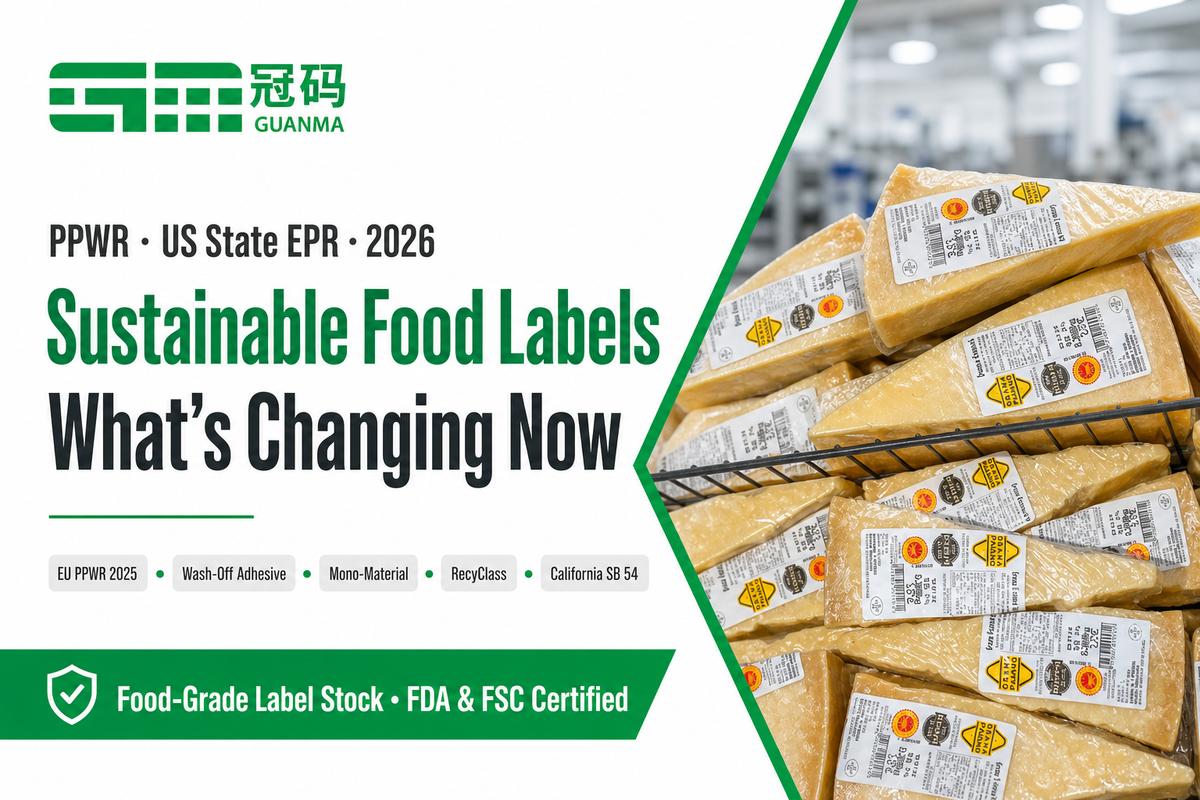
No momento, a maior tendência de rotulagem de embalagens de alimentos não é cosmética, é regulatória e trata-se de rótulos de embalagens serem incluídos na legislação de reciclabilidade. Uma regulamentação da UE adotada em 2025 e implementada em 2026, conhecida como Regulamento de Embalagens e Resíduos de Embalagens (PPWR) 20 25/40 (UE) 20 20 40 (a UE deve ditar que a partir de 2030, todas as embalagens do mercado na UE devem ser compatíveis com o design para reciclagem e devem ser tecnicamente recicláveis, com um rótulo que atinja um grau específico de reciclabilidade não é mais considerado reciclável. Se a cola incorreta e o material facial incorreto utilizados, uma garrafa PET inteira não poderá ser classificada e categorizada como reciclável e, portanto, os rótulos das embalagens tornam-se não um elemento criativo, mas um problema de conformidade.
Essa pressão está remodelando os materiais. A cobertura comercial da Labelexpo 2024 e 2025 revela uma rápida comercialização de adesivos wash-off, que permitem uma tira de etiqueta limpa de uma garrafa PET através de todo o processo de reciclagem; construção mono-material e facestocks PCR. No nível estadual nos EUA, a legislação EPR, como o SB 54 da Califórnia, aplica pressão impondo taxas de embalagem.
Para compradores, a ação é direta: se você vende para a UE ou para qualquer estado que tenha adotado um programa EPR, peça hoje ao fornecedor de materiais um material de etiqueta wash-off compatível com RecyClass e solicite essa confirmação por escrito, para ter tempo suficiente e evitar mudança apressada antes do prazo de 2030. (As previsões de tamanho de mercado são direcionalmente úteis; as datas regulatórias são restrições reais.)
Perguntas frequentes
O que deve incluir um rótulo de embalagem de alimentos?
Ver Resposta
Nos EUA, um rótulo de alimento vendido no varejo deve incluir a declaração de identidade, a quantidade líquida do conteúdo, a lista de ingredientes em ordem decrescente de peso, informações sobre alérgenos que abranjam os nove principais alérgenos, o painel de Informações Nutricionais e o nome e o local de atividade do fabricante, embalador ou distribuidor. Carne e aves acrescentam uma legenda de inspeção do USDA. A UE exige os mesmos elementos essenciais, além de 14 alérgenos declarados e marcação obrigatória de data.
Os rótulos das embalagens de alimentos são seguros para contato direto com alimentos?
Ver Resposta
Quase todas as etiquetas de embalagens de alimentos são de contato indireto — ficam na embalagem, não no alimento. O componente regulamentado é o adesivo, coberto nos EUA por FDA 21 CFR 175.105 para contato indireto. Contato direto com alimentos, como adesivo aplicado em produto fresco, segue uma via separada de migração de substâncias e requer testes específicos, produzidos sob solicitação em vez de como material padrão.
Qual é a diferença entre etiquetas de rolo e etiquetas de folha?
Ver Resposta
As etiquetas de rolo alimentam as etiquetadoras automáticas de alta velocidade e adequam-se a execuções de produção maiores; as etiquetas de folha são pré-cortadas para impressoras a jato de tinta ou a laser de mesa e se adequam a curtas tiragens, startups e DIY O material pode ser idêntico (a diferença é o formato e como a etiqueta é aplicada).Escolha o rolo para rendimento e a folha para flexibilidade e pedidos mínimos baixos.
Os rótulos das embalagens de alimentos precisam ser à prova d’água ou seguros para freezer?
Ver Resposta
Somente se o ambiente exigir Um frasco de prateleira ambiente seco pode usar uma etiqueta de papel revestido, mas produtos congeladores, resfriados, úmidos ou oleosos precisam de um material facial de filme impermeável e um adesivo compatível com a temperatura. Caso contrário, você obterá elevação de borda ou manchas.
O que significa “food-grade adhesive”, e minha etiqueta precisa dele?
Ver Resposta
“Food-grade” é usado de forma imprecisa, portanto vincule-o a uma regulamentação. Para uma etiqueta de embalagem normal — pote, garrafa, pouch ou caixa — o alimento nunca toca o adesivo; assim, o necessário é um adesivo em conformidade com FDA 21 CFR 175.105 para contato indireto com alimentos (ou equivalente UE/GB). Somente etiquetas aplicadas diretamente ao alimento precisam de adesivo de contato direto, uma especificação diferente e mais rigorosa. Ao solicitar material, peça a declaração específica de conformidade em vez do termo “food-grade,” pois os dois podem ter significados muito diferentes conforme o fornecedor. Fornecedores realmente usam o termo dos dois modos: alguns para indicar segurança de contato direto, outros para indicar conformidade de contato indireto; por isso, o número da regulamentação é a única informação inequívoca para uma especificação de compra.
Os rótulos dos alimentos recicláveis ou lavados são exigidos por lei?
Ver Resposta
Cada vez mais, sim — indiretamente. As regras PPWR da UE exigem que todas as embalagens sejam recicláveis até 2030, e uma etiqueta que dificulte a reciclagem pode desqualificar toda a embalagem, impulsionando adesivos wash-off e etiquetas de monomaterial. Leis estaduais de EPR nos EUA adicionam taxas de embalagem vinculadas à reciclabilidade. Se você vende nesses mercados, material de etiqueta compatível com reciclagem está se tornando um requisito prático.
Exibindo um rótulo de embalagem de alimentos?
Guanma também oferece estoque de filmes PET, BOPP, papel sintético, papel revestido de qualidade alimentar com adesivos certificados FDA 21 CFR 175.10 5 cortados em seu formato, com rolos de amostra disponíveis para seu próprio teste de imprensa.
Por que escrevemos isso
Como fabricante de materiais autoadesivos para rótulos, a maioria das perguntas sobre rótulos de alimentos que recebemos não se refere à arte-final, mas a qual adesivo está em conformidade para contato indireto com alimentos e qual frontal resiste a um freezer ou a uma fritadeira. Este guia separa as questões da legislação de rotulagem (o que deve ser impresso) das questões de material (o que o mantém aderido e em conformidade), pois é ao misturá-las que as marcas de alimentos mais frequentemente encontram dificuldades. Revisado pela equipe técnica da Guanma.
Referências e fontes
- Nutrição, Rotulagem de Alimentos e Alimentos Críticos (21 CFR 101)Administração de Alimentos e Medicamentos dos EUA
- A Lei MAIS RÁPIDA: O gergelim é o nono maior alérgeno alimentarAdministração de Alimentos e Medicamentos dos EUA
- 21 CFR 175.105, Adesivos (contato indireto com alimentos)Código Eletrônico de Regulamentações Federais dos EUA
- 10 Erros de Rotulagem Mais Comuns e Como Evitá-losServiço de Inspeção e Segurança Alimentar do USDA
- Informação alimentar obrigatória, Regulamento (UE) 1169/2011Comissão Europeia
- Regulamento de Embalagens e Resíduos de Embalagens (PPWR)Comissão Europeia, Ambiente
- Recalls de rotulagem de alimentos: dados de alérgenos não declarados de 2024Trustwell (citando Sedgwick Recall Index)
Artigos Relacionados
- Soluções de materiais para etiquetas de embalagens de alimentos, PET, BOPP & material de papel revestido
- Seletor de decisão adesivo Facestock ×
- Material da etiqueta Calculadora TCO
- Verificador da região de conformidade do rótulo alimentar (FDA /UE / GB)
- Filme de etiqueta BOPP: tipos, especificações e como escolher