Entre em Contato com Guanma

Label durability testing is an assessment of label attachment and legibility, meaning readable identification, under the conditions of intended use. A useful test begins with the failure that would cause you to reject the label and then aligns the construction, application surface and exposure to that specific failure. A material name or a successful scan can’t resolve the purchase decision.
This guide produces a production-matched specimen record, screening comparisons that do not prove causes, and hold-or-release evidence for a defined label construction. Use the linked standards guide for method choice, conditions and limitations; the decisions here concern specimen preparation and incoming-lot disposition.
For a technical evaluator, the challenging transition is from a promising sample to an approved purchase order. What surface was tested? Was production ribbon used? Does the report address wiping following condensation? Label durability matters because lost identification can interrupt the intended use of the item. The set of questions presented herein transforms those issues into specimen records, screening comparisons and an evaluation of acceptance evidence.
This document addresses general industrial materials screening. Safety-critical markings, electrical product labels, and hazardous-chemical warnings require their own applicable requirements. A durability test won’t confirm product compliance. For test method interpretation, refer to the separate guia de padrões de teste de durabilidade de etiquetas.
Start With the Label Failure You Cannot Accept
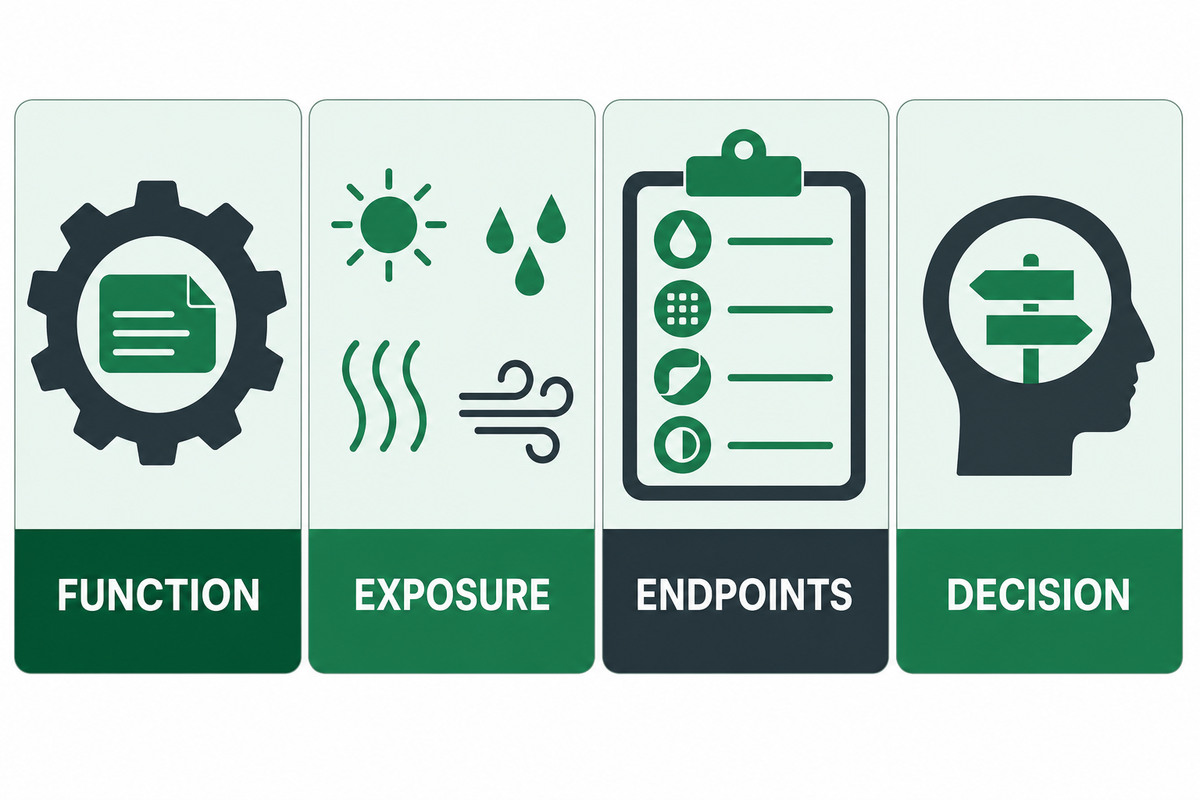
Prior to requesting tests, identify a label’s function, exposure, and observable failure mode that’s unacceptable. The identification text may be required to remain legible even after cleaning, while the tracking code must meet its specified quality requirement. Determine who judges the endpoints and what supporting evidence is required to approve the construction for use.
“the test methods and associated information do not in themselves imply any specification of performance relating to the materials under test.”
Requests for “labels for harsh environments” leave the test provider figuring it out on their own. Please write an application statement instead. It should describe printed identification on a textured enclosure that’s exposed to outdoor light and the site’s named cleaning agent, with required text and edges inspected after exposure. Describe what information the user needs to read. Explain the reasons that labels must remain legible. Also, please indicate the actual concentrations, temperatures, durations, and the handling sequence in your controlled specification.
- Function: identification, traceability, operating instructions or another defined task.
- Exposure: substances, contact pattern, environmental conditions, and wear and tear.
- Endpoints: attachment, visible damage, legibility and any barcode requirement.
- Decision: Screening, Construction Qualification, or Inspection against an Approved Specification.
Common mistake: accepting “passed abrasion testing” without the method settings or rejection rule. Rigorous testing still answers the wrong question when the required label function is missing. Ask the supplier to attach those conditions to the result before comparing quotations.
Shortlist the Complete Label Construction

Consider a durable label as a complete printed construction: facestock, adhesive, ink or ribbon, protective coating, and laminate. All elements must be suitable to the intended surface and label printing process. While material families help narrow the list, they don’t rank finished label systems or prove the durability of the label over time and whether it will withstand service.
Dave Joseph, the Director of Product Solutions at Armis, discusses this interrelated nature of the components in his explanation in Label & Narrow Web’s 2026 engineering feature. His supplier-provided explanation inspires the construction checklist. It isn’t comparative test data for Guanma products.
| Material or construction route | Question before ordering samples |
|---|---|
| Filme PET | Does this adhesive, finish and print system meet the actual attachment and image requirements? |
| Polypropylene film | Is the specific grade compatible with printing, handling and the application geometry? |
| Papel sintético | What polymer and surface treatment does that product name describe? |
| Vinyl labels | Which grade, adhesive and print combination is being proposed for the service conditions? |
| Protected print construction | Does a topcoat or laminate address the observed image damage, and what else changes? |
Guanma PET adhesive film label stock, synthetic paper label facestock and other label stock items identify material routes for sample discussion. Please provide the grade and specifics of the construction. Don’t assume those family names indicate chemical resistance or outdoor life.
Comparison limit: A higher peel number cannot automatically decide between different constructions. ASTM D3330/D3330M-04(2025) cautions that the stiffness of the backing and the rheology of adhesive affect comparisons between manufacturers. Measurements used within their stated scope should be evaluated in relation to the candidate’s intended functions.
Make Samples Match the Production Application
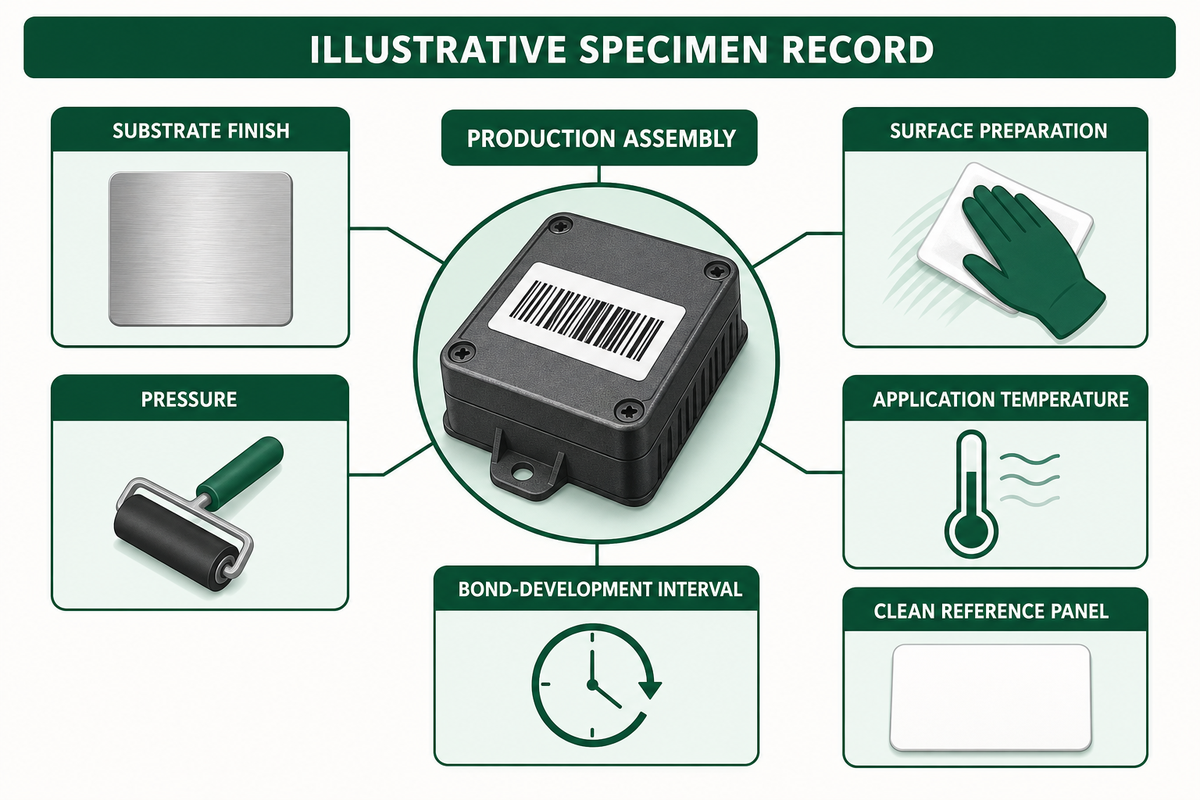
Production-matched samples reproduce the proposed label, printed image, and application surface for the intended decision. Note the substrate finish, the preparation of the application surface, the application temperature, degree of pressure and the time interval for bond development. A question asked by an investigator may be answered by testing labels on a convenient clean panel, although it may not resolve any potential problems with the production assembly.
O IoPP label qualification planning document lists variables of the substrate, printing, and application. It’s an old, undated sample for a different product and is used here only in the context of its planning. Its test settings and examples of acceptance aren’t transferred here to industrial labels.
How does surface energy affect label adhesion?
For adhesive, surface energy affects wetting and contact. There are other issues such as surface texture, contamination, and curvature that affect contact. “Sticks to plastic” is clearly an inadequate specification. Determine the actual polymer and the surface treatment finish. Compare the specimens prepared by the intended methods. There’s no guarantee that a single surface energy value ensures a finished label will remain intact.
Illustrative specimen record: A buyer is examining labels for a textured polypropylene enclosure. The retained assembly records the enclosure material and finish, the proposed printed PET construction, ribbon identity, printer settings, and the production cleaning process. The other specimen shows the same label on a clean reference panel. Neither result is substituted for the other. If the production assembly lifts at an edge and the reference panel holds, the record calls for an investigation of contact, geometry and application conditions. Currently, it doesn’t identify the adhesive as defective. The buyer wants a targeted comparison before accepting a material substitution or a change in the cleaning process.
Separate application temperature from the temperatures experienced later. Extreme temperature ratings don’t describe bonds forming during application. Ensure both sets of conditions are present when labels are applied to cold or damp items. Include the actual label design in your submission. Size, corner geometry, and positioning of elements can impact what the trial needs to inspect.
Use a 3-Branch Exposure Design
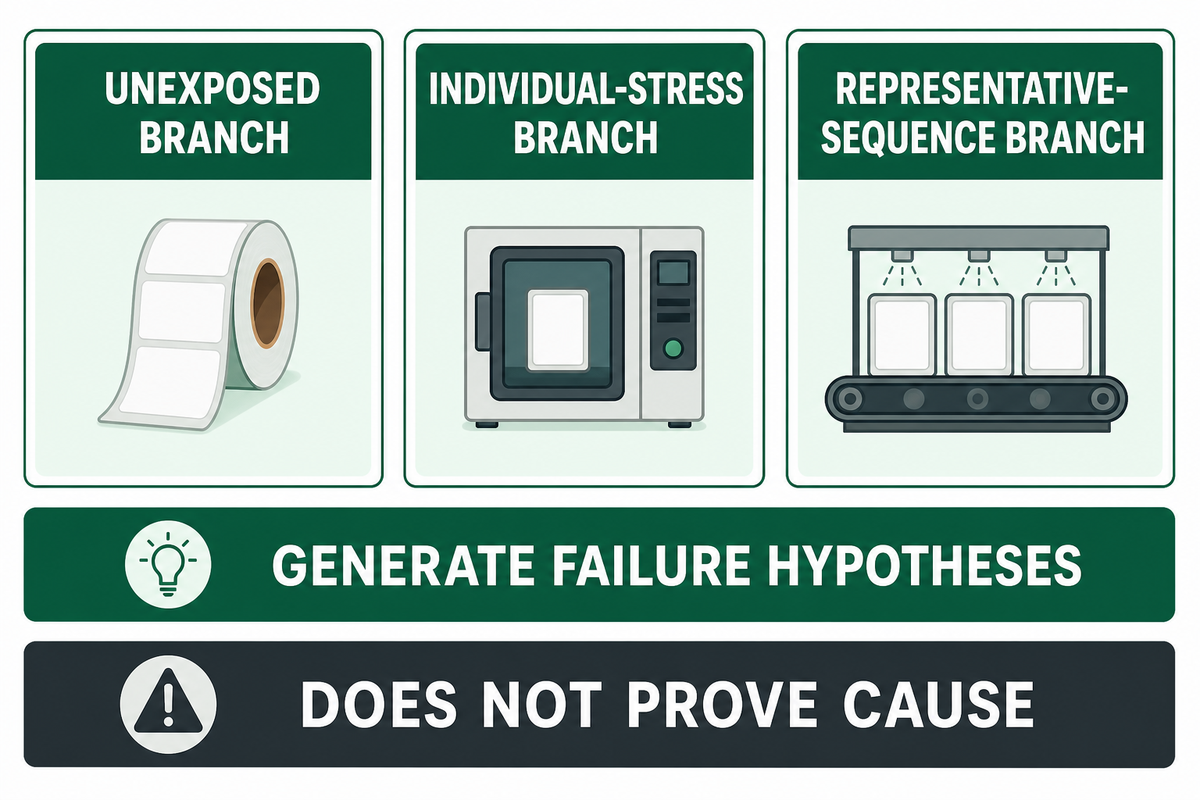
The 3-Branch Exposure Design is a conceptual design to explain the branches of a label testing sequence: retain unexposed specimens, test individual stresses on separate specimens, and run a representative sequence on another group. These branches help formulate failure hypotheses. They don’t independently identify interacting stresses, prove a failed layer, or account for all possible exposure sequences.
NIST’s discussion of one-factor experiments explains isolated comparisons leave interactions unresolved. For example, if chemical contact alters the response to abrasion at a later stage, a specialist may need a designed experiment with the appropriate factor combinations, replication and control of incidental variation. Consider randomization or blocking before distributing specimens.
- unexposed branch: retain matched specimens to record measurements and provide initial appearance.
- individual-stress branch: screen responses to specified stresses using other specimens.
- Representative-sequence branch: expose an additional group of specimens in the documented order of use and inspect the intermediate and final condition.
Illustrative sequence: A reusable container is moved from a cool storage area to a warm loading area, is wiped and then comes into contact with other containers. The proposed study captures condensation, wiping, and subsequent rubbing in that order. Separate specimens are subjected either to the selected wiping or rubbing exposure. Suppose the sequence group shows image damage, while the isolated groups don’t. Then, the next set of questions would center around the combined conditions. This observation wouldn’t prove a chemical-abrasion mechanism. The quality lead holds the candidate and requests that the test provider vary the selected factors and the exposure order in a suitable experimental design.
For accelerated weathering comparisons, include a suitable known-performance material exposed alongside candidates, as recommended by ASTM G151-26. An unexposed retained label and an exposed control answer different questions. Record the role of each control, and ensure an adequate number of specimens for the agreed replication and destructive measurements. A study can simulate select real-world conditions; it cannot reproduce every service history.
Choose Tests That Answer Your Failure Questions
Select label testing methods based on the failure question, the measurement end point and the method’s limit. Adhesion, printed-image abrasion, chemical resistance testing and weathering examine different properties. A report needs both exposure settings and the agreed acceptance rule; a standard number or laboratory duration alone can’t establish the quality and durability required in service.
ASTM D5264-98(2019) describes the lab-based comparison of abrasion resistance for printed materials. Its public scope considers factors relating to inks, coatings, laminates and substrates while employing predetermined criteria. Confirm that the selected method matches the sample geometry and the type of damage you wish to evaluate. For a FINAT FTM 1 or FTM 2 peel result, record the specified 300 mm/min rate with the method; that setting is not a lot-acceptance limit.
Testing-input reference: Use this matrix to record the exposure, observed endpoint and conditions for a production-matched specimen. It is not a test method, a pass limit or a batch-release rule. For method selection and limitations, use the separate guia de padrões de teste de durabilidade de etiquetas.
| Exposure or test | Endpoint | Report conditions | Decision limit |
|---|---|---|---|
| Dry abrasion | Image loss or surface damage | Contact material, load, motion and cycles | Does not represent wet wiping |
| Wet abrasion | Smear, transfer and legibility | Liquid, wetting and rubbing conditions | Liquid identity matters |
| Chemical spot contact | Local discoloration or damage | Substance, concentration and contact time | Not an immersion result |
| Chemical immersion | Image, film and attachment condition | Fluid, temperature, duration and recovery | May differ from intermittent contact |
| Adesão descascar | Force and observed failure mode | Surface, dwell, angle, speed and width | Cannot alone predict functional life |
| Static holding or shear | Movement or loss of hold | Geometry, load, time and temperature | Not a peel measurement |
| Temperature cycling | Lift, distortion or image change | Limits, dwell, transitions and moisture | Use a relevant exposure history |
| Condensation or moisture | Attachment and image condition | Wet/dry sequence and inspection timing | Dry inspection alone can miss behavior |
| Light and weathering | Property change and readability | Spectrum, irradiance, temperature and wetting | No universal hours-to-years conversion |
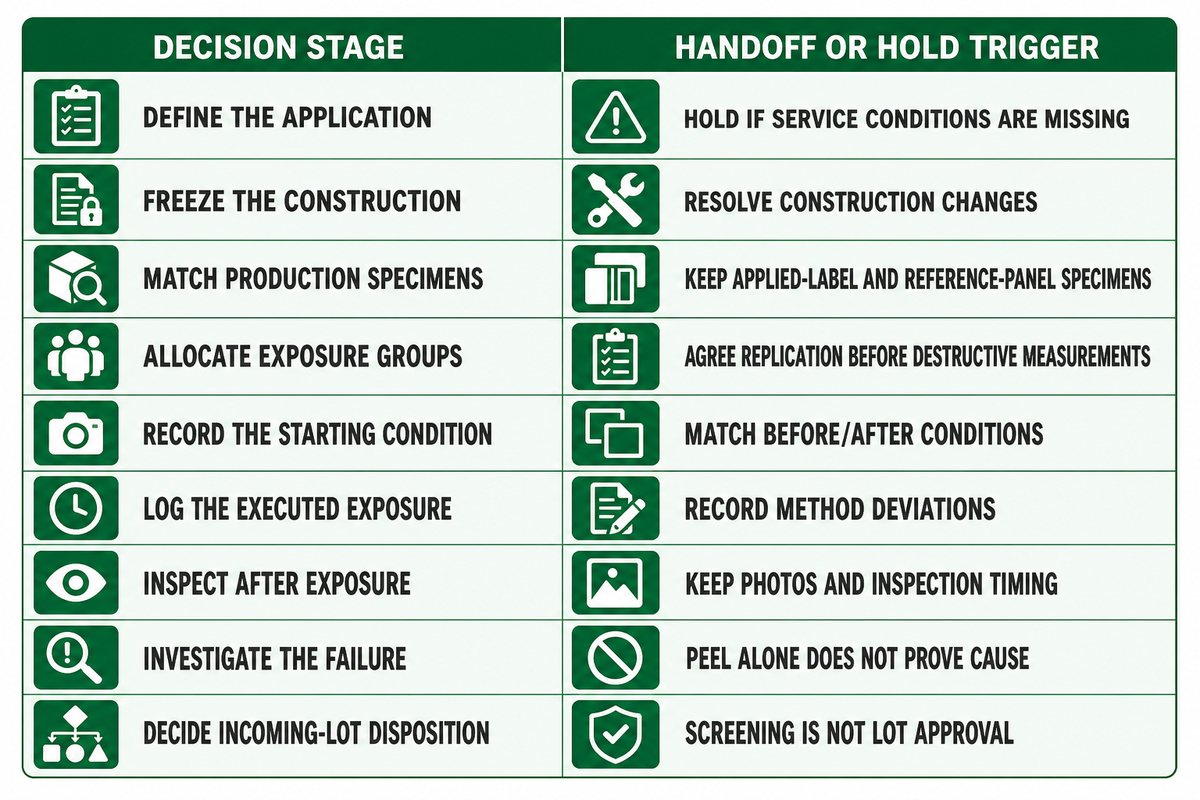
Carry these test inputs and observations into the specimen record and decision handoff below; a screening result still does not establish incoming-lot approval.
| Decision stage | Required record | Responsible owner | Handoff trigger |
|---|---|---|---|
| Define the application | Function, actual surface, finish, geometry and handling | Engineering | Hold the plan if the service conditions are missing |
| Congele a construção | Facestock, adhesive, ink or ribbon, coating, laminate and lot revision | Aquisição e conversão | Resolve a construction change before specimens are prepared |
| Match production specimens | Actual substrate, surface preparation, print settings, attachment and reference-panel identity | Production quality | Retain both assemblies; do not substitute a panel result for an applied-label result |
| Allocate exposure groups | Unexposed controls, individual-stress groups and a representative wet/dry sequence | Test owner | Agree replication and specimen allocation before destructive measurements |
| Record the starting condition | Image appearance, initial edge condition, print quality and readability | Qualidade | Use matched measurement conditions for before/after comparison |
| Log the executed exposure | Actual chemical concentration, fluid contact time, temperature, wetting, rubbing load and cycles, or light spectrum and irradiance when specified | Test provider | Record deviations from the agreed method; no universal hours-to-years conversion |
| Inspect after exposure | Visible image loss, smear, transfer, discoloration, distortion, movement, attachment and recovery condition | Qualidade | Keep photographs with inspection timing; dry inspection alone can miss wet behavior |
| Investigate the failure | Observed failure mode, peel force if measured, affected layer hypothesis and next controlled comparison | Technical evaluator | A peel measurement cannot alone predict functional life or prove the failed layer |
| Dispose of the incoming lot | Construction identity, specimen records, approved sampling plan, authorized criteria and decision reason | Authorized release owner | Accept, reject or hold under the agreed plan; a screening result is not lot approval |
ASTM G151-26 cautions against a general acceleration factor from laboratory time to real world years. There must be actual data to support correlations for a specific material and a specific environment. Use the uv exposure to compare candidates within a specified scope of the study. Keep a separation between an outdoor-life claim and the laboratory result. UV light is one of the exposure variables; extreme conditions used without an application basis can cause a different failure mode.
Locate the Failed Layer Before Upgrading Materials
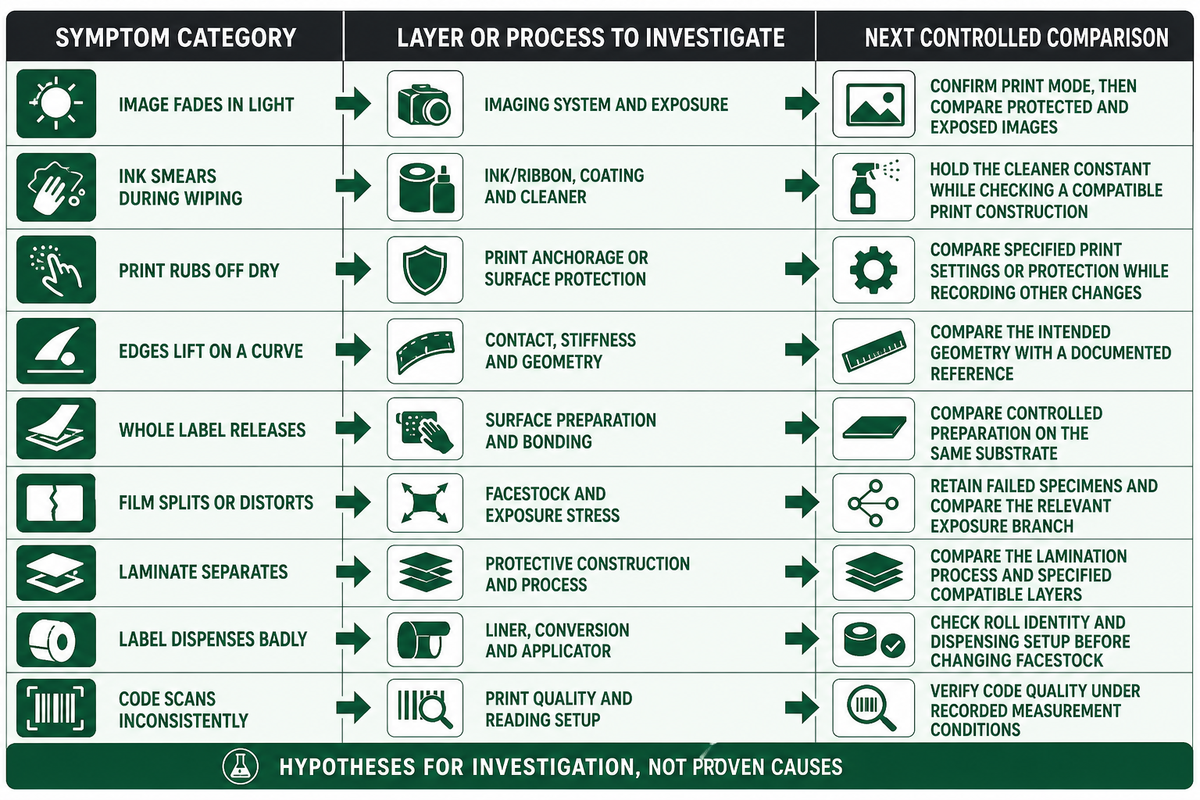
First, describe the symptoms you’ve observed in production and select a comparison that allows you to test a possible cause. Failure symptoms such as fading, smearing, edge lift, and liner problems may involve different levels of the construction or process. The Failure-Layer Diagnostic Table contains a set of follow-up questions; appearance alone can’t determine the failed layer or justify approval of a substitute.
ASTM D3330/D3330M-04(2025) limits the attribution of a cause from peel results since both a backing and an adhesive can affect the response. Keep the photos and the observed failure mode with the measurement. Do not call every low measurement an adhesive failure.
| Symptom category | Layer or process to investigate | Next controlled comparison |
|---|---|---|
| Image fades in light | Imaging system and exposure | Confirm print mode, then compare protected and exposed images |
| Ink smears during wiping | Ink/ribbon, coating and cleaner | Hold the cleaner constant while checking a compatible print construction |
| Print rubs off dry | Print anchorage or surface protection | Compare specified print settings or protection while recording other changes |
| Edges lift on a curve | Contact, stiffness and geometry | Compare the intended geometry with a documented reference |
| Whole label releases | Surface preparation and bonding | Compare controlled preparation on the same substrate |
| Film splits or distorts | Facestock and exposure stress | Retain failed specimens and compare the relevant exposure branch |
| Laminate separates | Protective construction and process | Compare the lamination process and specified compatible layers |
| Label dispenses badly | Liner, conversion and applicator | Check roll identity and dispensing setup before changing facestock |
| Code scans inconsistently | Print quality and reading setup | Verify code quality under recorded measurement conditions |
Check imaging mode on the label printer before purchasing new ribbon. Direct thermal and thermal transfer are different print routes; ribbon changes belong to thermal transfer. With thermal transfer, consider the proposed ribbon and the printing surface. Substitution of the film while changing print energy or ribbon leaves a number of mixed explanations.
When labels fail in harsh industrial environments, preserve the failed samples. An image may become unreadable, but if the label remains attached, purchasing a stronger adhesive has likely not resolved the failure that you’ve observed. Record your hypothesis, compare the relevant input, and rethink the entire candidate once the cause is better understood.
Separate Batch Release From Material Qualification
The process of material qualification determines if a label construction is appropriate to a specific application. The process of batch inspection considers a specific lot and whether it meets an approved specification within an applicable sampling and inspection plan. Any successful screening sample isn’t sufficient to draw a conclusion on either aspect. Within the record, retain the construction evidence, the lot identity, and the authority to release the stock.
ISO 2859-1:2026 addresses acceptance sampling by attributes for lot-by-lot inspection, with schemes indexed by acceptance quality limit. Its public description concerns series of lots. An isolated lot needs a suitability review of the sampling approach; do not transfer continuing-lot rules without checking their assumptions.
The Lot Disposition Evidence Sheet is offered as an editorial aid for the acceptance handoff. The template doesn’t supply sample sizes, acceptance numbers, or a statistical guarantee. Separately describe the inspection unit, defect definitions, applicable sampling plan, the producer/consumer risk basis, and the release responsibility. If the testing services provide the report, agree on these responsibilities before the samples leave your site.
Example hold decision: an incoming roll contains the name of the known product, but the construction record has a different adhesive code. The previous qualification applies to the earlier adhesive that was on the actual enclosure. Therefore, the record states “hold pending construction review” and identifies the affected roll, and references the approved specification. Procurement requests that the supplier provide the change information. Quality will evaluate the evidence and determine what needs to be re-evaluated and what evidence is applicable, then apply the authorized acceptance plan before disposition. For this example, no passing sample count is assumed, and the known product name isn’t considered to mean that the changed batch is qualified.
- Identity: lot, construction revision, print system and approved specification.
- Evidence: specimen records, test report, actual results and deviations.
- Acceptance basis: applicable plan and authorized criteria.
- Disposition: Accept, reject, or hold and state the reason and the person that made the decision.
A supplier’s “same label quality” statement isn’t a closure of a documented construction change. Resolve the change before releasing the stock, and keep the change evidence available as a record.
Keep Barcode Readability in the Next Qualification Plan
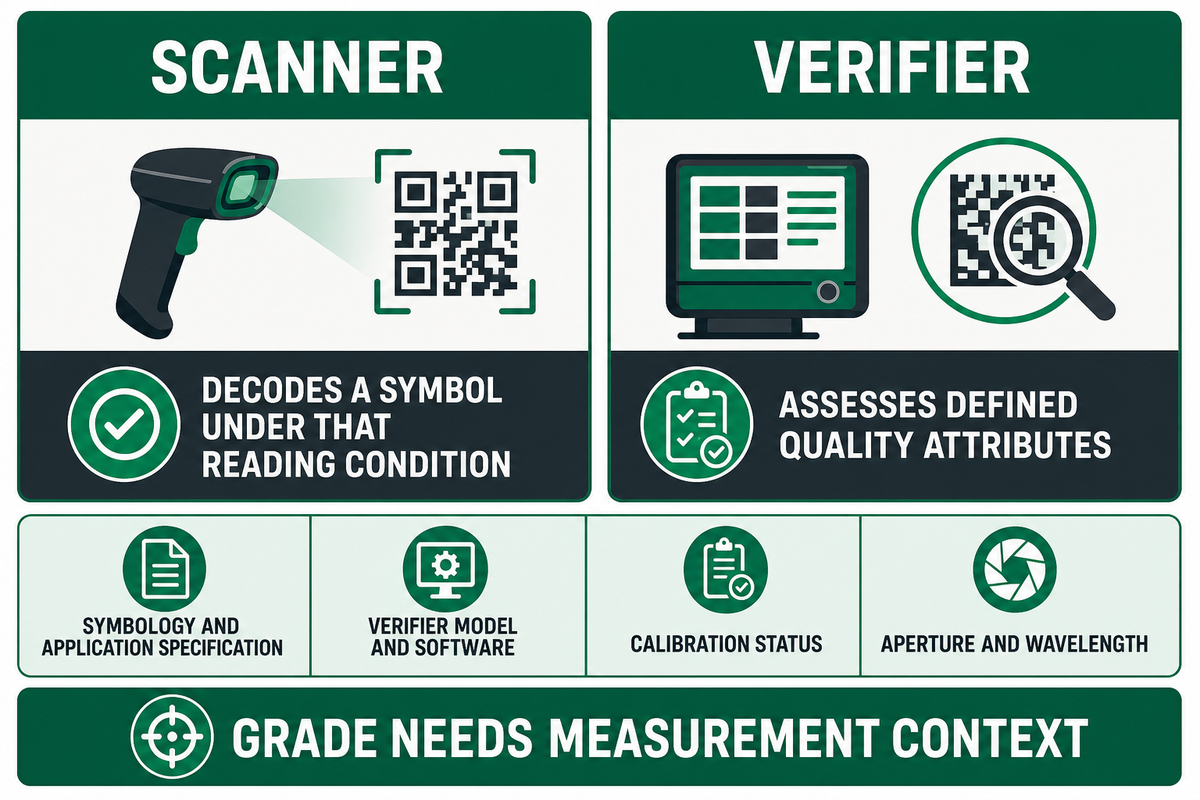
Barcode quality should be included in the exposure plan where a durable identification solution relies on a barcode. Record the quality prior to and after the barcode was subjected to the selected stresses under the same measurement conditions. A label can stay affixed even if the print contrast or the other attributes required by the reading system are lost. Thus, label attachment and barcode acceptance must be justified by separate evidence.
In terms of barcodes, GS1’s 2D-in-retail guideline outlines the industry’s aim to have point-of-sale (POS) systems capable of reading and processing 2D codes alongside linear codes by the end of 2027. This time frame is specific to retail, and isn’t an industry-wide deadline for industrial barcode labels. However, it illustrates that one should consider loss of quality within the timeframe between printing and the final scan.
Why not just use a barcode scanner?
A scanner shows if that device is able to decode a symbol under those reading conditions. A verifier assesses defined quality attributes. Capture the symbology and application specification, verifier model and software, calibration status, aperture and wavelength. Keep those conditions stable across comparisons; without measurement context, a grade can be misleading.
ISO/IEC 15415:2024, which was published in December 2024, focuses on the assessment and grading of the print quality of two-dimensional symbols. It does not provide a full label assessment against harsh conditions. Select the applicable quality methodology for the 1D and 2D symbologies in use, and state the acceptance level in the application specification.
Include all relevant information regarding artwork and printing process alongside actual code size and required cleaning or handling sequence for the next qualification review. Evaluate the durability of printed labels under realistic conditions and determine if labels remain intact and if the codes retain the required quality. Keep this report with the construction record. Barcode verification also doesn’t assure that a linked website will remain active during the label lifecycle.
Perguntas frequentes
Como você testa a durabilidade?
The first step is to identify the environment, handling, and failure that make the label unacceptable. Print the proposed construction and apply it to the actual surface.
The first step is to identify the environment, handling, and failure that make the label unacceptable. Print the proposed construction and apply it to the actual surface. Keep comparison samples, select relevant exposures, and compare attachment, appearance and readability to the agreed criteria.
Separate stress groups can be used for screening, but interactions and exposure-order effects require a suitable experimental design before a possible cause is claimed. Keep the report linked to the construction revision, print settings, and application record. If the objective is lot acceptance, also identify the applicable sampling plan and release authority, as a few successful screening samples don’t mean that lot acceptance is justified.
O que é um teste de rótulo?
A label test evaluates one or more properties of the finished label system in the stated conditions. It can address adhesive hold, printed-image abrasion, chemical response, weathering, or barcode quality.
A label test evaluates one or more properties of the finished label system in the stated conditions. It can address adhesive hold, printed-image abrasion, chemical response, weathering, or barcode quality. In this case, label testing addresses the physical label and the information that was printed on the label. It doesn’t include the evaluation of a product’s nutritional values or compliance with each of the legal requirements for the words on the packaging.
Qual é o material de etiqueta mais durável?
There isn’t a single material that works for every surface, chemical exposure and handling pattern. Some possible options include polyester, polypropylene, constructions of synthetic-paper, and vinyl labels, depending on grade specific limitations.
There isn’t a single material that works for every surface, chemical exposure and handling pattern. Some possible options include polyester, polypropylene, constructions of synthetic-paper, and vinyl labels, depending on grade specific limitations. Label performance is also impacted by the adhesive system, printing method, coating, and lamination. Before approving a material for use, assess the alternatives under the relevant conditions, and use the appropriate methods.
Quais são as normas ISO para rotulagem?
Different standards address different questions. ISO/IEC 15415:2024 concerns 2D barcode print quality; ISO 2859-1:2026 concerns lot-by-lot acceptance sampling by attributes. Neither establishes a universal label durability test or a universal pass limit.
Diferentes padrões abordam diferentes questões ISO/IEC 15415:2024 diz respeito à qualidade de impressão de código de barras 2 D; ISO 2859-1:2026 diz respeito à amostragem de aceitação lote a lote por atributos Nenhum dos dois estabelece um teste de durabilidade de rótulo universal ou um limite de aprovação universal Identifique a propriedade e a aplicação primeiro, depois obtenha o método aplicável e a especificação de aceitação.
How many samples should a label durability trial use?
Before deciding on a sampling plan, describe the constructions, substrates, printing process, and exposure unit groupings. Include discussion of appropriate replication and specimen allocation for destructive measurements.
Before deciding on a sampling plan, describe the constructions, substrates, printing process, and exposure unit groupings. Include discussion of appropriate replication and specimen allocation for destructive measurements. A screening set isn’t automatically a statistically justified lot-acceptance plan. Describe the rationale and the risks associated with the decision.
When should label materials be requalified?
Consider changes to the construction, printing process, substrate, or application. Repeat the affected comparisons when previous data don’t cover the proposed configuration. Identify the review owner and keep the affected construction revision, changed input and disposition linked to the supporting evidence.
Consider changes to the construction, printing process, substrate, or application. Repeat the affected comparisons when previous data don’t cover the proposed configuration. Identify the review owner and keep the affected construction revision, changed input and disposition linked to the supporting evidence.
When submitting application information to Guanma, include the substrate and finish, the proposed printing system, the exposure sequence, and the acceptance evidence required. Use the self-adhesive film material range to identify possible constructions for your specified application.
Related application: the durable outdoor label solutions page provides the product application route for environmental identification projects. Treat proposed materials as candidates for the tests and acceptance process defined here.
Referências e fontes
- Métodos de teste FINAT: public methods and performance-specification disclaimer.
- Label & Narrow Web, The Science Behind Engineering Labels That Last: Dave Joseph, Armis, August 2026; supplier-affiliated expert contribution.
- IoPP, Package Label Qualification Plan: undated educational sample; general planning principles only.
- NIST, One variable at a time: restrictions of isolated-factor comparisons.
- ASTM D5264-98(2019): public abrasion method scope.
- ASTM D3330/D3330M-04(2025): public peel-method scope and limitations.
- ASTM G151-26: public accelerated-exposure interpretation guidance.
- ISO 2859-1:2026: public acceptance-sampling description.
- GS1, 2D barcodes in retail: adoption context and barcode quality verification.
- ISO/IEC 15415:2024: official print-quality standard catalogue.