Liên hệ với Guanma

A resistant tag material is only a starting point. To finalize a choice, define the exposure, attachment, printed image, finished-sample checks and purchasing controls. A tag can stay on the item while the barcode becomes unreadable; a sound-looking sheet can also leave the hole or fastener untested.
This guide helps technical evaluators shortlist constructions and decide what evidence is still missing. It covers hanging tags first, with a separate route for adhesive labels. The examples are supplier-specific published data and clearly marked hypothetical buyer records. They aren’t Guanma test results or a universal durability ranking.
Chìa khóa mang đi
Approve the material, printed image and attachment as one finished construction. A material-family name or a test on a different specimen does not establish that your tag will pass.
Choose a hanging tag or an adhesive label first
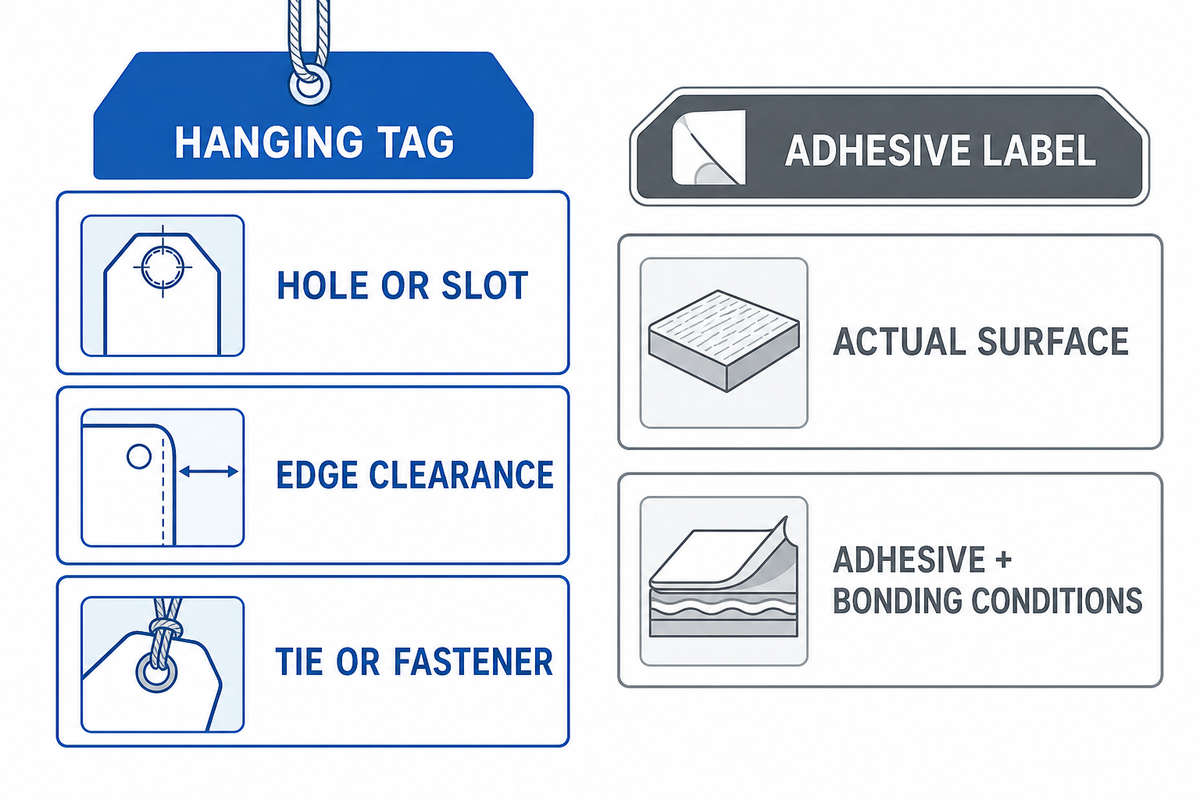
Use a hanging tag when identification must be mechanically attached through a hole, slot, or loop rather than bonded to a surface. Use an adhesive label when a suitable surface is available and identification can be bonded to it. Each option introduces different considerations; therefore, the attachment option must be chosen prior to requesting a sample or comparing film thickness.
For a hanging tag, the fixing point, tie and tag edge should be specified. For pressure-sensitive labels, the surface, adhesive, and the application should be considered. Textured castings, oily parts and clean flat panels are different bonding problems. Curved surfaces on industrial equipment also require a sample; a flat test panel doesn’t represent that surface. Hanging a tag may solve one bond problem and introduce an attachment problem.
Hanging tag
- Specify the hole or slot and edge clearance.
- Identify the tie, wire or other fastener.
- Evaluate the loaded, printed assembly.
Adhesive label
- Specify the actual application surface.
- Identify the adhesive and bonding conditions.
- Evaluate the bonded, printed assembly.
Buying objection: “The material certificate has already been sent.” Ask what construction and test it describes. This material certificate for unconverted film cannot provide the desired result for your punched opening or fastener. For the bonded route, begin with chemical resistant label material selection guide when the decision is driven by chemical exposure.
Resistant tag material: compare candidate constructions
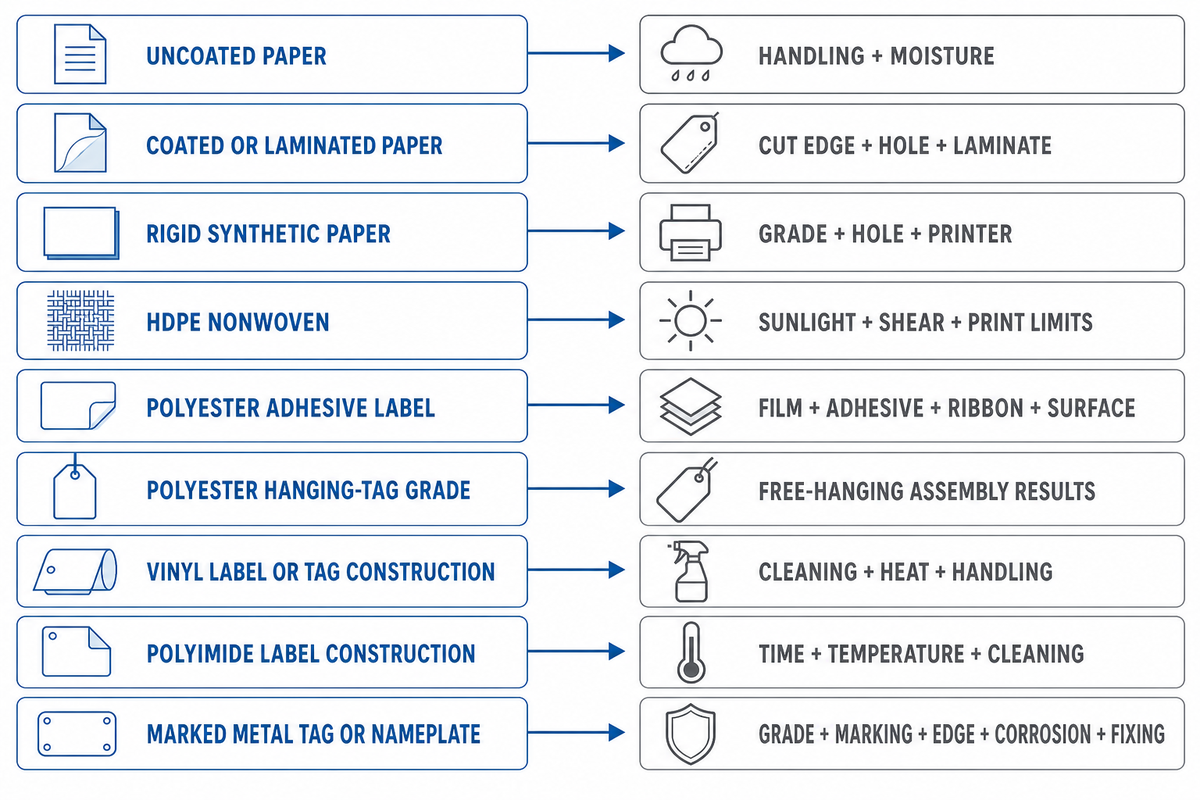
Shortlist resistant tag material by the construction that you can order and test. Paper, synthetic sheet, polyester, vinyl, polyimide and metal all are starting points; there is no universal winner. The table separates material candidates from the evidence required to accept a finished tag or adhesive label.
Don’t interpret the rows as equal products. A construction that employs a coating, laminate or adhesive changes the material, and “synthetic paper” may describe several polymers. Even glossy and matte finishes may need different print settings. To make an apples-to-apples comparison, use a supplier grade code. Polycarbonate labels can enter a shortlist when a supplier documents a suitable construction, but a polymer name alone does not establish suitability for the specific application.
| Candidate | Reason to consider a sample | Evidence to request before approval |
|---|---|---|
| Giấy không tráng | Temporary identification in a protected, dry process | Actual handling and moisture exposure; reject a dry-only sample as proof of outdoor use |
| Coated or laminated paper | A protected printed face is needed | Cut-edge, hole and laminate performance after the intended exposure |
| Rigid synthetic paper | A stiffer printable hanging tag is useful | Exact polymer or grade, hole geometry and printer compatibility |
| HDPE nonwoven, such as a specified Tyvek style | A lightweight, flexible tag is needed | Style-specific sunlight, shear and printing limits |
| Polyester adhesive label | Equipment labels or fixed asset identification need a bonded film | Facestock, adhesive, ribbon and actual surface as one combination |
| Polyester hanging-tag grade | A film tag is preferred over an adhesive label | Free-hanging assembly results; do not borrow an adhesive-label rating |
| Vinyl label or tag construction | Flexibility or conformity is a selection priority | Exact grade under cleaning, heat and handling; stretching must not spoil the image |
| Polyimide label construction | A high-temperature process calls for a specialized candidate | Full time-temperature cycle, adhesive and print system, including subsequent cleaning |
| Marked metal tag or nameplate | A polymer construction may be unsuitable for the process | Metal grade, marking method, edge finish, corrosion exposure and attachment compatibility |
A useful supplier comparison is Pannier’s tear-resistant tag range. Its PSP200 synthetic paper is listed for −23°F to 215°F with 9–12 months of ultraviolet stabilization; PTR200 polymer tags are listed for −70°F to 180°F with one-year ultraviolet and weather resistance. These are separate product descriptions and are not necessarily the limits for all synthetic tags. The page doesn’t provide a universal punched-hole load rating.
“No single label stock meets every challenge.”
Purchasing teams should evaluate the delivered construction, as opposed to just the quoted price per tag, when considering competing offers. In some cases, lower-cost options can be reasonably justified as alternatives. However, this too requires relevant evidence. For polyester labels, the hướng dẫn vật liệu nhãn PET goes into detail regarding the bonded-film route.
Finished-Tag Failure Map: inspect the whole assembly
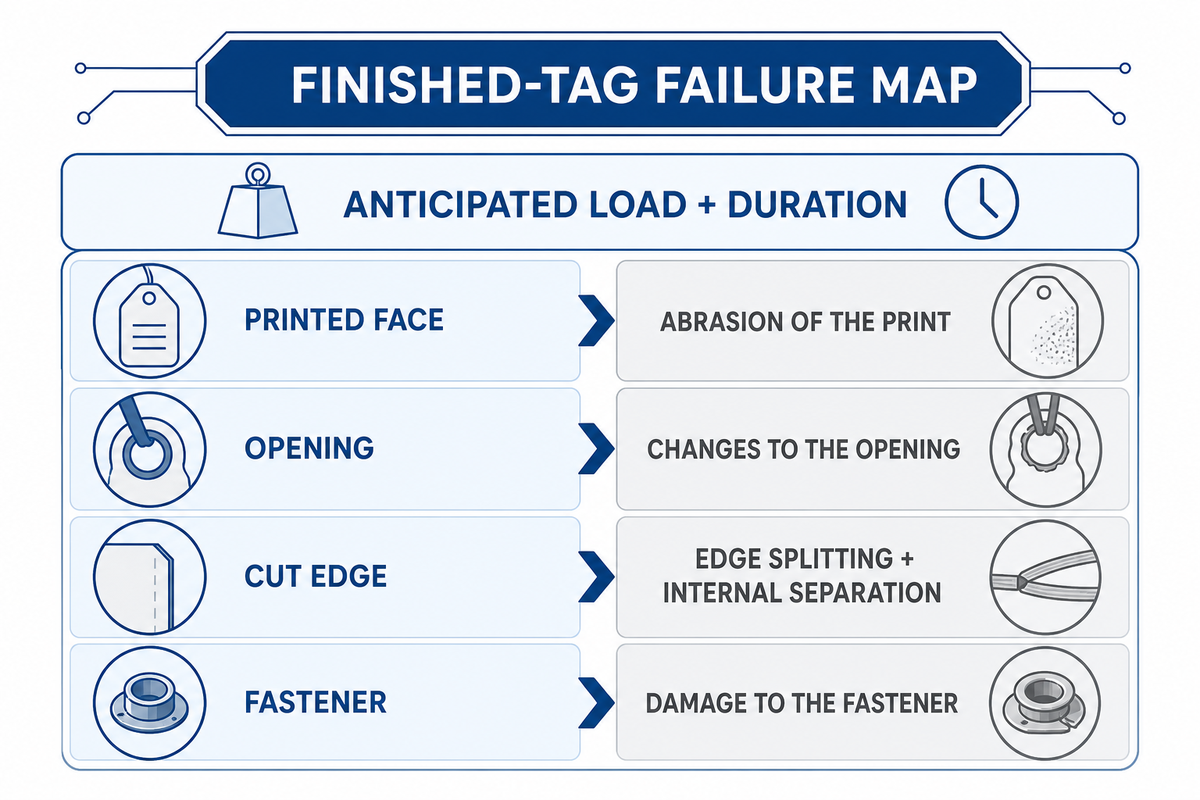
The Finished-Tag Failure Map identifies problems at the printed face, cut edge, opening, and fastener. Evaluate these areas of converted samples and assess them under the anticipated load and duration of exposure. An obvious defect may become visible with a quick hand pull, but it can’t confirm the long-term performance of the attachment.
Begin with the supplied shape. Record the hole diameter or slot dimensions, distance to the nearest edge, corner form, and any reinforcement. Photograph the sample with the intended tie installed. When evaluating the sample, look for abrasion of the print, changes to the opening, edge splitting and internal separation, damage to the fastener, and rotation that conceals the printed information.
The geometry question has a published precedent. US6267152B1, a historical hang-tag patent related to Panduit, discusses slot spacing and reinforcement in the context of tearing. Its examples use certain materials and ties. They explain why those details matter, but don’t set a standard for hole clearance, or endorse a Guanma construction.
Timing is important too. The public scope and guidance for ASTM D2990-17(2025) address plastic creep and creep rupture under sustained loads. If the attachment is kept tight, ask the evaluator to describe the load and the duration and the environment. A tag that appears to be satisfactory immediately following installation needs to be supported with data pertaining to the expected service.
Internal delamination can be caused by actions as simple as rubbing or creasing. Sharp-angle bending can also cause internal delamination. The DuPont Tyvek FAQ states that shearing forces can cause internal delamination. The same guidance does not regard Tyvek as ultraviolet resistant for constant sunlight. Ask for the specific style and finished-sample result instead of assuming Tyvek meets a universal “tear-proof” standard. The adjective shouldn’t be used as a surrogate for the client accepting the product.
Separate exposure specifications, then test the real sequence
Record heat, chemical contact, weather, and mechanical loading separately so that each condition is clear. After, evaluate the situations which may occur together in service. For example, a situation may include short exposure to high heat, longer exposure to lower heat, and a cleaning cycle in which a tag is stretched. Each of these may require different forms of evidence, even if the supplier describes every candidate as durable tag material.
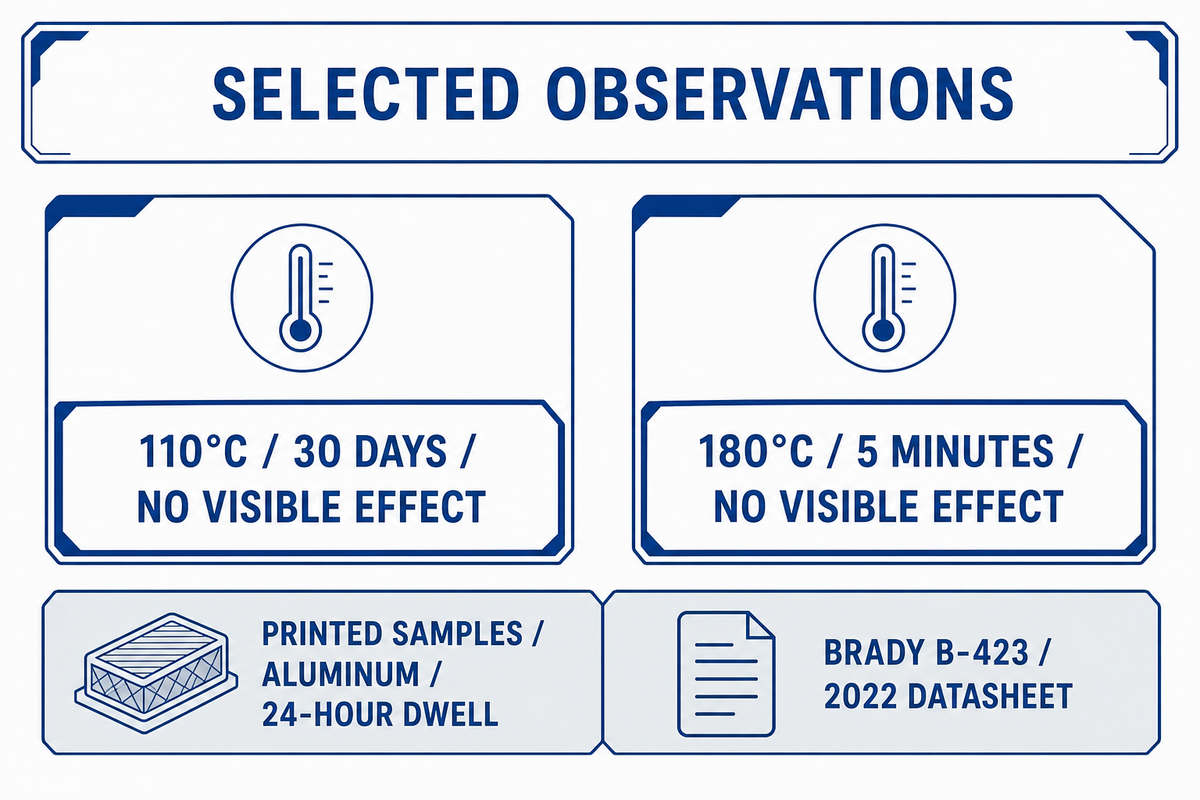
Các 2022 Brady B-423 technical datasheet provides some clarity regarding time. Its stated performance samples were printed, applied to aluminum, and given 24 hours of dwell. The observations documented here are also associated with this construction and setup.
| Published test | Phơi nhiễm | Reported observation |
|---|---|---|
| High service temperature | 110°C for 30 days | No visible effect |
| High service temperature | 120°C for 30 days | Slight discoloration |
| High service temperature | 145°C for 30 days | Moderate discoloration; label still functional |
| Short-term high temperature | 180°C for 5 minutes | No visible effect |
| Short-term high temperature | 200°C for 5 minutes | Slight discoloration and shrinkage; label functional |
| Short-term high temperature | 210°C for 5 minutes | Nonfunctional because of shrinkage |
Brady’s B-423 product spotlight also reports the 110°C, 30-day result. Both sources are from Brady. Neither turns 180°C into a continuous-service rating for all polyester, and neither measures the strength of a free-hanging tag.
Chemical resistant tag material selection starts with the actual solvent or cleaner, concentration, contact mode, and duration. Solvent-resistant labels qualified for a wipe do not automatically have evidence for continuous immersion. The public guidance for ASTM D543-21 considers reagent exposure together with temperature and applied stress. Use the plant’s real sequence when defining an evaluation, including conditions that overlap. Chemical resistance is conditional: oil-resistant labels and acid-resistant labels need the named fluid and concentration, not an assurance that they resist chemical exposure in general. For chemical containers or chemical processing equipment, bring the actual cleaning schedule to the evaluator.
Buying objection: “It’s weather resistant and chemical resistant already.” Those descriptions leave the exposure undefined. Use the existing hướng dẫn nhãn kháng hóa chất for the detailed chemical branch and the outdoor durable-label guide for weathering. A brief heat-resistance claim can’t fill either evidence gap. Replace phrases such as “extreme temperatures,” “extreme heat” and “extreme conditions” with values and durations. A quotation for high-temp labels is still incomplete without those conditions.
Match the printer, ribbon and label surface
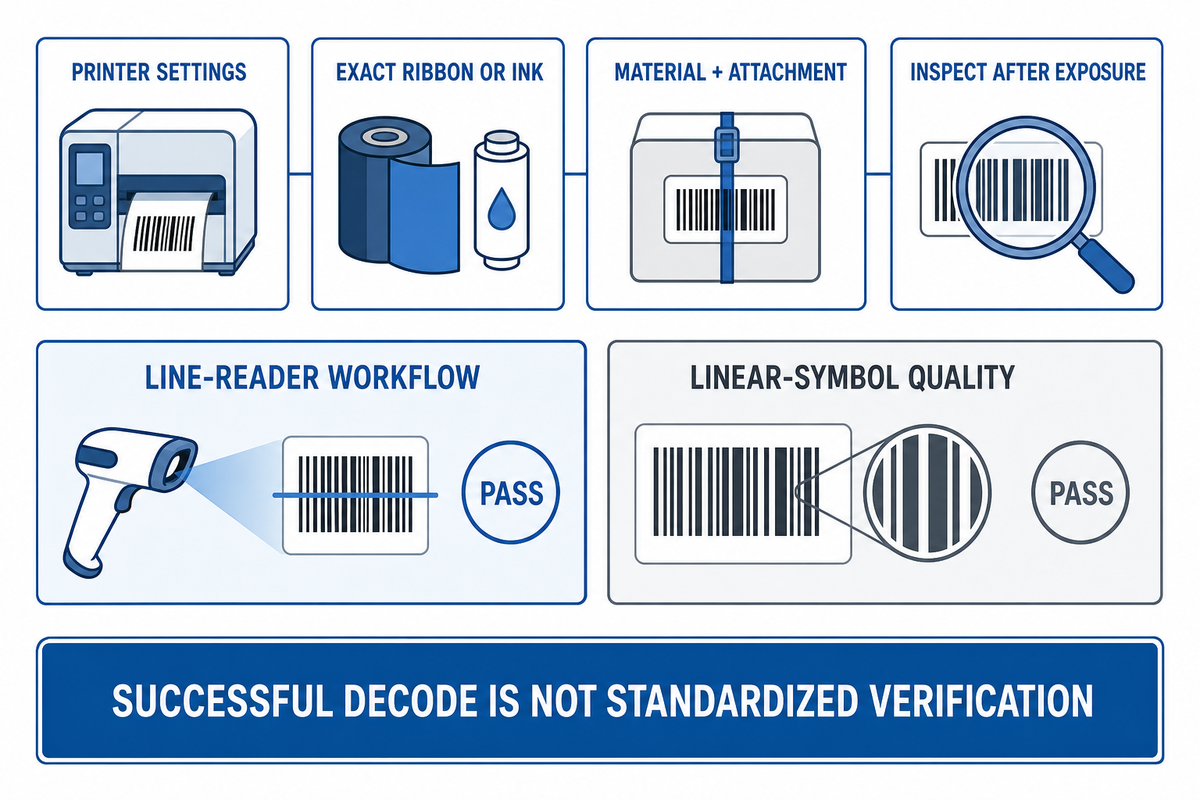
Qualify the printed image with the selected label material and attachment. Thermal transfer, inkjet and other printing methods have different compatibility requirements. Record the printer settings and exact ribbon or ink, then inspect and read the finished sample after exposure. A clean print at installation is only the starting condition. Product identification fails when the printed labels lose the information needed at the next operation, even if their base material remains intact.
B-423, for example, is a glossy white polyester material with permanent acrylic adhesive. The datasheet specifies a 0.002-inch film and 0.001-inch adhesive layer, excluding the liner, and names compatible Brady ribbons. These details identify the tested construction. Substituting another thermal transfer ribbon changes the evidence question, even if the print initially looks identical.
Printer heat deserves attention too. DuPont doesn’t recommend ordinary dry-toner laser printing for Tyvek because it can melt the material. Its guidance recommends staying at or below 79°C under tension in printing or coating operations to avoid deformation. The reported 135°C melting point isn’t a safe printer setting.
Barcode acceptance requires distinguishing a successful decode from standardized symbol-quality verification. The reader trial used on the line checks the intended workflow. ISO/IEC 15416:2025 describes attribute measurements and an overall quality assessment for linear symbols. If the customer specifies a certain verification grade, confirm the method and limit; do not default to “our scanner read it.”
Equipment labels, wire and cable markers, and circuit board labels can all contain variable data, but their printing mechanisms and exposure differ. Suppliers of high-temperature labels for circuit board processing should identify the complete heating and cleaning cycle. When artwork, ribbon or coating changes, retain the old sample so the print team can review the specific changes.
Use an Exposure-to-Approval Record for the sample decision
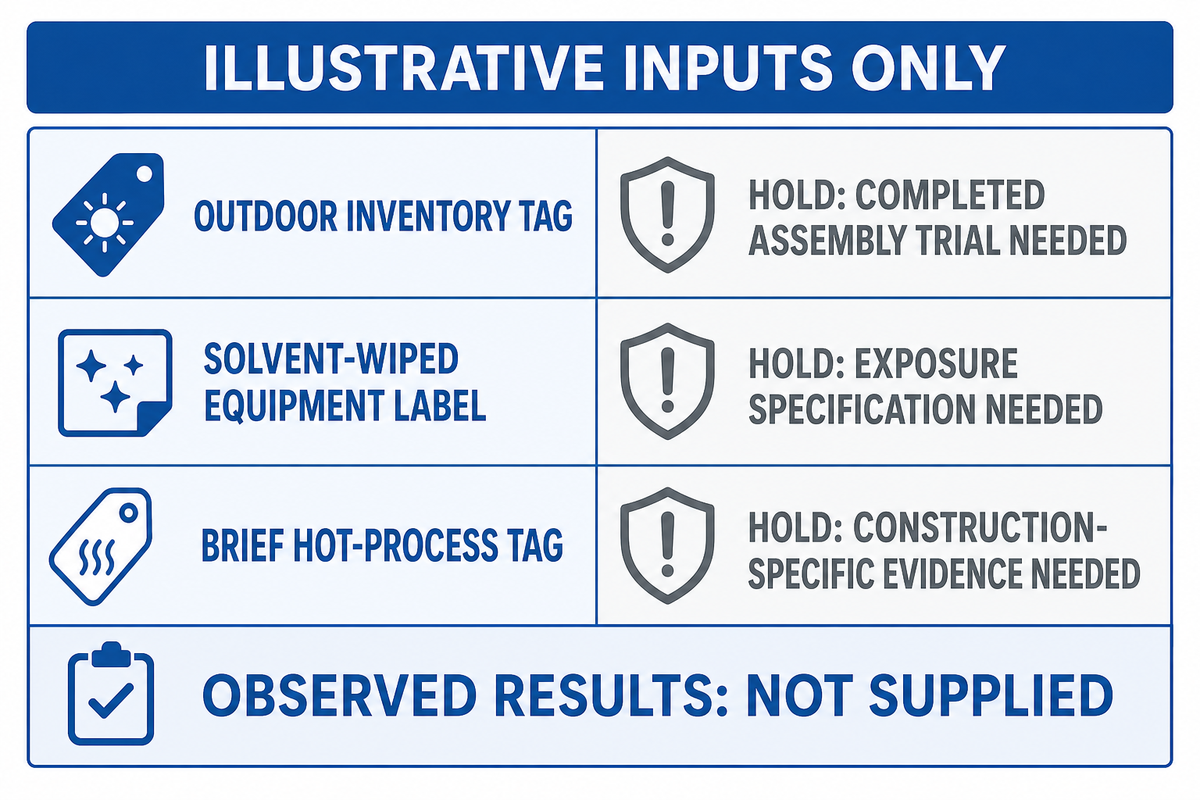
The Exposure-to-Approval Record makes missing evidence visible before a batch is approved. Fill it with the actual construction, service conditions and agreed acceptance criteria, then attach the measured results. The following three cases illustrate how to prepare that record; none contains a completed test or a recommendation to release material.
Illustrative inputs only: the outdoor case assumes six months of intended use. The hot-process case assumes a 180°C, five-minute process step. These are hypothetical buyer requirements, not proven service limits. The solvent-wipe case specifically leaves cleaner concentration unstated, because that omission prevents a comparison.
| Trường hợp | Outdoor inventory tag | Solvent-wiped equipment label | Brief hot-process tag |
|---|---|---|---|
| Purpose | Identify a stored component outdoors | Keep asset text readable after cleaning | Retain identity through the hot step |
| Candidate | Supplier-specified synthetic tag grade; final code pending | Specified polyester, adhesive and ribbon combination; code pending | Specialized high-temperature construction; grade pending |
| Attachment | Punched tag and intended tie on the actual component | Bond to the actual coated equipment surface | Intended tag opening and heat-compatible fixing; evidence pending |
| Phơi nhiễm | Six-month target; sun, rain and handling conditions to document | Named plant cleaner; concentration and wipe schedule still missing | Assumed 180°C for five minutes; subsequent process conditions to document |
| Combined conditions | Wet handling with the tie installed; sustained load to define | Cleaning at operating surface temperature; bonding dwell to define | Heating with the actual fixing, followed by any cleaning or handling |
| Print record | Printer, ribbon and artwork revision required | Printer, ribbon, label surface and artwork revision required | Marking process and artwork revision required |
| Pass criteria | Agree retained attachment, deformation and readable-image limits | Agree adhesion, image condition and any barcode-grade requirement | Agree dimensional, fixing and readable-image limits |
| Observed results | Not supplied | Not supplied | Not supplied |
| Decision and owner | Hold: quality team needs the completed assembly trial | Hold: technical evaluator first needs the exposure specification | Hold: process owner needs construction-specific evidence |
Use a hold that names the next action. It prevents procurement from treating a sample request as technical approval. Assign an owner and a date to each missing item. Add the test report when it becomes available. Separate the actual results from the acceptance criteria to prevent either from being rewritten to justify the acceptance of the sample.
In the bonded example, ASTM D6252/D6252M-98(2025) provides a 90-degree peel method for pressure-sensitive label stocks and discusses use with agreed acceptance criteria. It does not test a hanging tag’s slot or tie. The more general hướng dẫn tiêu chuẩn kiểm tra độ bền nhãn helps the reader distinguish method selection from a pass for the product.
Order the same construction that was evaluated
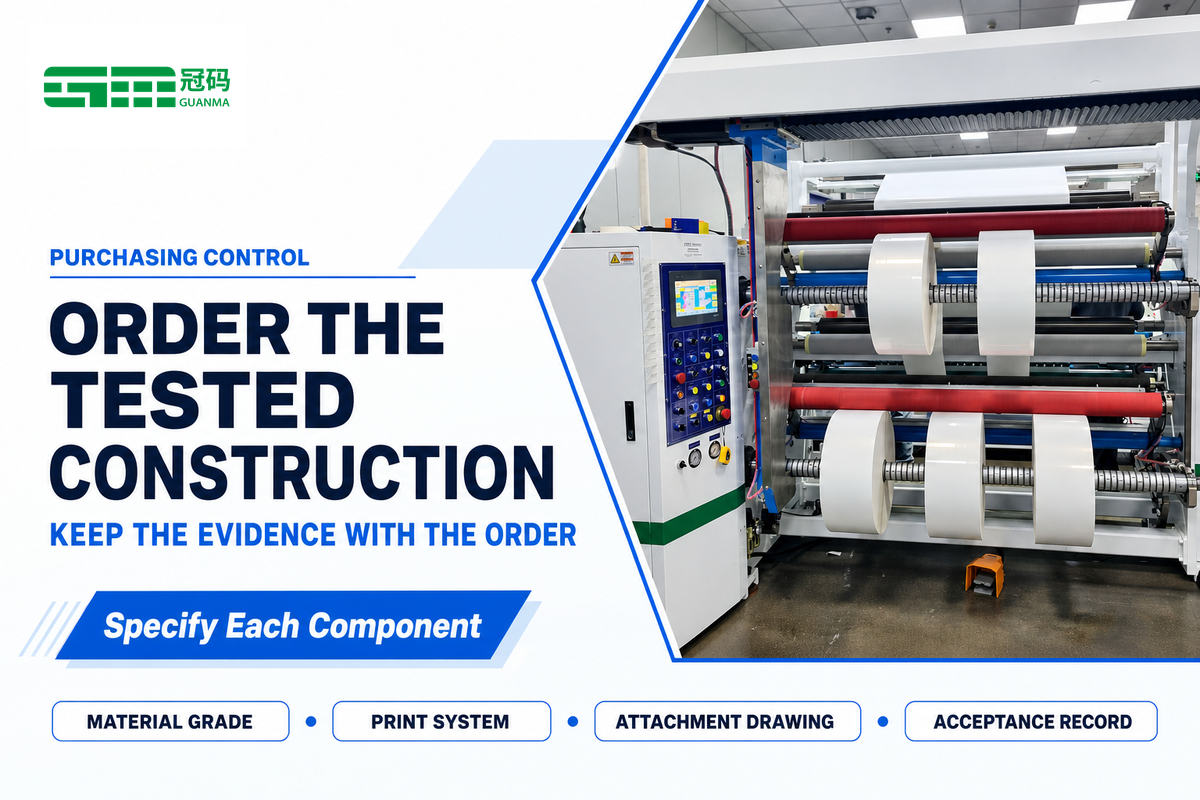
Label material specifications in a purchasing brief should identify the tested construction closely enough that a replacement order can reproduce it. Keep material grade and thickness, the print system, the attachment drawing, and the acceptance record as a set. Ask the supplier to disclose substitutions before shipment so the technical evaluator can decide which evidence needs to be renewed.
In industrial applications, the specification for labeling also requires reproducibility. The quote for “durable materials” is incomplete. Please include the facestock name, any overlaminate, label adhesive where relevant, and the hanging tag fastener. Provide the finished size and a hole drawing. Attach the approved artwork and indicate which amendments require review. A resin ribbon, an adhesive, or a metal grade is a component with an identity, not an interchangeable adjective.
Recognition also demands an appropriate scope. The public listing for UL 969 Edition 6, revised July 28, 2025, includes mechanically affixed labels. Certain flag labels, flag tags and related products on electrical flexible cords or fluid-carrying hoses are instead covered by UL 969A. Identify the actual end-product conditions; neither a generic UL reference nor a sample record alone establishes acceptance. Where safety labels carry required safety information, confirm the end-product requirements with the responsible specialist before release. This material-selection record doesn’t determine the necessary message or legal classification.
When sourcing adhesive film, send Guanma the exposure record and required construction details through its self-adhesive film material page. Require documented alternatives for the bonded-film route. The competing grades and patent discussed here are examples of evidence, not claims that Guanma supplies those products or holds their recognition.
Industry Outlook: recheck changed and recycled-content grades
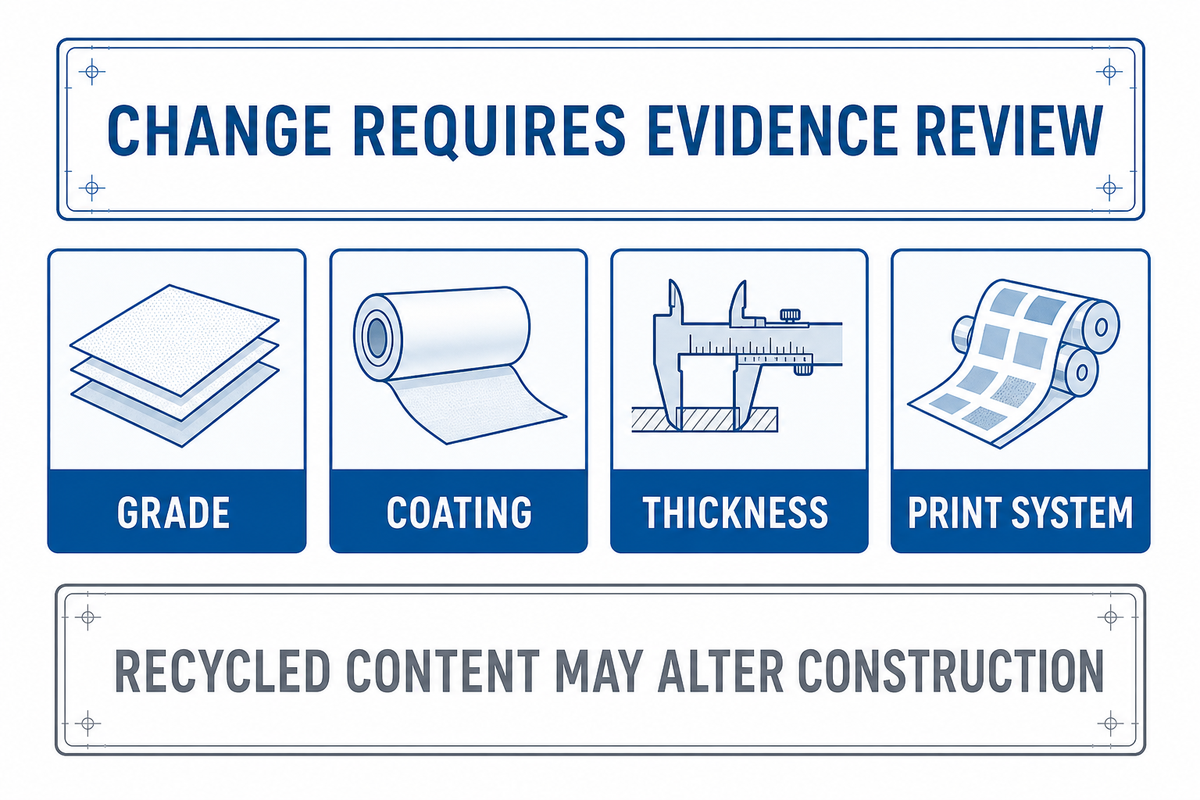
Regard a change of grade of material, while keeping the same family of polymers, as a reason to review the evidence. Recycled content, a thinner facestock, or a different coating may alter the specified construction. Compare the new documentation and converted sample with the version that was evaluated before accepting a substitute.
A case in point is a real example. In its September 4, 2025 announcement, Avery Dennison described PET labels containing chemically recycled content for durable goods. The announcement relates to Avery Dennison. It does not demonstrate that an unspecified equivalent has the same performance, or that Guanma has a comparable construction.
Find out which part has changed, and which results may be retained. Place the new specification next to the retained original sample. If the supplier has no matching finished-construction evidence, return the relevant fields to the evaluator. The outcome is to make a justified choice based on the available evidence.
During a September 2026 purchasing review, separate a new product announcement from evidence for the exact grade on the quotation. The launch date establishes when a supplier described an option; it does not establish your exposure limit. Procurement can request the exact grade and recycled-content documentation while the quality team checks the evidence for the finished construction. Neither task substitutes for the other.
The ways substitution is evident in industrial applications may vary. For example, printed identifications on industrial processing equipment may be subjected to cleaning and handling that a retained, unused sample won’t. When comparing revisions, ensure that they are in the same relevant industrial applications, with the same print and attachment detail. If a new supplier report uses a different surface or a different duration, indicate that to the evaluator rather than merging the results into a single apparent history.
The price objection is “The polymer name and recycled-content claim match.” Determine if the grade, coating, thickness, and print system of the assessed item are also the same. Once procurement defines the differences, finance can compare the quoted prices when quality determines if new evidence is needed. There is no evidence of a cost saving or a universal requalification interval in this case.
Những câu hỏi thường gặp
What is the most durable label material?
Read answer
No material is the most durable in every application. Metal, polyester and other synthetic constructions can be useful candidates, but the marking method, attachment and exposure decide suitability. For a hanging tag, include the hole and fastener in the evaluation. For an adhesive label, include the actual surface and adhesive. Compare results for the exact construction rather than rank family names.
What stickers can withstand heat?
Read answer
Specific polyester and polyimide label constructions can be candidates for heat exposure. Check the supplier grade, temperature, duration, printed image and adhesive together. Brady B-423 illustrates why time matters: its published five-minute high-temperature observations are distinct from its 30-day observations. A sticker that survives a short process step hasn’t thereby demonstrated continuous use at that temperature or survival through later cleaning.
Which label maker makes heat-resistant labels?
Read answer
Choose the compatible label construction before choosing a label maker. Ask the material supplier to identify the printer or printing process and the approved ribbon or ink, then evaluate the printed sample under the intended heat cycle. The printer brand alone can’t establish durability. Some synthetic materials are unsuitable for ordinary laser printing, so a machine that prints paper labels may be the wrong choice.
What are non-hazardous labels?
Read answer
“Non-hazardous” describes a message or use category. It doesn’t specify the label’s resistance to heat, water or handling.
Why might a tear-resistant tag split at its fixing hole?
Read answer
A tear-resistance description may refer to sheet material rather than the converted opening and installed fastener. Examine the hole geometry, nearby edge, reinforcement and load. Include sustained tension and the actual exposure sequence where relevant. A split requires diagnosis of that construction; it doesn’t prove that every tag made from the same polymer will fail in the same way.
Related articles
For material-layer terminology, see what facestock means in a label construction. For cold use, compare freezer-resistant and freezer-proof label claims.
Tài liệu tham khảo & Nguồn
- PFFC: Five Label Material Must-Haves for Market Growth, Diane Merzbach, January 2026; supplier-authored technical viewpoint.
- ASTM D2990-17(2025): public creep and creep-rupture scope.
- ASTM D543-21: public guidance on plastics and chemical reagents.
- ISO/IEC 15416:2025: public abstract on linear barcode print quality.
- ASTM D6252/D6252M-98(2025): public 90-degree label-stock peel scope.
- UL 969, Edition 6: current public scope and July 2025 revision listing.
- US6267152B1: historical patent disclosure, not a current product approval.
Supplier-specific figures are linked beside the relevant discussion. Public standard summaries were reviewed on September 8, 2026; full test procedures and product acceptance requirements must be obtained for the intended evaluation.