Ponte en contacto con Guanma

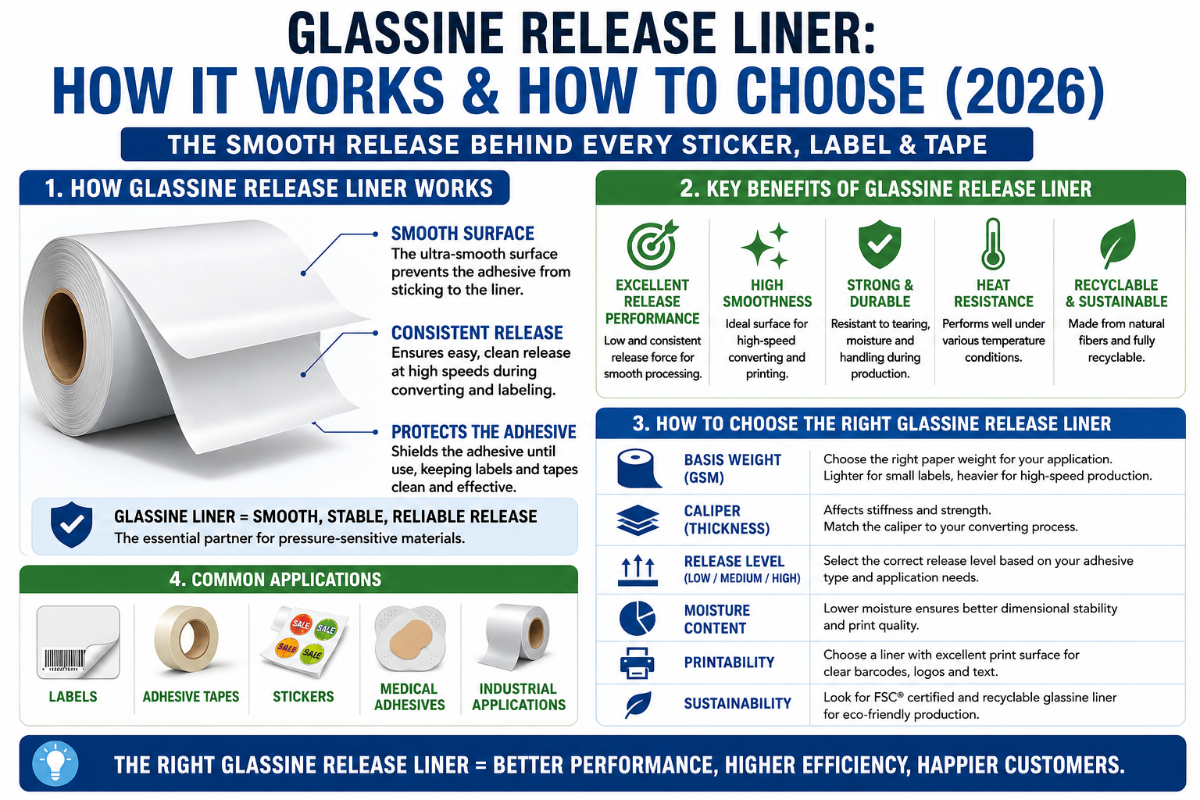
A forro antiadherente Glassine Es el soporte liso y semitranslúcido que sostiene una etiqueta o cinta sensible a la presión hasta el momento en que la despega. Parece una humilde hoja de respaldo, pero la elección entre glassine y las alternativas decide si sus etiquetas se troquelan limpiamente, se dispensan a velocidad de línea y sobreviven a un almacén húmedo. Esta guía explica cómo funciona realmente el material, cómo leer su hoja de especificaciones y cuándo es la llamada correcta escrita desde el punto de vista de los materiales en lugar de un argumento de venta. Si ya sabe que el glassine es lo que necesita y desea, calificaciones, precios y plazos de entrega, consulte nuestro forro antiadherente Glassine página del producto en su lugar.
Especificaciones rápidas « Referencia típica de la industria (no una sola especificación de producto)
| Sustrato | Papel de pulpa química (glassine) súper calandrado y sin relleno |
| Peso base | ~50-80 g/m² estándar (especialidad 35-120 g/m²) |
| Calibrador | ~35-75 µm |
| Recubrimiento de liberación | Silicona (curado sin disolvente/disolvente/emulsión); peso de la capa ~1 g/m² |
| Fuerza de liberación | ~5-30 g/pulgada (depende de la velocidad de pelado) |
| Transparencia | Alto / translúcido « ayuda a la detección y el registro web |
| Usos comunes | Etiquetas PS, cintas, adhesivos médicos, artes gráficas |
Qué es realmente un liner de liberación de glassine (y qué no es)
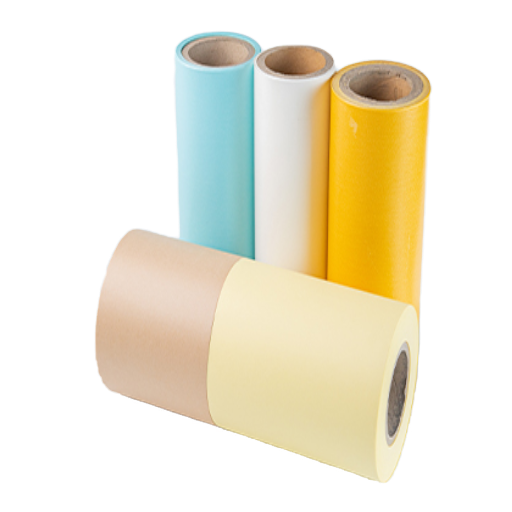
Glassine es un papel denso, liso y semitranslúcido elaborado a partir de pulpa química virgen refinada y acabado mediante prensado repetido supercalandrado entre rollos pulidos y calientes (la ruta de fabricación de glassine se detalla en patentes como US 9.587.355). Esta compactación le confiere una superficie cerrada de baja porosidad y una densidad de 1.040-1.120 kg/m³. Un revestimiento antiadherente de vidrio es ese papel base, normalmente de 50-80 g/m² y 35-75 µm de espesor, después de haber sido recubierto con una fina capa (aproximadamente 1 µm) de silicona curada, lo que proporciona una superficie antiadherente para que se pueda laminar un adhesivo y luego despegar limpiamente. Como sustrato para revestimientos antiadherentes, el vidrio combina esa superficie antiadherente con suficiente resistencia para funcionar en una prensa.
La terminología hace tropezar a la gente aquí, por lo que vale la pena ser precisa. “glassine” nombra el sustrato base; “papel de silicona” describe la misma hoja después del recubrimiento; y tampoco es lo mismo que el papel encerado de cocina o el pergamino para hornear, que no están diseñados para una liberación controlada y repetible de adhesivos sensibles a la presión. Hacer bien esta distinción ahorra mucha confusión al leer hojas de datos.
¿qué es el papel antiadherente de cristal?
El papel antiadherente Glassine es una lámina de vidrio supercalandrada recubierta con silicona en uno o ambos lados para que un adhesivo sensible a la presión se adhiera ligeramente, permanezca colocado durante la conversión y el almacenamiento y luego se libere con una fuerza predecible. Debido a que la superficie es tan lisa y translúcida, se prefiere donde el troquelado limpio y la inspección óptica de la red importan etiquetas, cintas y adhesivos médicos. La translucidez también permite a los convertidores utilizar sensores transparentes para rastrear la red a través de una prensa.
Cómo se diseña el efecto de liberación: supercalandrado y curado de silicona
Dos procesos hacen el verdadero trabajo. Primero, el supercalandrado (el acabado supercalandrado) cierra la superficie del papel para que absorba muy poca silicona. Los papeles densos como el vidrio se usan específicamente para minimizar la cantidad de silicona necesaria para alcanzar la liberación objetivo. Un papel más abierto absorbería el recubrimiento y lo desperdiciaría. En segundo lugar, se aplica y cura un sistema de silicona líquida, los sistemas sin disolventes normalmente curan a aproximadamente 120-150°C y pueden funcionar a velocidades de línea de 600 m/min o más, en una película de baja energía superficial de aproximadamente una micra (aproximadamente 1 g/m²) de espesor. Esa película es lo que el adhesivo no puede agarrar con fuerza, por lo que deja ir «el comportamiento de liberación fácil y confiable que define un buen rendimiento de liberación en la producción real.
La silicona se aplica a través de una de tres químicas: sin solventes (la predeterminada moderna, curada con calor y un catalizador de platino), a base de solvente o emulsión a base de agua. Un papel base debe ser químicamente compatible con la silicona, por lo que el recubrimiento se ancla en lugar de frotarse; La glassina generalmente tiene un acabado con alcohol polivinílico (PVA), lo que brinda un mejor anclaje de silicona a largo plazo que el acabado de almidón utilizado en el papel kraft súper calandrado. El reciente desarrollo de recubrimientos empuja el curado a velocidades de línea más altas con cargas de catalizador más bajas y temperaturas de horno más bajas, según patentes como USPTO US 9.212.299.
📐 Nota de ingeniería
La fuerza de liberación no es un número único: depende de la velocidad de pelado y se mide en condiciones especificadas mediante ensayos como FINAT FTM 3, 4 y 10, o procedimientos de adhesión por pelado ASTM D3330. Un liner especificado como “10-15 g/inch” se comporta así solo a la velocidad de ensayo; si se tira más rápido, la fuerza de liberación aumenta. Igual de crítica es la transferencia de silicona: cuando los ingenieros hablan de migración de silicona, explican que la silicona con movilidad molecular se transfiere gradualmente al adhesivo con el tiempo y lo contamina. Los ensayos ASTM y TAPPI también consideran la energía superficial y la transferencia para tener en cuenta este fenómeno.
Lectura de una hoja de especificaciones del revestimiento Glassine: GSM, calibrador, fuerza de liberación y transparencia

La mayoría de las hojas de datos de revestimiento de vidrio enumeran los mismos números. Saber lo que controla cada uno «y lo que intercambia « le permite comparar la calidad de cualquier proveedor según sus méritos. Detrás de todas ellas se encuentran dos cualidades: la estabilidad dimensional del papel (no debe desplazarse bajo presión de troquelado o el registro se desplazará) y la consistencia de su revestimiento de silicona.
| Parámetro | Rango típico | Qué controla/compensación |
|---|---|---|
| Peso base | 40-80 g/m² | Rigidez y resistencia a la tracción. Un encendedor ahorra carga pero se curva más fácilmente. |
| Calibrador | 35-75 µm (aproximadamente 1,4-3,0 mil) | Debe ser muy consistente “la variación del calibrador causa problemas de troquelado y de extracción de matriz. |
| Fuerza de liberación | 5-30 g/pulgada (aproximadamente 2-12 N/m) | Demasiado bajo y las etiquetas se levantan prematuramente; demasiado alto y mermeladas dispensadoras. Combina con el adhesivo. |
| Peso de la capa de silicona | ~0,8-1,8 g/m² | Suficiente para una película completamente cerrada; Más silicona cuesta sin beneficio en vidrio denso. |
| Transparencia | Alto (translúcido) | Una mayor transmisión de luz ayuda a los sensores ópticos; Los valores exactos varían según el grado y deben confirmarse en la hoja de datos. |
| Lados de revestimiento | S1S sau S2S | Un lado para etiquetas estándar; dos lados para cintas de transferencia y versiones de liberación diferencial. |
¿qué es un revestimiento de cristal?
En las charlas de taller, un “revestimiento de vidrio” es solo el revestimiento antiadhesivo de papel siliconado en un rollo de material autoadhesivo, para controlar la liberación de adhesivos hasta su uso. De hecho, cuando elige uno, en realidad está eligiendo cuatro factores separados: el peso del papel, su tratamiento de silicona y el peso de la capa, la fuerza de tracción prevista contra su adhesivo y si es de una sola cara (S1S) o de doble cara (S2S). Para ver cómo esas opciones se asignan a grados reales, nuestro selector de grado Glassine los coloca uno al lado del otro.
Glassine frente a CCK, SCK y PET Film: un cuadro de mando de línea objetiva
Glassine es una de las cuatro familias de sustratos que pesará, y la comparación honesta incluye dónde pierde Glassine, no solo dónde gana. Este cuadro de mando Glassine-vs-Kraft-vs-Film Liner resume las ventajas prácticas que realmente sienten los convertidores en la prensa, desde revestimientos cotidianos rentables hasta películas de alto rendimiento para trabajos exigentes.
| Propiedad por tipo de revestimiento | Glassine | SCK kraft | CCK (recubierto de arcilla) | Película de PET |
|---|---|---|---|---|
| Transparencia | Alto (translúcido) | Bajo (opaco) | Bajo (opaco) | Claro |
| Suavidad superficial | Muy alto | Alto | Alto (recubierto) | Muy alto |
| Precisión troquelada de alta velocidad | Bueno a velocidad moderada | Bueno, estable | Menos consistente (el recubrimiento puede agrietarse) | Excelente |
| Humedad / reposo plano | Propenso a enrollarse con la humedad | Mejor rigidez | Moderado; más polvo cortante | No afectado |
| Tolerancia a la temperatura | Limitado (~80°C) | Limitado (~80°C) | Limitado (~90°C) | Alto (150°C+) |
| Reciclabilidad del flujo de papel | Da (EN 13430) | Sí | Sí | No (corriente de plástico) |
| Acabado superficial | PVA | Almidón | Abrigo de arcilla | Ninguno |
| Costo relativo | Más alto | Inferior (estándar estadounidense) | Moderado | Más alto |
| Mejor ajuste | Inspección óptica, troquelado fino, médica | Etiquetas generales de gran volumen | Troquelado pesado/multicapa | Alta temperatura, electrónica, automoción |
SCK es estándar para EE. UU., o se puede decir que es estándar para NA. Por otro lado, el revestimiento de vidrio se considera estándar en Europa. A diferencia de SCK y PCK, el revestimiento que se encuentra en CCK produce más residuos después de la operación de corte y puede agrietarse en troquelado complejo, por lo que está reservado para trabajos más pesados. Ver nuestro Papel de liberación CCK página para esa familia, o la completa gama de forro de liberación.
Forro coincidente con la aplicación: etiquetas, cintas, artes médicas y gráficas
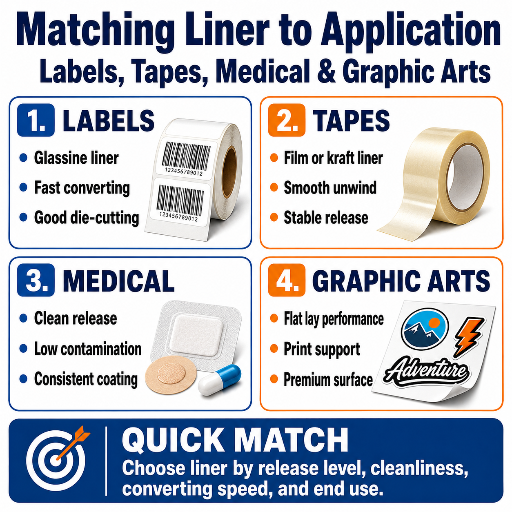
Cada trabajo presenta una oportunidad para el rendimiento del revestimiento en una prensa determinada, por lo que el primer paso para identificar un revestimiento óptimo es realizar ingeniería inversa en estas necesidades para documentar las especificaciones.
- ✔Etiquetas sensibles a la presión: necesita una liberación constante a velocidad de dispensación y un troquelado limpio; La suavidad y translucidez del cristalino se adaptan a la inspección de la red óptica en aplicaciones rollo a rollo y procesos de fabricación de alta velocidad.
- ✔Cintas industriales y de doble cara: a menudo se utilizan revestimientos siliconados de doble cara (S2S) con liberación diferencial para que la cinta se desenrolle y se transfiera correctamente.
- ✔Adhesivos médicos: los parches transdérmicos, apósitos para heridas, electrodos y dispositivos portátiles dependen de la limpieza y la liberación repetible. Estos son sensible al cumplimiento «vea la nota a continuación.
- ✔Artes gráficas: la superficie lisa permite un troquelado impecable de gráficos y calcomanías de vinilo; Las piezas ligeras troqueladas se adaptan al vidrio, mientras que los trabajos multicapa o de alta resistencia «o trabajos que necesitan resistencia adicional a la humedad « pueden necesitar PCK o película.
Un escenario visual: una impresora para etiquetas farmacéuticas correr a alta velocidad prefiere el cristalino para su pinza compacta, sabiendo que puede mantener un corte limpio sin romperse durante horas; En el mismo taller, un fabricante de etiquetas para congeladores considera que el rizo es una preocupación más apremiante a medida que la humedad relativa disminuye y fluye en la sala de impresión. Cualquiera que sea el revestimiento con mejor rendimiento, es el que se adapta a la operación de la prensa y al clima ambiental, no el que tiene el atributo más fuerte. Nuestro etiquetas de envases de alimentos guide profundiza en esa aplicación.
⚠¦ Importante: el uso alimentario y médico está impulsado por el cumplimiento
“A prueba de alimentos” no es intrínseco al material del revestimiento. La elegibilidad para el contacto con alimentos para la construcción de etiquetas o cintas requiere una revisión de cada elemento que probablemente migre, mientras que las reglas estadounidenses como 21 CFR 175.125 aplicar sólo bajo condiciones prescritas. Para cualquier aplicación médica o alimentaria, trate las preocupaciones de cumplimiento normativo como pertenecientes a todo el sistema [adhesivo] y obtenga autorización por escrito para la construcción real en uso.
Habiendo experimentado de primera mano reunir facestocks, adhesivos y revestimientos bajo un mismo techo como convertidor de etiquetas, reconocemos que la elección del revestimiento a menudo no se debe a fallas inherentes al revestimiento en sí sino a su combinación con el adhesivo. Un revestimiento que se desprende limpiamente de un acrílico removible compatible con adhesivos puede adherirse demasiado fuertemente a un fuerte termofusible, razón por la cual evaluamos los revestimientos en conjunto con adhesivos reales.
La paradoja del Glassine: por qué se rechaza un revestimiento “mejor”
Considere este fenómeno aparentemente paradójico antes de especificar sus materiales. Basado en una mayoría de cualidades físicas (incluido un calibre significativamente más bajo, superficies más suaves y mayor transparencia), el vidrio a menudo tiene una clara ventaja técnica. A pesar de esto, muchos fabricantes en el mercado norteamericano lo evitan por completo. A esto lo llamamos la paradoja de Glassine: una cuestión impulsada comercialmente y arraigada en consideraciones prácticas más que en deficiencias técnicas.
“Nuestro principal obstáculo es invariablemente: ‘Tendré que reemplazar todos mis equipos’. Para un convertidor de etiquetas, las actualizaciones y modificaciones de la maquinaria para acomodar el glassine representan un esfuerzo considerable medido en muchos meses, incluso años, y fácilmente pueden llegar a millones; por lo tanto, cuando SCK funciona tan bien como lo hace, ¿por qué molestarse en pagar una prima por el glassine?”
En apoyo de esta paradoja hay varios factores: los comentarios dentro de la industria convertidora estiman que el glassine cuesta aproximadamente 20% más por unidad que SCK; La producción norteamericana de glassine es relativamente baja “Ahlstrom-Munksj se encuentra entre los pocos fabricantes que lo producen a nivel regional y dentro de la industria se estima que produce aproximadamente 70.000 toneladas por año de glassine y SCK combinados, y para los convertidores que hacen la transición desde SCK, la película de poliéster se selecciona más comúnmente que el glassine. Ninguno de estos puntos desacredita a la glassine como material, pero resaltan que ”lo mejor en teoría“ no siempre equivale a ”lo mejor para su entorno operativo”
¿cuáles son las desventajas del papel glassine?
Los inconvenientes físicos fundamentales de Glassine residen en su construcción. Si bien es más denso, el glassine es más flexible y flexible. Cuando el nivel de humedad cambia, su mayor susceptibilidad a la inestabilidad dimensional provoca problemas de rizado y dificulta un rebobinado suave y plano en la prensa. Como sustrato de papel, es inherentemente menos resistente a la humedad y al desgarro que el PET, y funciona mejor a velocidades modestas en comparación con velocidades operativas más altas. También tiene el mayor coste de las tres opciones principales de papel debido a la humectación adicional y la recalandración que requiere su fabricación, a diferencia de SCK, cuyo proceso de menor coste es objeto de patentes como US 12.473.693. Si bien estas concesiones podrían ser aceptables para muchas aplicaciones, para un convertidor de etiquetas como el de alta velocidad que se ocupa de condiciones que involucran humedad fluctuante o calor elevado, estos compromisos podrían volverse problemáticos.
El método de 4 palancas para elegir un revestimiento Glassine
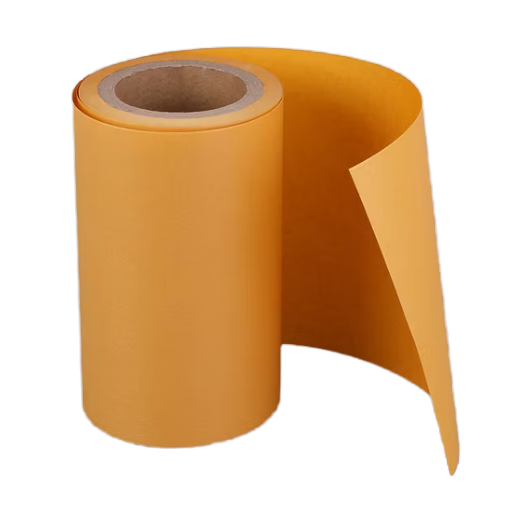
Elegir el revestimiento antiadherente adecuado en diferentes aplicaciones de revestimiento antiadherente es más fácil si, en lugar de memorizar grados, decide con cuatro palancas. Coloque cada uno en su trabajo y se caerá la especificación correcta.
El método de selección de revestimientos de 4 palancas
- Fuerza de liberación versus agresividad del adhesivo. Liberación de coincidencia con el adhesivo: liberación ligera para acrílicos removibles, más firme para termofusibles agresivos. La liberación no coincidente es la falla de dispensación más común.
- Dispensación y velocidad de línea. Las líneas más rápidas aumentan la fuerza de despegado efectiva; Si ejecuta aplicadores automáticos de alta velocidad, inclínese hacia un revestimiento más estable o valide a gran velocidad.
- Precisión troquelada y tira de matriz. Los cortes finos e intrincados necesitan un calibre ajustado y consistente; Si las roturas de la matriz ralentizan la línea, la consistencia del calibrador suele ser la culpable.
- Medio ambiente: humedad y temperatura. Las plantas húmedas y las cadenas de frío castigan el papel propenso a rizarse; La curación o el uso a altas temperaturas pueden empujarle a filmar.
Haga funcionar las cuatro palancas en orden y conocerá su peso base, configuración de capa y liberación objetivo antes de consultar el precio. Para convertir eso en una calificación real, nuestro selector de fuerza de liberación hace coincidir los valores de liberación con los tipos de adhesivos y el forro antiadherente Glassine page enumera las calificaciones en sí.
Sostenibilidad: ¿Se pueden reciclar los revestimientos de vidrio?
La respuesta honesta es “sí, con condiciones”. Un estudio de CELAB-Europe y CTP concluyó que tanto los revestimientos antiadherentes de silicona a base de glassine como CCK son reciclables según la norma EN13430, sin perjuicio del reciclaje de papel mixto en condiciones adecuadas. Esto refuta la creencia común de que el papel recubierto de silicona es automáticamente sólo para vertederos.
Sin embargo, la advertencia es real. La reciclabilidad como clasificación no es lo mismo que la recuperación limpia en una línea determinada. El Laboratorio de Productos Forestales de EE. UU. ha informado que las partículas residuales del revestimiento desprendible pueden reducir la resistencia y la calidad de impresión del papel reciclado; la detección y limpieza eliminan esas partículas de manera eficiente mientras que la flotación no lo hace, y las pulperas continuas pueden necesitar un tiempo de residencia más prolongado para desintegrar el revestimiento. En la práctica, la recuperación depende del equipo del molino y de la logística de recolección (en la brecha que la iniciativa CELAB de la industria está trabajando para cerrar, con el objetivo declarado de reciclar o reutilizar más de 75% de revestimiento y matriz usados en Europa). Las construcciones más nuevas también ayudan: diseños de revestimientos repulpables (por ejemplo WO 2018/057451) y están llegando al mercado grados siliconados de doble cara que siguen siendo reciclables en papel.
El lugar de la glassine en el mercado de liners de liberación (y hacia dónde se dirige)
El glassine sigue siendo el material de referencia. Los análisis del sector suelen situar al glassine y a otros papeles supercalandrados cerca del 36-38% de los sustratos de soporte antiadherente por superficie – del orden de 20,000 millones de metros cuadrados – y el glassine junto con el kraft supercalandrado representan aproximadamente la mitad de todos los soportes de la industria de etiquetas. Las empresas de investigación de mercado valoran el mercado general de soportes antiadherentes en cerca de USD 17 mil millones en 2025 y proyectan que se acerque a USD 25 mil millones para 2031, con una CAGR aproximada del 6%. Asia-Pacífico es la región más grande, con una cuota cercana al 42%, y la de crecimiento más rápido, próximo al 7% de CAGR (las estimaciones varían según la empresa y el alcance definido para el mercado).
Tres fuerzas están cambiando este panorama. Se están rediseñando revestimientos de papel para lograr una mayor resistencia de la fibra para mantener el suelo (consulte las patentes de sustratos recubiertos, como US 9.212.299), pero los revestimientos fílmicos (BO-PET, BOPP) están ganando terreno donde las secciones curan o corren por encima de la temperatura que el papel puede soportar “electrónica, automoción, cintas de batería y compuestos preimpregnados « y la película ya representa alrededor de 25% del mercado de revestimientos norteamericano. (PET ~14%, PE ~8%, PP ~4%). Los propietarios de marcas están pidiendo revestimientos de menor gramaje para reducir las emisiones de carga, lo que reduce el tonelaje de papel incluso cuando aumenta la demanda de área. Y las etiquetas sin revestimiento, que omiten por completo el revestimiento, son pequeñas pero aumentan rápidamente en logística y restaurantes de servicio rápido. Prácticamente, para el abastecimiento: si está asegurando un suministro de revestimiento para varios años, considere endurecer las regulaciones de reciclabilidad del papel (el PPWR de la UE guiará los requisitos de las etiquetas para 2030) frente a las especificaciones dimensionales y de temperatura que impulsan ciertas aplicaciones a filmarse.
Preguntas frecuentes

P: ¿Puedo usar papel pergamino en lugar de un revestimiento antiadherente de cristal?
Ver respuesta
No, no para trabajos sensibles a la presión. El pergamino para hornear es un papel tratado con silicona hecho para cocinar sin palos, no para la liberación controlada y repetible de un adhesivo con una fuerza definida. Un revestimiento antiadherente de vidrio está diseñado con un peso de capa de silicona específico y cura para que el adhesivo se desprenda de manera predecible y el revestimiento sobreviva a la conversión, troquelado y dispensación. El pergamino no le dará esa consistencia.
P: ¿Es un revestimiento antiadherente de cristal lo mismo que el papel de silicona?
Ver respuesta
Describen el mismo producto en diferentes etapas. “Glassine” es el sustrato base “el papel supercalandrado. ”Papel de silicona“ o ”papel antiadherente de silicona” describe esa hoja una vez recubierta con silicona curada. Entonces, un revestimiento antiadherente de glassine es un tipo de papel antiadherente de silicona; el término simplemente le indica que el papel base es glassine en lugar de kraft o film.
P: ¿Qué GSM es un revestimiento antiadherente de cristal típico?
Ver respuesta
La mayoría de los grados estándar oscilan entre 50 y 80 g/m², y los grados especiales abarcan aproximadamente entre 35 y 120 g/m². El peso básico controla la rigidez y la resistencia a la tracción: los revestimientos más pesados resisten el rizado y se dispensan de manera más confiable, mientras que los revestimientos más livianos reducen el costo de flete y las emisiones, pero son más propensos a rizarse. El peso correcto depende de su prensa, aplicador y entorno de almacenamiento.
P: ¿Es reciclable un revestimiento antiadherente de vidrio?
Ver respuesta
Sí, los revestimientos de vidrio están clasificados como reciclables según la norma EN 13430, aunque la recuperación limpia depende del proceso del molino y de la logística de recogida, más que del material solo.
P: ¿Cuál es la diferencia entre glassine y CCK o SCK liner?
Ver respuesta
Los tres son revestimientos de papel, pero están hechos y acabados de manera diferente. Glassine tiene un acabado súper calandrado y PVA, lo que brinda una alta transparencia y una superficie muy lisa y densa preferida para el troquelado fino y la inspección óptica. SCK (kraft supercalandrado) tiene un acabado de almidón, es más rígido y de menor costo «el estándar de volumen estadounidense. CCK (kraft recubierto de arcilla) utiliza un revestimiento de arcilla para mayor suavidad, pero produce más polvo cortante y puede agrietarse en troqueles complejos, por lo que se adapta a trabajos multicapa más pesados. Glassine generalmente cuesta la mayor parte de los tres debido a los pasos adicionales de remojado y recalandrado.
P: ¿Funciona el glassine para dispensar etiquetas a alta velocidad?
Ver respuesta
Puede, dentro de límites. Glassine dispensa bien a velocidades moderadas y su suavidad ayuda a limpiar el troquelado, pero a las velocidades de línea más altas su menor rigidez y sensibilidad al rizo pueden causar problemas de manejo de la banda y la fuerza de liberación efectiva aumenta con la velocidad de pelado. Para aplicaciones automáticas de muy alta velocidad, valide el grado específico a su velocidad de línea real o considere un revestimiento de película si las condiciones son exigentes.
Especifique su revestimiento antiadherente de cristal con confianza
Comparta su adhesivo, aplicación y velocidad de línea, y nuestro equipo de materiales le recomendará un grado « o haga las calcs usted mismo con nuestros selectores.
Acerca de esta guía
Esta guía ha sido escrita y revisada por el equipo de ingeniería de materiales de Guanma. Como fabricante de etiquetas autoadhesivas que en nuestras operaciones en Tailandia y Vietnam, en nuestras operaciones en Tailandia y Vietnam, probamos el comportamiento de las placas de liberación contra adhesivos reales y no de forma aislada, por lo que esta guía evalúa las compensaciones de la vidriera de forma más honesta que las demás.
Referencias y fuentes
- CELAB-Europe × CTP « Reciclabilidad de revestimientos antiadherentes de silicona (EN 13430) « CELAB-Europa
- Iniciativa de reciclaje de Release Liner & Matrix « FINAT
- Efecto de los residuos de la línea de liberación sobre el papel reciclado « Laboratorul de produse forestiere USDA
- 21 CFR Parte 175 « Adhesivos y componentes de revestimientos (175.125) « eCFR / FDA de EE. UU
- Papel de revestimiento de liberación de silicona reutilizable (WO 2018/057451) « USPTO / Patentes de Google
- Tecnología de revestimiento de liberación de silicona (Label Academy) « Etiquetas y etiquetado
Artículos relacionados
- Papel autoadhesivo: una guía de 2026 « cómo se combinan el material frontal, el adhesivo y el revestimiento
- Etiquetas impermeables: materiales y cómo funcionan
- Explicación de las etiquetas del congelador « consideraciones sobre el rizo del revestimiento y la cadena de frío
- Guía de materiales de etiquetas de vino
- Materiales de película autoadhesiva « facestocks y revestimientos cinematográficos