Entre em Contato com Guanma

Atualizado em agosto de 2026 · Um guia de interpretação de métodos para equipes de qualidade, engenharia e compras
Padrões de teste de durabilidade de etiquetas são procedimentos controlados para medir um comportamento especificado, como descascamento, cisalhamento, abrasão, mudança química ou intemperismo, sob condições declaradas. Eles não concedem um grau de“ universal ”durável. Evidências de grau de decisão emergem apenas quando o método, amostra, ambiente, limite de aceitação e relação de uso final são todos registrados.
Resposta curta: Um método de teste prova como uma construção de etiqueta especificada se comportou nesse teste. Ele não prova, por si só, a vida útil, a certificação ou o desempenho em cada substrato. A FINAT afirma que seus métodos não implicam uma especificação de desempenho; Os escopos ASTM limitam repetidamente as comparações com o procedimento e as condições declarados.
- Mais importante: “Testado para ASTM” nomeia um procedimento, não um resultado de aceitação.
- Os métodos FINAT são especialmente úteis para conversão de etiquetas e controle de qualidade do sistema adesivo.
- Os métodos ASTM geralmente respondem a questões materiais mais restritas e cada escopo afirma o que o resultado não pode estabelecer.
- Um comprador precisa de uma regra de aprovação/reprovação declarada mais validação de uso final antes de aprovar a construção de uma etiqueta.
Um método de teste é apenas o primeiro degrau da escada de prova
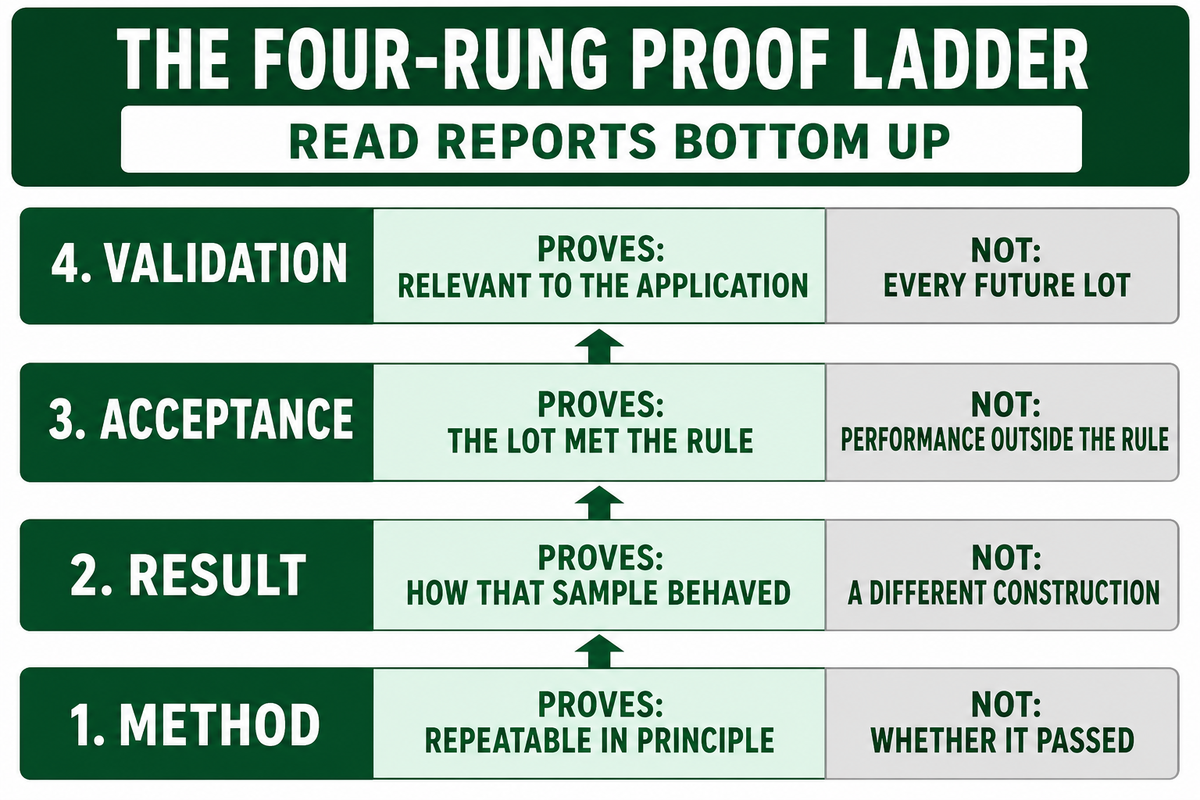
Um método de teste de rótulo controla como uma medição é feita, mas não decide se o resultado é aceitável Os compradores precisam de quatro camadas separadas: um método nomeado, o resultado medido, uma regra de aceitação pré-escrita e evidências de que a condição do laboratório representa a aplicação real Removendo qualquer degrau altera o que o relatório pode provar.
A FINAT torna a distinção explícita Métodos de teste página: FINAT fornece métodos padronizados, ainda os métodos e informações relacionadas não implicam em si uma especificação de desempenho Escopos ASTM individuais tomam a mesma abordagem cautelosa Um resultado pode ser preciso e ainda responder à pergunta errada.
| Rung | O que deve ser gravado | O que prova | O que não prova |
|---|---|---|---|
| 1. Método | Padrão, procedimento, aparelho, geometria do espécime | A medição era repetível em princípio | Se o resultado passou |
| 2. Resultado | Valor, unidades, variabilidade, modo de falha | Como aquela amostra se comportou | Se uma construção diferente se comporta da mesma forma |
| 3. Aceitação | Mínimo, máximo, alteração permitida, regra da amostra | Se o lote testado atendeu à regra do comprador | Desempenho a longo prazo fora da regra |
| 4. Validação | Superfície real, impressão, exposição, manuseio e duração | O resultado é relevante para a aplicação definida | Cada lote futuro ou um caso de uso diferente |
Considere dois fornecedores que relatam o peeling “ASTM.” O Fornecedor A nomeia o procedimento exato, painel, permanência, condicionamento, ângulo de descascamento, taxa, largura da amostra, média, alcance e modo de falha O Fornecedor B relata apenas um valor Mesmo que o número de B seja maior, A forneceu provas mais utilizáveis porque o teste pode ser reproduzido e comparado com um requisito escrito.
Métodos de teste FINAT: um mapa para desempenho de etiquetas e impressões
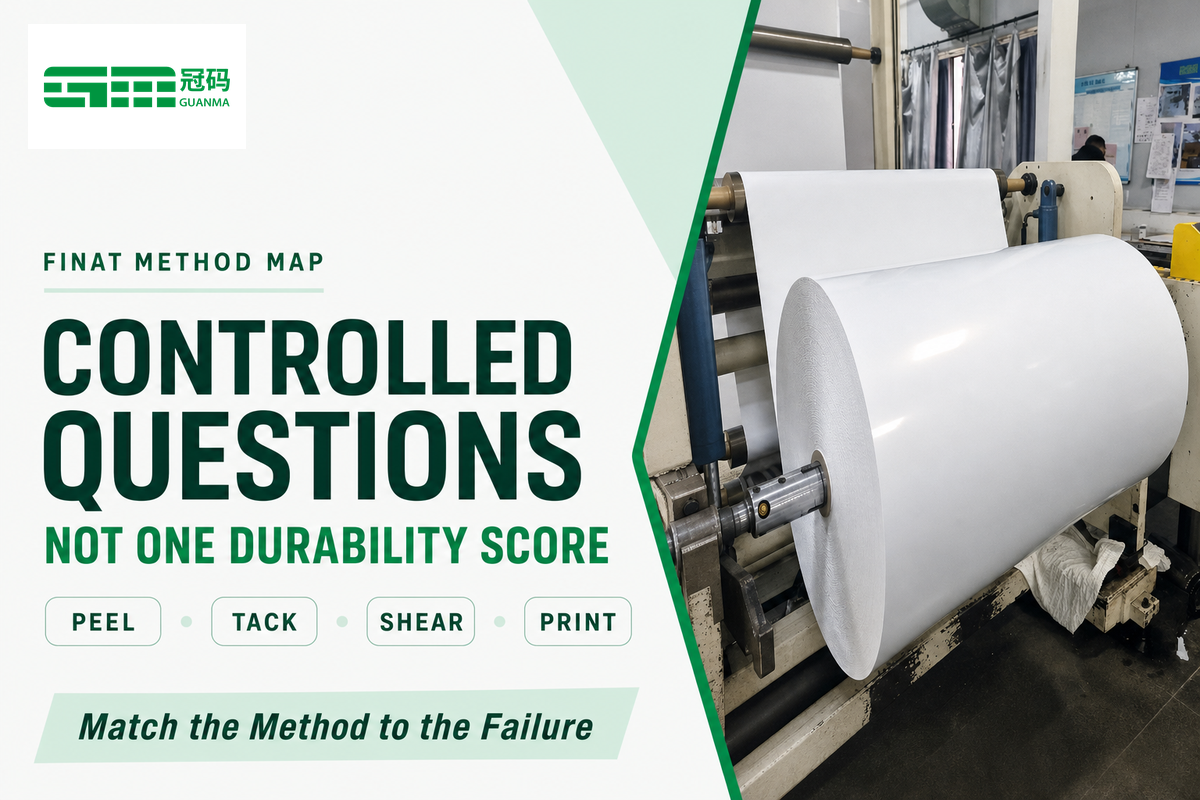
A atual coleção da 11a edição da FINAT lista 31 métodos para materiais de etiquetas autoadesivas Sua cobertura abrange comportamento adesivo, liberação, envelhecimento, exposição ultravioleta, alterações químicas e durabilidade da superfície de impressão. Cada método isola uma questão; nenhum método converte a construção completa do rótulo em uma reivindicação de vida útil de serviço universal.
Para o planejamento da qualidade, a abordagem útil é agrupar os métodos FINAT por modo de falha, Peel and tack ajudam a caracterizar a formação de ligação O cisalhamento mede a resistência ao movimento sob carga Os métodos de esfregar e arranhar a tinta abordam os danos na superfície de impressão Os métodos químicos e de envelhecimento avaliam a mudança após uma exposição controlada Essas famílias não devem ser colapsadas em uma pontuação de “durabilidade.”
| Método | Pergunta primária | Saída útil | Limite |
|---|---|---|---|
| FTM 1 | Descascamento de 180° a 300 mm/min | Força de descascamento sob essa geometria e taxa | Não é diretamente intercambiável com um resultado de 90° |
| FTM 2 | Descascamento de 90° a 300 mm/min | Força de descascamento com menor reversão de flexão | O ângulo ainda muda a mecânica |
| FTM 3 | Liberação em baixa velocidade | Força de liberação do revestimento na velocidade indicada | Não prevê conversão de alta velocidade por si só |
| FTM 4 | Liberação em alta velocidade | Comportamento de liberação sob separação mais rápida | A geometria e a aceleração da máquina ainda importam |
| FTM 5 | Envelhecimento acelerado | Alteração após uma exposição definida ao envelhecimento | Nenhuma conversão automática para anos de campo |
| FTM 6 | Exposição ultravioleta | Alteração sob a exposição declarada | O clima ao ar livre não é reduzido a um ciclo de lâmpada |
| FTM 8 | Resistência ao cisalhamento | Comportamento de retenção sob a carga do método | Não é um substituto para casca ou aderência |
| FTM 9 | Alça de laço | Pegada inicial sob uma geometria de loop | Não retenção de títulos de longo prazo |
| FTM 16/17 | Ponto químico/exposição de imersão | Alteração visível ou medida após o contato químico nomeado | Reagente, concentração, duração e temperatura permanecem decisivos |
| FTM 21/22/27/29 | Adesão da tinta, esfregue e arranhe | Resistência da impressão-superfície sob a ação nomeada | Não prova a retenção adesiva ou a leitura de código de barras após cada exposição |
Levantamento chave
Os métodos FINAT são um menu de perguntas controladas Selecione o método no modo de falha que você precisa evitar; não calcule a média dos resultados diferentes em um grau de durabilidade da etiqueta.
Métodos ASTM comprovam comportamentos materiais mais restritos
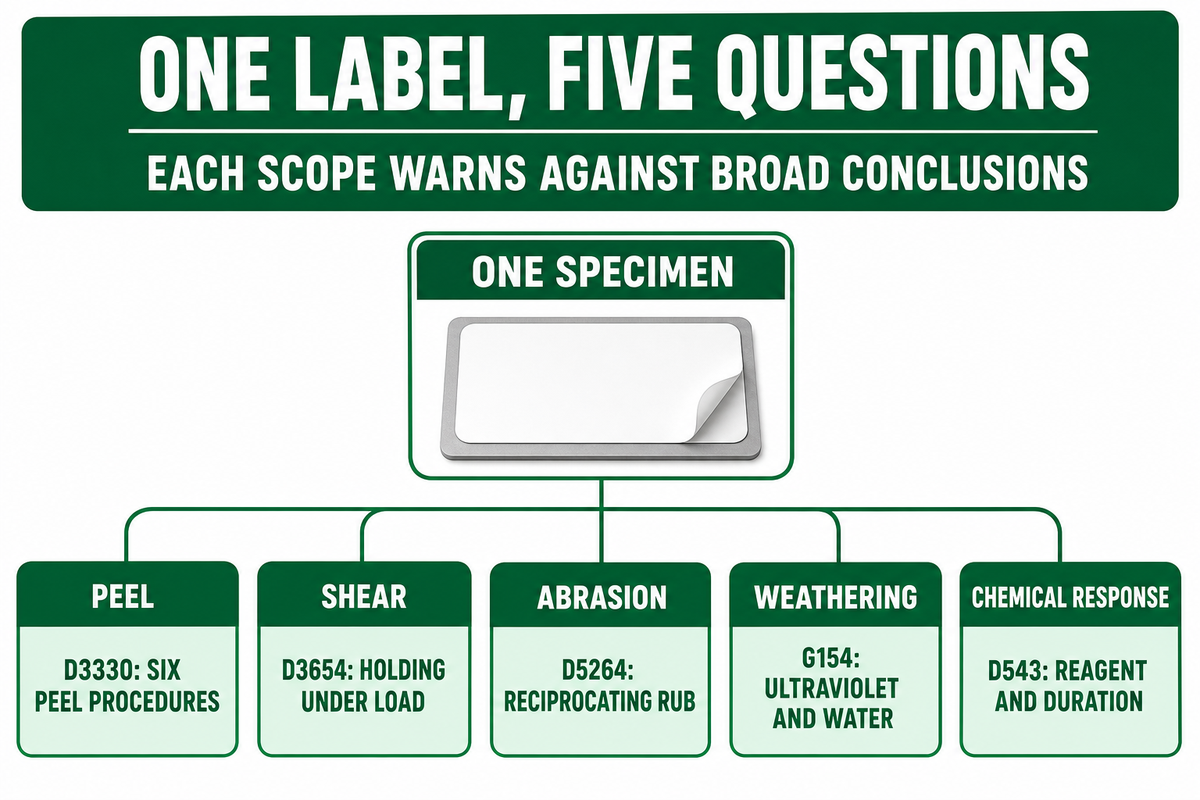
Procedimentos ASTM separados abordam descascamento, cisalhamento, abrasão, intemperismo e resposta química, mas seus escopos alertam repetidamente contra conclusões amplas D3330/D3330 M, por exemplo, suporta garantia de qualidade e testes de aceitação, ao mesmo tempo em que afirma que vários procedimentos não podem comparar universalmente fitas com diferentes suportes e reologia adesiva.
D3330/D3330M-04(2025) contém seis procedimentos de descascamento. D3654/D3654M-06(2024) measures holding under constant load parallel to the surface. Its scope also notes that results on standard steel may or may not relate to a different surface. A buyer comparing labelstocks therefore needs the actual application substrate, not only a steel-panel number.
For printed surfaces, ASTM D5264-98(2019) uses a reciprocating rub device to compare abrasion resistance. That method can rank print systems under the selected load and cycle count, but field damage also depends on handling, temperature, humidity, time, and contact material. Such a laboratory result is a controlled comparison, not a replica of every warehouse or transport route.
Weathering and chemical methods carry the same boundary. ASTM G154-23 is an ultraviolet and water exposure practice; the lamp, cycle, temperature, moisture, duration, and evaluation method must be reported. ASTM D543-21 makes reagent, concentration, stress, duration, temperature, and the measured property part of a chemical-resistance result.
Method controls the question. Acceptance criteria control pass or fail. End-use validation controls whether the answer is useful.
Why Two Peel Numbers May Not Be Comparable
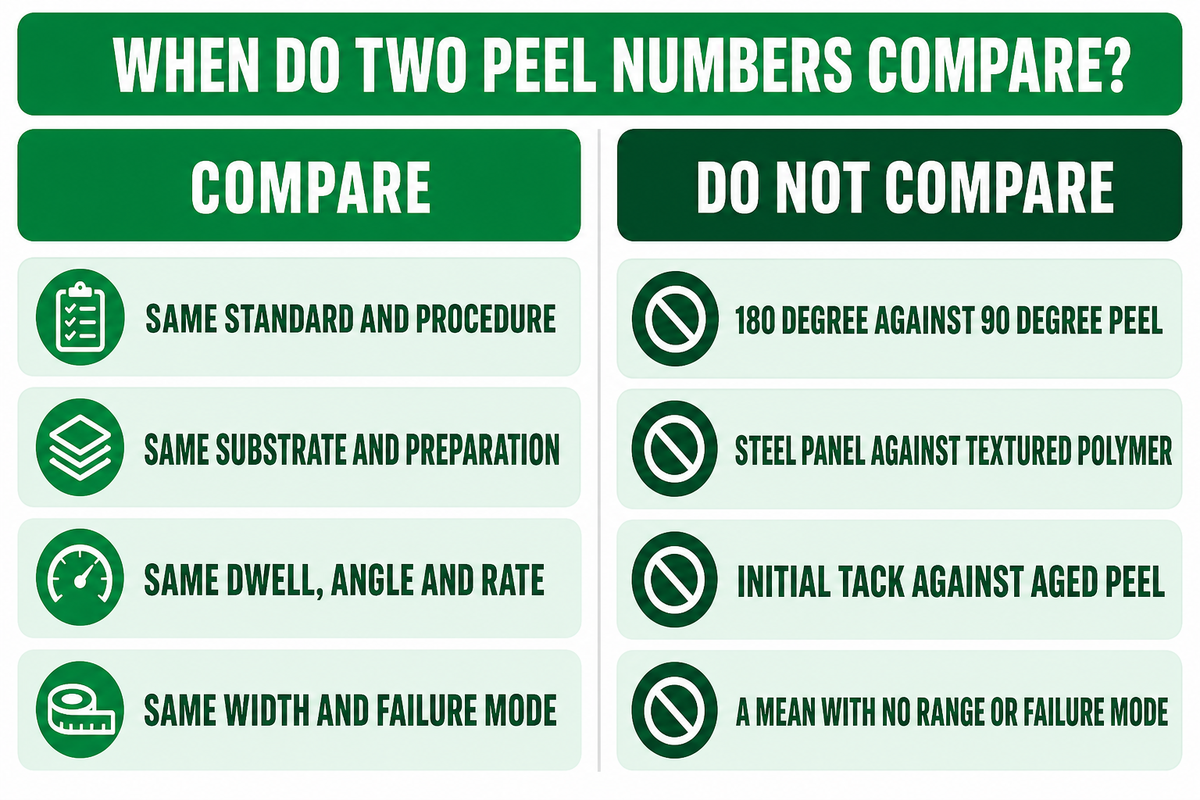
Peel adhesion isn’t a single material constant. Angle, rate, dwell, panel, conditioning, specimen width, backing stiffness, adhesive rheology, and failure mode all affect the measured force. Two values belong in the same comparison only when those conditions match or a validated conversion has been established.
This limitation is practical, not theoretical. D3330/D3330M says several of its procedures cannot compare tapes from different sources when backing stiffness and adhesive rheology differ. Its scope also says peel adhesion usually has no direct relationship to a functional requirement. ISO 29862:2024 provides another current method family for self-adhesive tape peel, but a standard number still does not erase specimen and procedure differences.
Compare
- Same standard and procedure
- Same substrate material and surface preparation
- Same dwell, conditioning, angle, and rate
- Same units, specimen width, and failure-mode reporting
Do not compare
- 180° peel against 90° peel as one ranking
- Steel-panel results against a textured polymer application
- Initial tack against aged peel or shear
- A single mean with no range or failure mode
Use a simple comparison rule: if the report can’t fill every field in one shared test-condition row, treat the values as separate observations. Don’t choose the higher number until the suppliers rerun a matched protocol.
The Method-Proof Matrix: Nine Questions Before You Accept a Claim
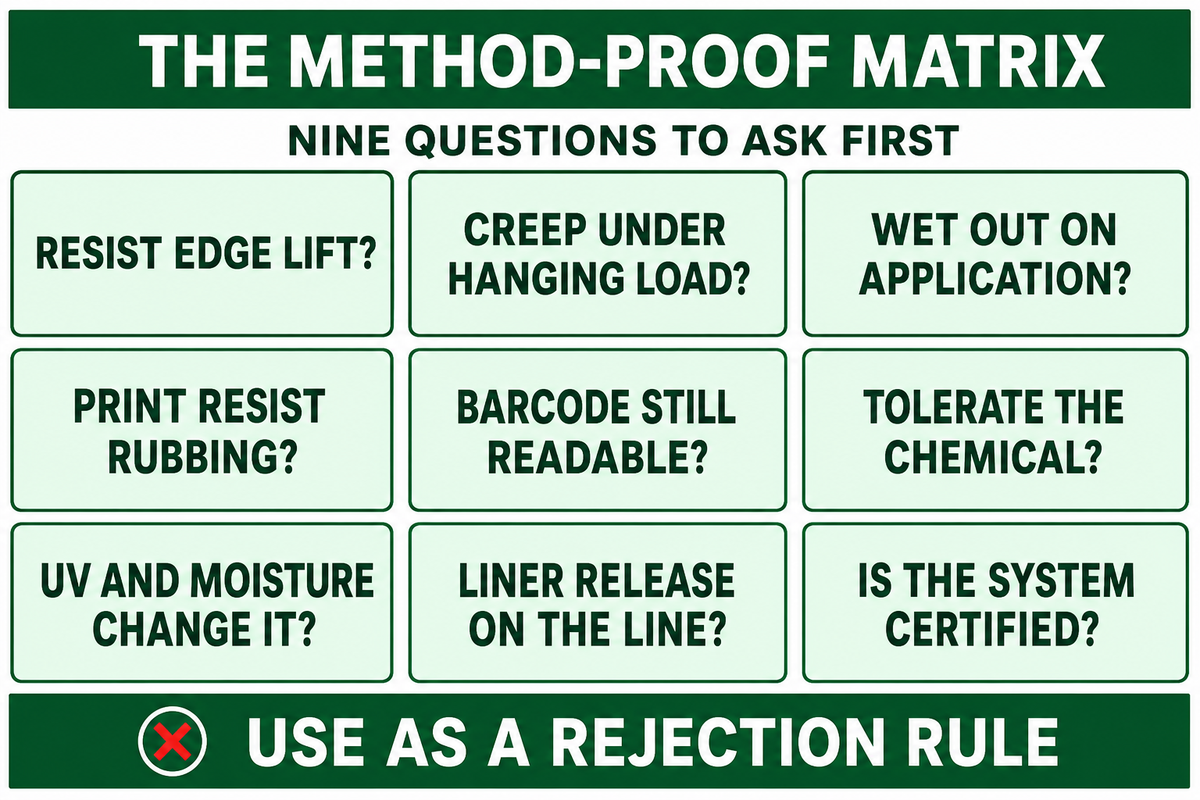
Our Method-Proof Matrix links the buyer’s failure concern to the narrow evidence needed. It prevents a common substitution error: using one convenient test to support a different property. Quality teams can use the last column as a report-rejection rule before comparing suppliers.
| Pergunta do comprador | Suitable method family | Evidências a serem retidas | Reject the claim when |
|---|---|---|---|
| Will the label resist edge lift? | Peel plus end-use edge geometry | Force, angle, rate, dwell, panel, failure mode | Only “high adhesion” is reported |
| Will it creep under a hanging load? | Static shear / holding power | Load, bonded area, temperature, time or displacement | Peel is used as the only evidence |
| Will it wet out during application? | Loop tack plus application trial | Initial tack, application pressure, surface condition | Long-term durability is inferred from tack alone |
| Will the print resist repeated rubbing? | FTM ink rub or ASTM D5264-type abrasion | Rub material, load, cycles, visible change, scan result | “Abrasion resistant” has no conditions |
| Will a barcode remain readable? | Exposure plus barcode verification | Pre/post grade or scan rule, image, exposure record | Only visual ink damage is checked |
| Will the construction tolerate a chemical? | FTM chemical exposure or ASTM D543-type practice | Reagent, concentration, temperature, duration, stress, property change | The chemical is named but exposure is not |
| Will ultraviolet and moisture change it? | FTM 6 or ASTM G154-type exposure | Lamp, cycle, temperature, water, hours, property change | Hours are converted directly into outdoor years |
| Will the liner release on the converting line? | Low- and high-speed release plus line trial | Release force, speed, direction, liner, die-cut geometry | One low-speed value is applied to every machine |
| Is the label system certified? | Applicable certification program | Listed construction, scope, environment, authorization | A single material test is presented as certification |
Testing and certification aren’t synonyms, which is why the final row matters. UL’s marking and labeling program evaluates defined systems against established performance requirements. Running a peel, abrasion, or weathering method on one sample doesn’t create that certification.
Build a Decision-Grade Label Qualification Protocol
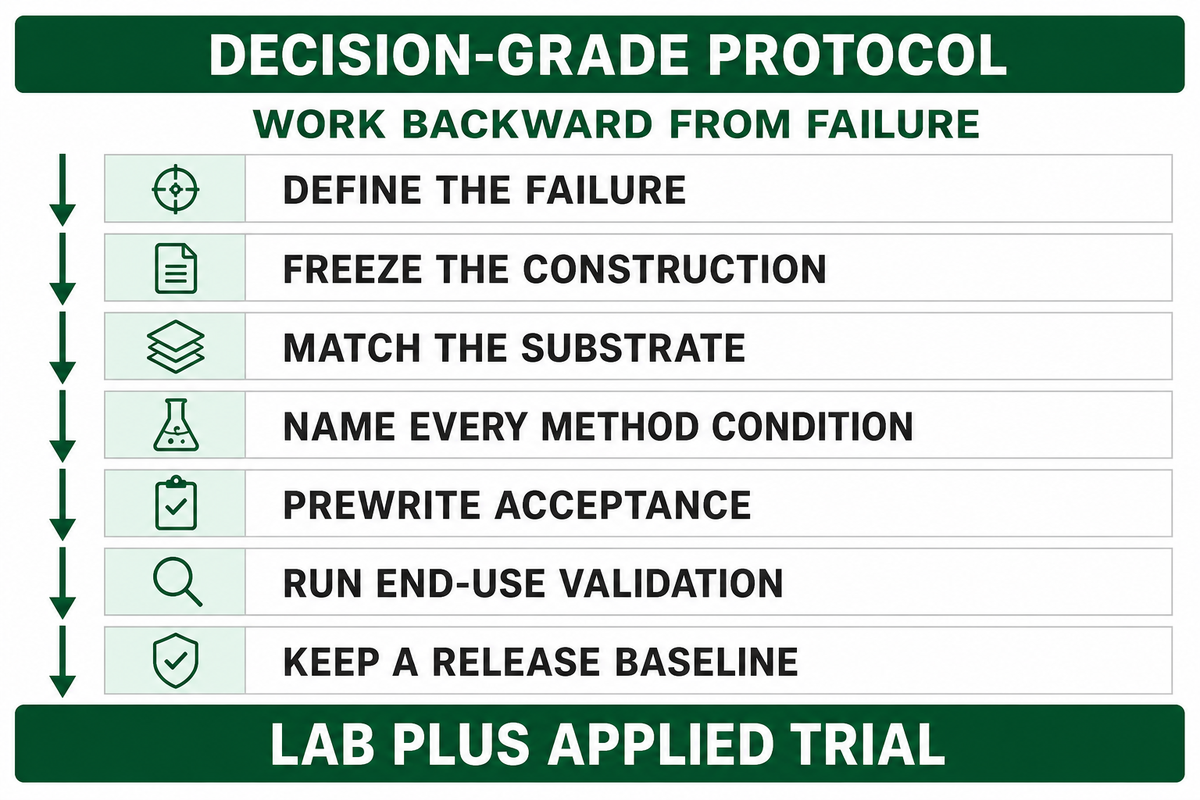
A decision-grade protocol starts with the failure mode and works backward to methods, acceptance criteria, and sample controls. The protocol should freeze the label construction and actual substrate before testing, then combine laboratory measurements with an application trial. This makes the result useful for supplier comparison and incoming quality control.
- Define the failure — state whether rejection means edge lift, adhesive residue, print loss, unreadable barcode, liner mis-release, chemical change, or another observed condition.
- Freeze the construction — record facestock, adhesive, coat, liner, ink, varnish or laminate, dimensions, print process, and lot identification.
- Match the substrate — use the actual material, finish, curvature, contamination state, and cleaning process whenever application relevance matters.
- Name every method condition — write procedure, geometry, equipment, conditioning, dwell, rate, load, temperature, humidity, reagent, and duration before samples arrive.
- Prewrite acceptance — define numerical limits where valid, allowable visual change, barcode rule, failure mode, sample count, and treatment of outliers.
- Run end-use validation — expose applied labels to the handling, cleaning, environment, and time sequence that the laboratory method is meant to represent.
- Keep a release baseline — approve the exact construction and retain the report, specimens, lot data, and agreed incoming-check method.
An illustrative protocol might pair matched-procedure peel and shear with abrasion, a defined chemical wipe, and barcode verification before and after exposure. The buyer would reject the sample if any prewritten condition fails, even if its peel value is the highest, because label performance is a system result, not a single-number contest.
No laboratory plan can simulate every real-world condition. A label that must withstand repeated handling, ultraviolet exposure, cleaning chemistry, and temperature change needs a focused laboratory sequence plus an applied-part trial. Regulatory compliance remains a separate documentation check; a durability result can support that file without replacing the applicable requirement or certification decision.
Use the 0–10 Report Completeness Score Before Comparing Results
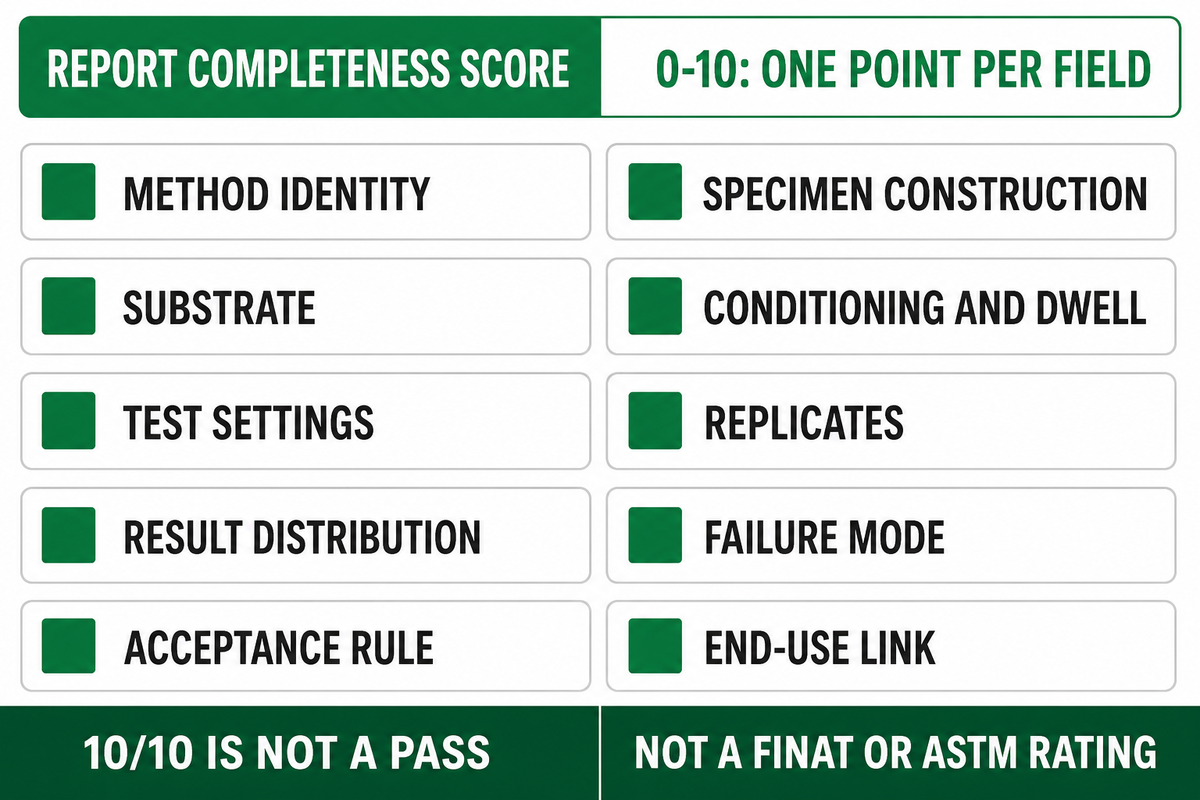
Guanma’s Report Completeness Score is an editorial procurement screen, not a FINAT or ASTM rating. Give one point for each of ten report fields. This score measures whether a result is interpretable and reproducible; it does not grade the label’s physical durability or replace a technical acceptance decision.
| Point | Required field | Minimum evidence | Why it changes the decision |
|---|---|---|---|
| 1 | Method identity | Standard, edition, procedure | Defines the measurement family |
| 1 | Specimen construction | Facestock, adhesive, liner, print, finish, lot | Prevents substitution between constructions |
| 1 | Substrato | Material, finish, preparation | Controls surface relevance |
| 1 | Conditioning and dwell | Temperature, humidity, time | Controls adhesive development and material state |
| 1 | Test settings | Angle, speed, load, cycles, reagent, or lamp cycle | Makes the result reproducible |
| 1 | Replicates | Sample count and specimen exclusions | Shows whether one value represents a set |
| 1 | Result distribution | Mean plus range or other agreed variability | Exposes unstable performance |
| 1 | Modo falha | Adhesive, cohesive, facestock, ink, substrate, or mixed | Explains what the number represents |
| 1 | Acceptance rule | Limit, change allowance, barcode or visual rule | Turns data into pass or fail |
| 1 | End-use link | Application trial or documented correlation | Connects the laboratory result to the buyer’s use |
Worked example: a supplier report identifies ASTM D3330 Procedure A, the label construction, steel panel, conditioning, peel settings, sample count, and mean value. It omits variability, failure mode, acceptance rule, and application correlation. This example scores 6/10: method identity (1) + construction (1) + substrate (1) + conditioning (1) + settings (1) + replicates (1) = 6. Procurement does not reject the report as “bad”; it holds the result out of supplier comparison until the four missing fields are supplied.
A score of 10/10 still doesn’t mean the label passed. It means the report contains the ten fields needed for interpretation. Pass or fail comes from the acceptance rule, while end-use confidence comes from the application evidence.
Put the Test Conditions Into the Label RFQ
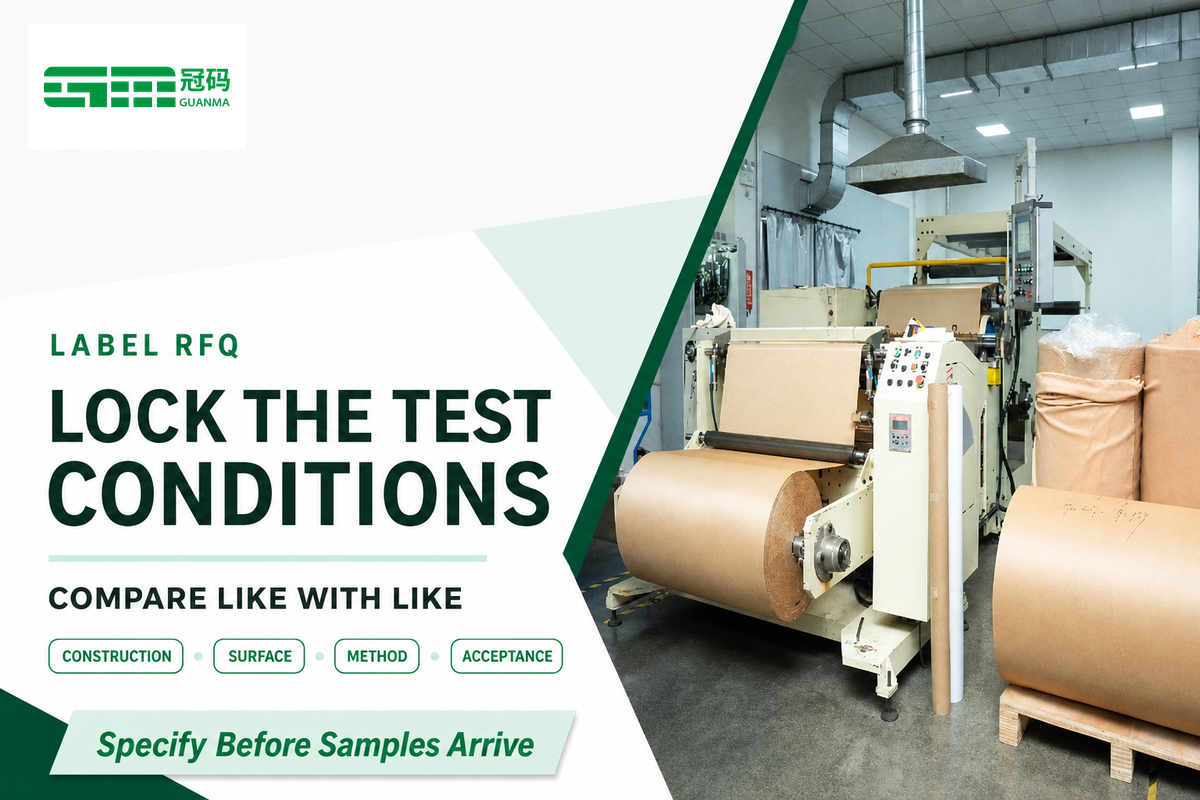
A label RFQ should ask suppliers to quote the same construction and test conditions. If one supplier chooses the substrate, dwell, peel angle, or chemical exposure independently, the resulting numbers describe different experiments. Copy the fields below into the sample request and leave numerical limits project-specific until engineering defines them.
Lista de verificação RFQ, copie-os em sua solicitação de orçamento:
| Parâmetro | Entrada necessária | Por que isso importa | Como verificar |
|---|---|---|---|
| Label construction | Facestock, adhesive, liner, print, coating or laminate, total thickness | Durability belongs to the complete construction | Approved specification and lot traceability |
| Application surface | Actual material, finish, shape, and cleaning method | Standard steel may not represent the end use | Controlled substrate coupons and applied-part trial |
| Peel requirement | Named FINAT, ASTM, or ISO method and exact procedure | Angle, rate, width, and dwell change the value | Full laboratory report with failure mode |
| Shear requirement | Load, bonded area, direction, temperature, time or displacement limit | Holding power answers a different question from peel | Matched method and retained specimens |
| Print and barcode | Rub material, load, cycles, post-test visual and scan rule | Legible text and barcode scannability can fail differently | Before/after images and recorded scan result |
| Chemical exposure | Reagent, concentration, temperature, contact method, duration, repetitions | A chemical name alone is not a test condition | Exposure log and defined property change |
| Weathering | Lamp, irradiance setting, cycle, temperature, water condition, duration | Accelerated hours do not equal universal field years | ASTM G154-type report plus outdoor correlation where claimed |
| Acceptance and change control | Limits, sample rule, failure mode, approved lot, notification triggers | Creates a repeatable release decision | Signed specification and incoming inspection record |
When a seller can’t provide every field, separate “not tested” from “failed.” Missing data is a qualification gap, not evidence of poor performance. Procurement can then decide whether to request a matched test, run an internal trial, narrow the claim, or choose a construction with stronger documentation.
When Not to Accept a Label Durability Claim
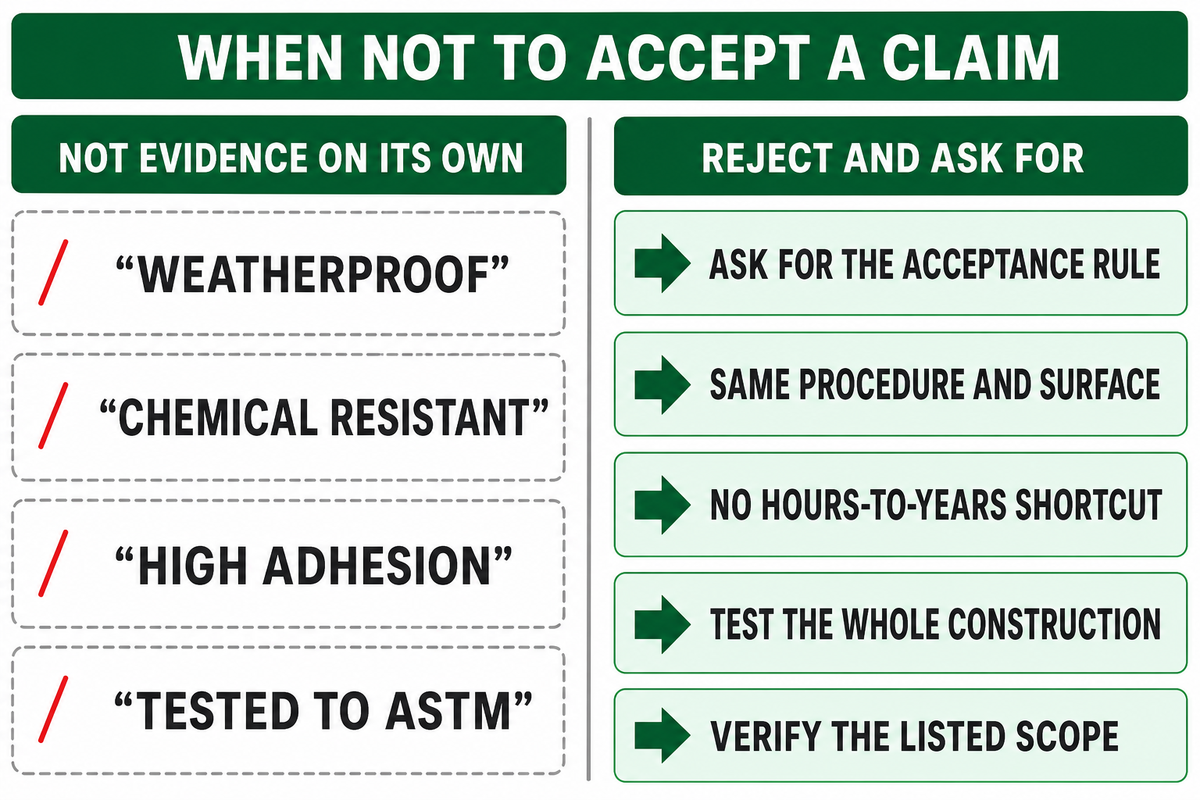
Do not accept a durability claim when the property, method, conditions, or acceptance rule is missing. Phrases such as “weatherproof,” “chemical resistant,” “high adhesion,” and “tested to ASTM” are starting points for questions. They are not self-contained evidence of performance in your environmental conditions.
- Reject method-only wording: ask for the result and acceptance criteria.
- Reject unmatched comparisons: ask suppliers to use the same procedure and application surface.
- Reject hours-to-years shortcuts: ask for a documented correlation to the specified outdoor use.
- Reject component substitution: a durable facestock doesn’t prove the ink, topcoat, adhesive, liner, and barcode remain intact together.
- Reject certification shorthand: confirm the listed construction, scope, environment, and authorization rather than assuming one passing test creates a certified system.
A buyer doesn’t need every possible durability test. The correct set is the smallest group that covers the credible failure modes, uses reproducible conditions, and connects to the actual application. That approach costs less and produces better evidence than ordering a broad menu of unrelated laboratory results.
Resumo
FINAT and ASTM methods create repeatable measurements, not universal durability promises. FINAT provides a label-industry method collection across adhesive, release, ageing, chemical, and print behaviors. ASTM methods offer detailed procedures and unusually useful scope limitations. Read those limitations as part of the result.
For supplier approval, apply the Four-Rung Proof Ladder: method, result, acceptance, and validation. Use the Method-Proof Matrix to choose tests from actual failure modes, then use the 0–10 Report Completeness Score to identify missing report fields before comparing numbers. Final approval belongs to the complete label construction on the intended surface and in the stated service profile.
Perguntas frequentes
O que os padrões de teste de durabilidade da etiqueta provam
A standard method proves how a defined specimen behaved under its recorded procedure and conditions; field service life, certification, and performance on another surface need separate evidence.
Ele suporta medição repetível quando a construção, aparelho, condicionamento e configurações coincidem O relatório pode comparar amostras ou apoiar uma decisão de aceitação se um limite foi definido Vida útil de campo, desempenho em outra superfície, um resultado de passagem sem critérios, e certificação todos exigem evidências separadas vinculadas à aplicação pretendida e construção completa da etiqueta.
O teste FINAT é igual ao teste ASTM?
No. FINAT centers on self-adhesive label materials, while ASTM publishes broader material and exposure procedures; similarly named tests still require scope, specimen, and condition checks.
FINAT’s collection is closely aligned with self-adhesive label materials and converting. ASTM standards cover individual material and exposure questions across many industries. A peel, shear, abrasion, or weathering method may address a related property without using the same specimen or procedure. Compare scope, edition, geometry, conditioning, units, and stated limitations before placing values in one supplier table.
“testado para ASTM” significa que um rótulo foi passado?
No. “Tested to ASTM” identifies a procedure, but only a declared minimum, maximum, allowable change, or visual rule can turn the measurement into pass or fail.
Ask for the exact standard edition and procedure, specimen construction, substrate and preparation, conditioning, test settings, sample count, result distribution, failure mode, and acceptance criteria. Without a declared minimum, maximum, allowable change, or visual rule, the report contains measurements but no pass/fail decision for the buyer’s specified application and agreed sample release rule.
As horas de intemperismo acelerado podem ser convertidas em anos ao ar livre
No universal conversion exists. Product-specific correlation is required for credible outdoor-year claims, using the same construction, defined failure endpoint, intended climate, orientation, mounting condition, and exposure sequence.
G154 descreve aparelhos e práticas de exposição ultravioleta e à água, mas não fornece um único fator horas a anos A escolha da lâmpada, ciclo, temperatura, umidade, geografia, orientação, sombra, poluição e a propriedade que está sendo medida podem mudar a relação Uma correlação também precisa de um ponto final de falha definido: mudança de cor, perda de adesão, rachaduras, danos na impressão ou outra propriedade Relate a exposição exata do laboratório, mostre a mudança medida e qualifique qualquer declaração de vida útil, a menos que a mesma construção tenha uma correlação de campo documentada sob o clima pretendido e a condição de montagem.
Qual teste mostra se um código de barras permanecerá legível?
Barcode readability needs the relevant exposure test followed by a defined verification or scan rule; visual ink inspection alone may not predict whether the code remains scannable.
Um teste de fricção ou abrasão de tinta pode mostrar danos à superfície, mas a inspeção visual por si só pode não prever a digitalização Defina a simbologia, o método de verificação ou a aceitação da digitalização, a localização, a medição antes/depois e a sequência de exposição Avalie a retenção do adesivo separadamente porque um código de barras legível em uma etiqueta de elevação ainda falha na aplicação.
Quantos testes devem ser incluídos em um plano de qualificação de rótulos?
Use the smallest test set that covers the credible failure modes and intended service profile, then add an end-use trial wherever laboratory conditions cannot represent the application.
Begin with the application surface and cleaning process, then list each exposure in order. Add the handling frequency, load direction, temperature, ultraviolet or moisture exposure, chemical contact, print and barcode requirement, liner behavior, and removal condition that actually occur. Map each credible failure to one suitable method family, remove duplicate tests, and write acceptance criteria before samples arrive. Where two methods answer the same narrow question, choose the one that best matches supplier equipment and the buyer’s baseline. Finish with an end-use trial whenever the laboratory setup cannot represent curvature, contamination, repeated handling, edge geometry, mixed exposures, or the full service sequence.
Related Guanma Guides
Referências e fontes
- FINAT Test Methods, 11th Edition Index. FINAT.
- ASTM D3330/D3330M-04(2025), Peel Adhesion of Pressure-Sensitive Tape. ASTM International.
- ASTM D3654/D3654M-06(2024), Shear Adhesion of Pressure-Sensitive Tape. ASTM International.
- ASTM D5264-98(2019), Abrasion Resistance of Printed Materials. ASTM International.
- ASTM G154-23, Operating Fluorescent Ultraviolet (UV) Lamp Apparatus for Exposure of Materials. ASTM International.
- ASTM D543-21, Resistance of Plastics to Chemical Reagents. ASTM International.
- ISO 29862:2024, Self-Adhesive Tapes: Determination of Peel Adhesion Properties. International Organization for Standardization.
- Marking and Labeling Testing and Certification. UL Solutions.
Build a Testable Label Specification with Guanma

Send the label construction, application surface, service conditions, failure concerns, and acceptance needs. Guanma can help turn those inputs into a material and sample brief for review with your quality, engineering, and procurement teams.
![Glassine vs CCK vs Film Release Liner [Comparação]](https://guanmalabel.com/wp-content/uploads/2026/07/glassine-cck-film-release-liner-featured-1-768x512.png)