Entre em Contato com Guanma

Atualizado em junho de 2026 · Avaliado pela equipe técnica de Guanma.
O filme da etiqueta de BOPP é um facestock autoadesivo da etiqueta feito do polipropileno biaxialmente orientado É o material que a maioria de etiquetas do produto são impressas sobre, contudo as mesmas três letras escondem uma série de decisões (acabamento, tratamento de superfície, adesivo, forro) que silenciosamente decidir se um rótulo sobrevive a um freezer no peito, uma cozinha oleosa, ou uma prensa flexográfica funcionando em velocidade Este guia explica o que BOPP filme rótulo realmente é, como ler suas especificações, por que os rótulos falham quando os números estão errados, e como escolher uma construção para seu produto em vez de um catálogo SKU.
Especificações rápidas: filme de etiqueta BOPP
| Polímero | Polipropileno orientado biaxialmente (BOPP); gravidade específica ~0,90 g/cc (branco cavitado ~0,710,76) |
| Espessura Facestock | 15 µm µm (clear 23 8; branco top-revestido 77 60; perolizado 58) |
| Energia superficial | 29 2 mN/m tratado → 38 2 mN/m tratado com corona |
| Acabamentos | claro, branco, fosco, brilho, prata/metálico, perolizado |
| Adesivos | borracha termofusível, acrílico à base de água, solvente/acrílico modificado |
| Métodos de ensaio de referência | FINAT FTM 1 (descascamento), FTM 9 (aderência em loop), ASTM D3330, BS 5609 Seção 2, FDA 21 CFR 175.105 |
O que é filme BOPP Label?
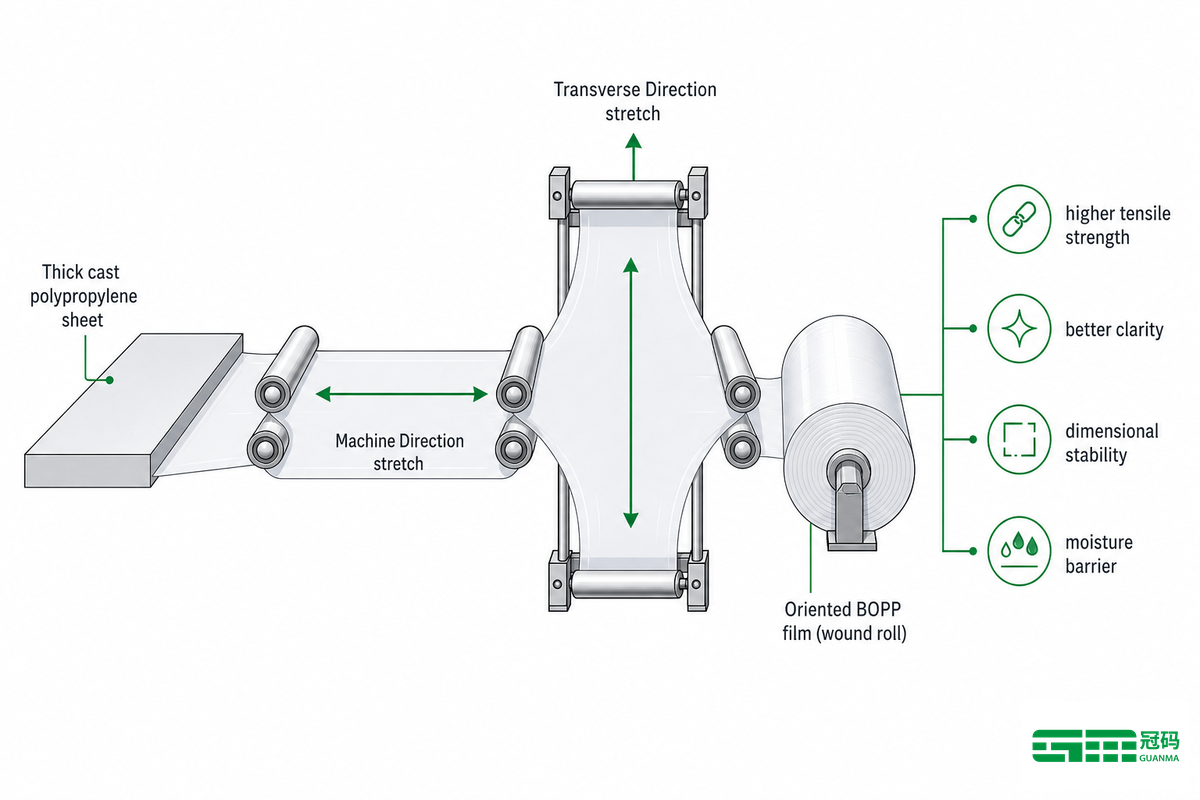
O filme de etiqueta BOPP é uma etiqueta autoadesiva feita de polipropileno orientado biaxialmente. Uma folha de polipropileno esticada nas direções da máquina e transversal, revestida com um adesivo sensível à pressão em um revestimento removível para que possa ser impressa, cortada e dispensado como um produto durável e resistente à umidaderesistente etiqueta.
Esse estiramento biaxial é o ponto principal: orientar o polímero em duas direções aumenta a resistência à tração, a resistência à perfuração, a clareza e a estabilidade dimensional, e melhora a barreira ao gás e à umidade em comparação com o polipropileno fundido (não orientado), como Pesquisa do Departamento de Energia dos EUA sobre filmes multicamadas documentos.
Um esclarecimento salvar muito desperdício sourcing Se você pesquisou “BOPP” e aterrou em caixa-selagem fita, esse é um produto diferente: a fita BOPP é um consumível de embalagem, enquanto o filme para rótulos BOPP é um material para rótulos sensível à pressão, projetado para fidelidade de impressão e vida útil. Eles compartilham um polímero, mas não uma finalidade. O material de grau para rótulos é o que a Guanma reveste como acabado Facestock filme etiqueta BOPP. Fornecido como filme plástico em rolos, este material de filme é negociado com a resistência e clareza que uma etiqueta de papel não consegue igualar, e é por isso que as marcas usam BOPP para rotulagem de produtos que deve durar.
P: O que significa BOPP?
Essas quatro letras representam polipropileno orientado biaxialmente. “Biaxialmente orientado” descreve a etapa de produção que estica o filme em duas direções; “polipropileno” é o polímero termoplástico A maioria dos rótulos de produtos descritos simplesmente como rótulos “polipropileno” ou “poli” são na verdade BOPP. Uma construção patenteada de filme-rótulo BOPP (USPTO US7144542B2) mostra a construção típica: uma camada de base orientada biaxialmente mais uma camada de cobertura revestida projetada para ancoragem de tinta e adesivo.
Acabamentos de estoque facial BOPP: transparente, branco, fosco, brilhante, prateado e perolizado
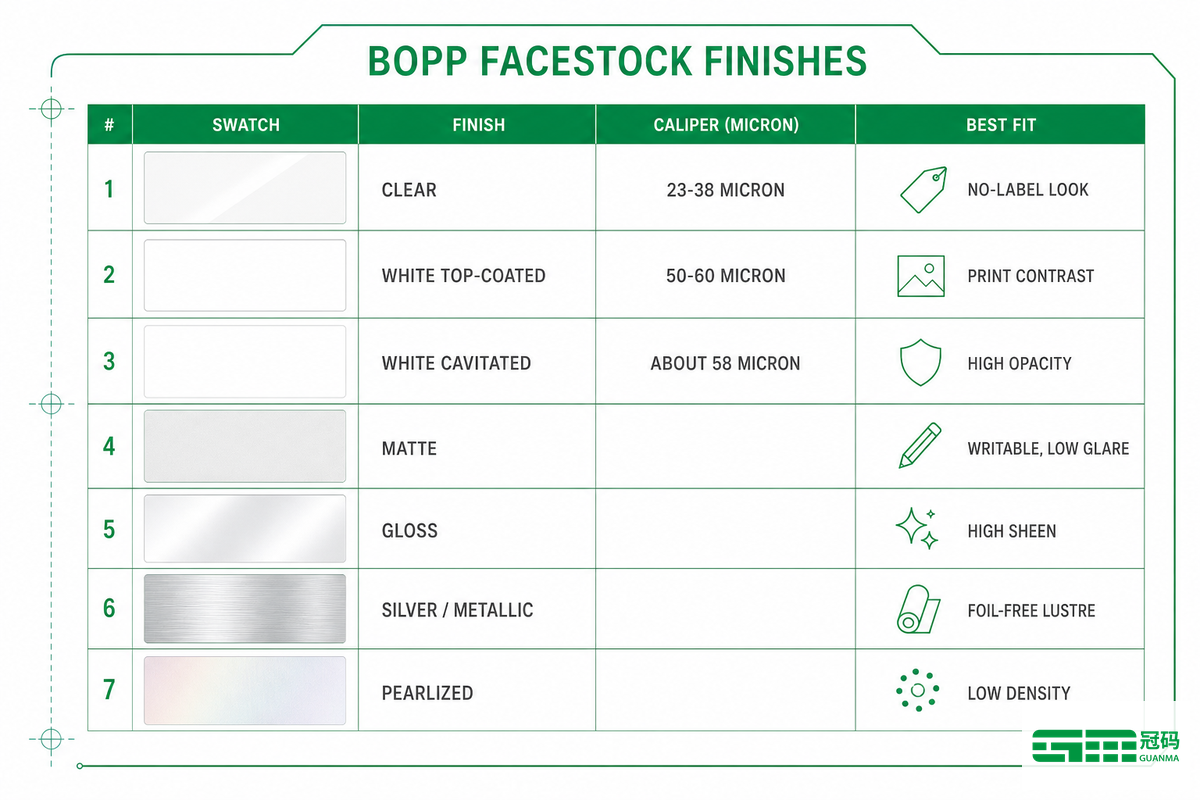
Um facestock BOPP não é um olhar Um acabamento define opacidade, paquímetro e apelo de prateleira, e ele emparelha de forma diferente com cada adesivo As âncoras BOPP brancas imprimem para marcas de alimentos e bebidas, enquanto BOPP prateado e metálico adicionam impacto de prateleira atraente sem o custo de estampagem de folha Medições independentes ajudam aqui: um estudo de 2023 de paquímetros comerciais perolizados (cavitados) BOPP registrados de 25, 30 e 38 µm em densidades de aproximadamente 0,71-0,76 g/cc com opacidade 70%, enquanto os dados de referência para BOPP claro/brilhante mostram uma gravidade específica próxima de 0,90, brilho em torno de 95% e neblina de 1-2%.
| Tipo de acabamento | Pinça típica | Propriedade chave | Melhor ajuste |
|---|---|---|---|
| Claro/transparente | 23 µm | “Sem aparência, alta clareza (haze 1-label”%) | Bebidas, cosméticos, varejo premium |
| Branco, sólido com revestimento superior | 50 µm | Base opaca, alto contraste de impressão | Saúde & beleza, alimento, agregado familiar |
| Branco, semi-sólido | ~47 µm | Maior rendimento do que o branco sólido, boa opacidade | Varejo geral, corridas de valor |
| Branco, cavitado | ~58 µm | Baixa densidade anulada, opacidade ~91% | Varejo premium, laticínios |
| Matte | ~50 µm | Superfície gravável de baixo brilho | Vinho, artesanal, etiquetas de instrução |
| Brilho | ~50 µm | Alto brilho, cor viva (brilho ~95%) | Embalagem promocional, varejo |
| Prata /metálico | ~50 µm | Lustre metalizado sem custo de folha metálica | Espíritos, eletrônicos, decorativos |
| Pearlizado (cavitado) | 25 µm | Branco perolado macio, baixa densidade (~0.710.76 g/cc) | Bebida premium, laticínios |
P: Quais acabamentos estão disponíveis para etiquetas BOPP?
Claro, branco, fosco, brilhante, prata/metálico e perolizado são os materiais de rosto principais do BOPP; além disso, você pode adicionar laminação de toque suave, verniz spot ou folha fria. Dois cuidados: o BOPP transparente precisa de um revestimento poli transparente e os acabamentos metálicos ou cavitados apresentam uma compensação de reciclabilidade (coberto abaixo).
Os compradores geralmente compram com acabamento etiquetas BOPP brancas, etiquetas BOPP transparentes, etiquetas BOPP foscas, etiquetas BOPP prateadas e etiquetas BOPP personalizadas emparelham o acabamento escolhido com o adesivo e forro direitos, enviando como rolos cortados ou folhas de etiquetas BOPP de Guan seletor de material facial e adesivo BOPP mapeia cada acabamento em um adesivo.
Filme branco e graus brancos brilhantes dominam as opções de rótulo, enquanto etiquetas BOPP douradas e acabamentos metálicos prateados adicionam brilho; etiquetas personalizadas combinam qualquer um destes com o adesivo certo O rótulo BOPP mais comum é branco, mas a gama de materiais BOPP vai de claro a metalizado branco BOPP também é a base a maioria das marcas começam a partir de produtos de saúde e beleza e domésticos.
Por que a energia superficial e o tratamento Corona decidem se sua etiqueta adere e imprime
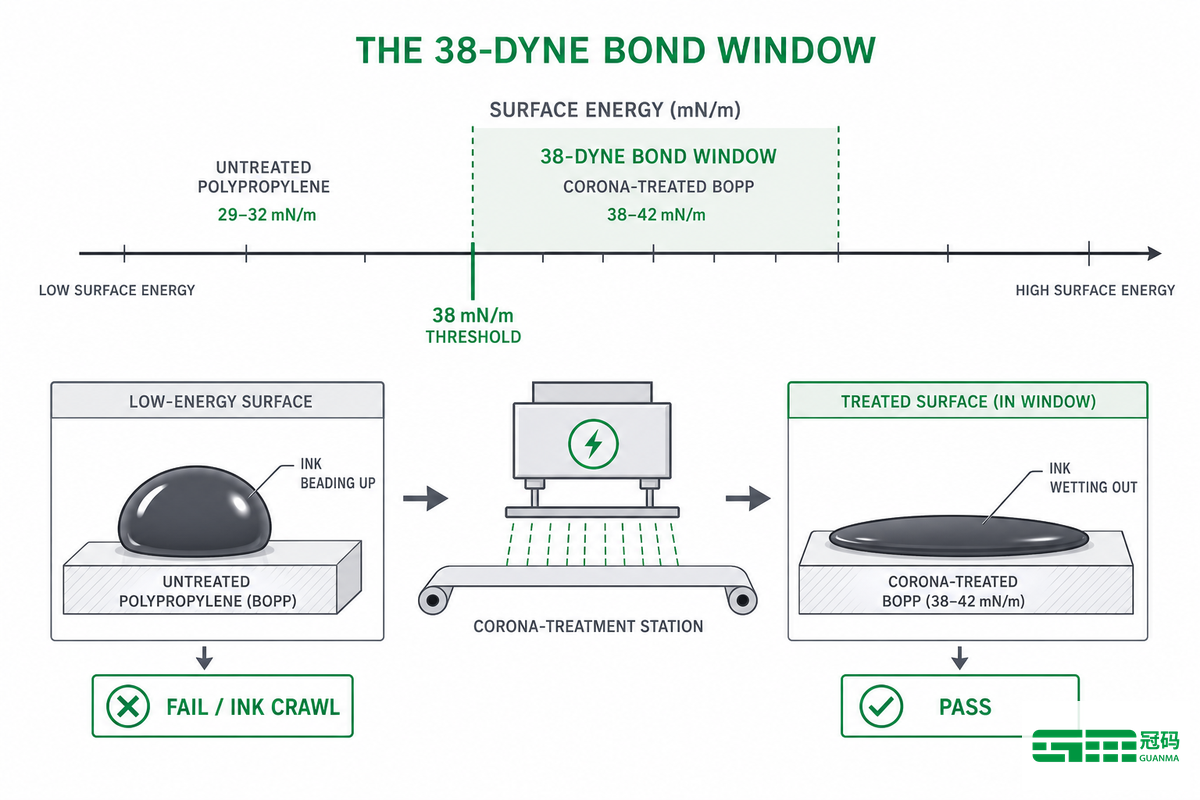
A impressão e a adesão falham quando a energia da superfície fica abaixo da janela de ligação; os PP não tratados variam de 29 a 32 mN/m e os adesivos de tinta/PS requerem 38 mN/m para molhar e segurar adequadamente. Corona aumenta a energia da superfície dos PP para 38-42 mN/m para permitir que a tinta e o adesivo se espalhem em vez de serem colocados.
Um método patenteado de BOPP corona documenta o mesmo efeito, atingindo 38 dinas corPP no filme tratado (patente CN116021808B).Sob essa marca, tinta “crawls”, e bordas puxar para cima.
O polipropileno, um material de “low-surface energy” (LSE) conforme projetado, é a causa do fenômeno. Os materiais “LSE parecem bons, mas se abrem ao entrar em serviço, de acordo com relatórios de serviço de campo sobre aplicações de etiquetas com falha.”
Chamamos a isto o Janela de ligação 38-Dyne, e ele único número mais útil um comprador pode levar em uma discussão B. O tratamento Corona não vai durar para sempre dynes são perdidos ao longo do tempo através do manuseio Um filme com uma leitura de 40 dyne no carretel de aprovação pode cair abaixo da marca de 38 quando está sendo processado on-line para volumes de produção.
Nota de Engenharia (Engenharia Note) trabalhando na janela de títulos
Uma garrafa de HDPE lê cerca de 31 mN na superfície Isso está abaixo da janela de 384 mN/m, então um acrílico padrão não vai molhar e o canto da etiqueta levanta em poucas horas A fixação leva dois movimentos: corona-tratar o facestock BOPP para 3842 mN/m e emparelhá-lo com um alto-tack hot-melt ou acrílico à base de água avaliado para esse substrato Mapear dyne do seu próprio recipiente leitura contra a linha de 38 mN/m antes de especificar o adesivo, a superfície, não o grau do filme, geralmente decide a falha Guanma mantém a corona dyne nível dentro da janela de 38 2 mN/m como uma receita documentada, lote a lote, em vez de re-tratar carretel por carretel.
Aqui está uma experiência de conversor para trazer isso para casa: uma loja executando BOPP pré-tratado relatou problemas de adesão intermitente e uma taxa de rejeição de bobina de aproximadamente 15%, porque o problema não era o grau do filme, mas sim a falta de nível de dine que havia passado pela inspeção recebida; chamamos isso de Drift de dino de amostra para produção. Qualifique-se para um único rolo de amostra e descubra que o problema está em toda a execução.
BOPP vs PET, vinil e papel: uma escada de troca de estoque facial de 4 filmes
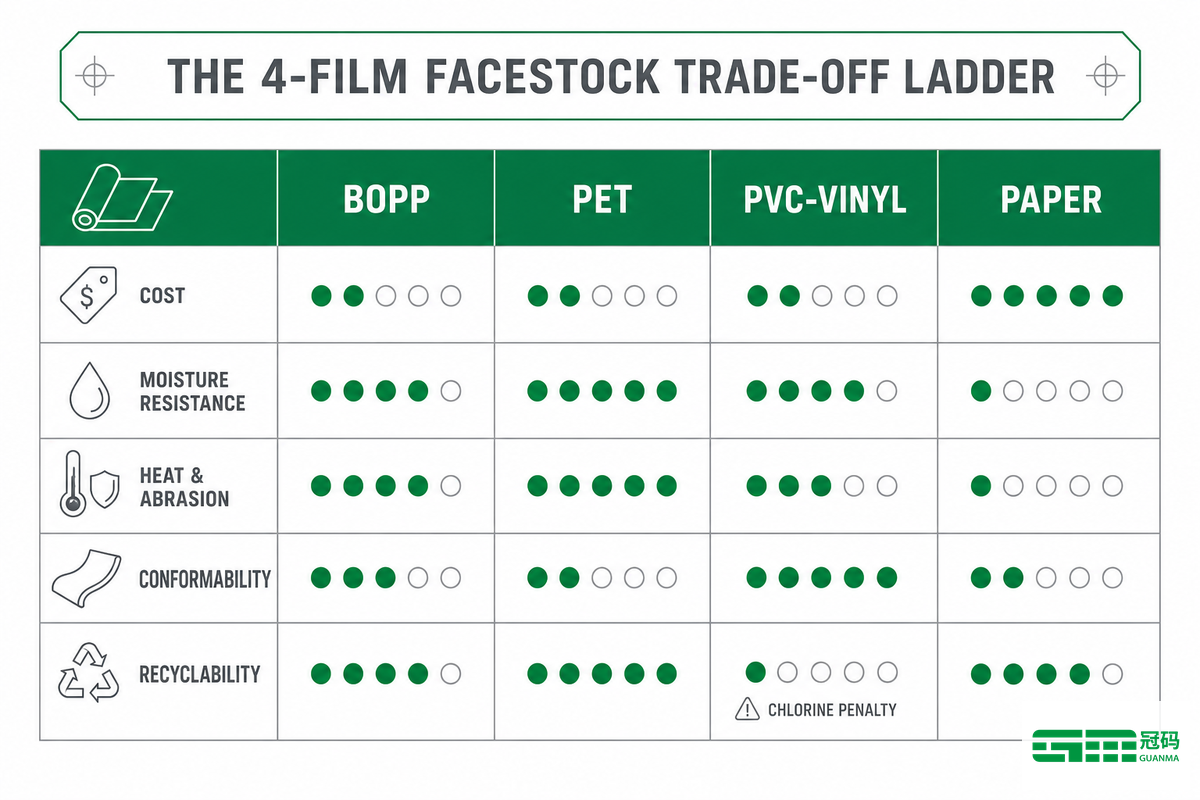
Para a maioria dos rótulos de produtos, o BOPP é a opção padrão — mas esse padrão não é definitivo. Mais precisamente, a comparação é um contínuo no qual se equilibram custo, conformabilidade e sustentabilidade. Como filme plástico, o BOPP oferece excelente durabilidade em vidro e plástico onde um rótulo de papel falharia, o que o torna uma opção durável para a maioria das linhas; para tubos flexíveis, porém, os rótulos BOPP semiflexíveis ainda ficam atrás da poliolefina, que continua sendo o material para rótulos preferido nessa aplicação.
| Propriedade | BOPP (PP) | PET (poliéster) | PVC/vinil | Papel |
|---|---|---|---|---|
| Custo relativo | Baixo | Alto | Moderado | Mais baixo |
| Resistência umidade | Excelente | Excelente | Excelente | Pobre (sem revestimento) |
| Calor/abrasão/solvente | Bom | Melhor | Bom | Baixo |
| Conformabilidade às curvas | Bom (não totalmente espremível) | Mais rígido | Mais flexível | Bom |
| História de reciclabilidade | Mono-PP amigável em recipientes PP/PE | Reciclável em fluxo PET | Penalidade baseada em cloro | Reciclável (fibra) |
| Claridade de impressão (“no-label”) | Excelente (claro) | Excelente | Bom | n/a |
As regras gerais tendem a vir em apenas dois Primeiro, opte por um Facestock PET-em vez de BOPP - se a aplicação for verdadeiramente extrema: temperaturas consistentemente quentes, solventes corrosivos ou exposições duras e de longo prazo à radiação UV e abrasão Em segundo lugar, o vinil parece ótimo enrolado firmemente em torno de contornos, mas como um plástico de cloreto de vinil poli acarreta uma penalidade para o cloro em esquemas de reciclagem, uma penalidade que os proprietários de marcas estão começando a evitar em favor do perfil BOPP mais limpo e geralmente mais barato, uma mono-poliolefina.
Se for apertado (squeeze) (squeeze) (squeeze) garrafas de polietileno (orqueeze), o melhor pode ser, enquanto uma mistura de boa durabilidade e o preço certo, o BOPP é o de fato E normalmente se encontra em alimentos, bebidas e itens de cuidados pessoais.
Impressão e conversão de BOPP: Flexo, UV, transferência térmica e revestimentos superiores
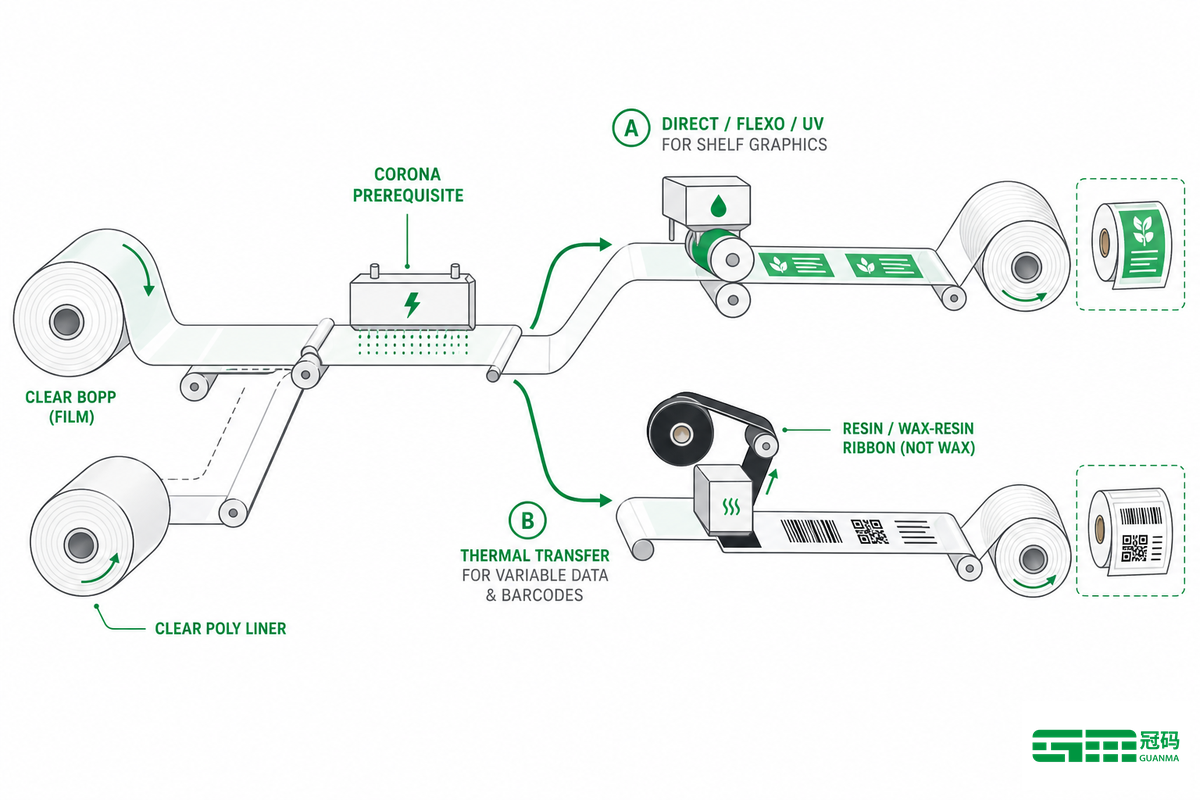
Na prensa, o filme de etiqueta BOPP pega tinta à base de água e solvente e funciona em impressoras flexográficas, UV e de transferência térmica (impressoras offset) quando tratadas com corona e opcionalmente revestidas na parte superior para lidar com tintas desafiadoras. Literatura técnica sobre modificação superficial do BOPP esclarece o mecanismo: o tratamento corona eleva a baixa energia superficial e faz com que a tinta ancore, não manche. O material frontal revestido superior branco permite uma boa ancoragem de tintas UV, flexo e de transferência térmica, com graus claros otimizando a superfície de impressão para a transparência de tintas e filmes transparentes.
Dois campos de impressão cobrem o filme da etiqueta BOPP: direto, flexográfico e UV para gráficos de prateleira e transferência térmica para dados variáveis Através dessas técnicas de impressão o filme leva tintas à base de água e solvente, então a impressão da etiqueta BOPP cobre gráficos de prateleira vívida e códigos de barras duráveis Se você estiver executando etiquetas térmicas BOPP para uso durável ou logístico, a escolha da fita é fundamental Uma fita de resina ou resina de cera oferece uma ligação muito melhor ao BOPP do que as fitas de cera construídas para papel, que podem descamar o polipropileno de baixa energia superficial em semanas e soltar um código de barras abaixo do contraste de grau de varredura Não execute novamente o trabalho: Se for um BOPP claro, ele precisa de um revestimento poli claro para sua planicidade, e a melhor maneira de garantir a capacidade de impressão é verificar o nível de dine do carretel recebido em sua impressora, não a amostra original Não se apaixone por graus genéricos (Guanma) corresponde a cada facestock e acabamento para sua prensa e tintas.
Um erro comum de impressão é qualificar tinta ou fita no carretel de aprovação e pular a verificação de dine de entrada-carretel Na prática, um conversor que faz isso pode perder uma mudança de produção completa para rub-off de tinta antes de rastreá-lo para um facestock que derivou de 40 para 36 dyne/cm em armazenamento abaixo dos 38 mN/m a tinta necessária Uma leitura de 60 segundos dyne-pen no desenrolamento pega antes que a imprensa faça.
Correspondendo as construções do BOPP às aplicações: bebidas, alimentos, freezer, pneus e produtos químicos
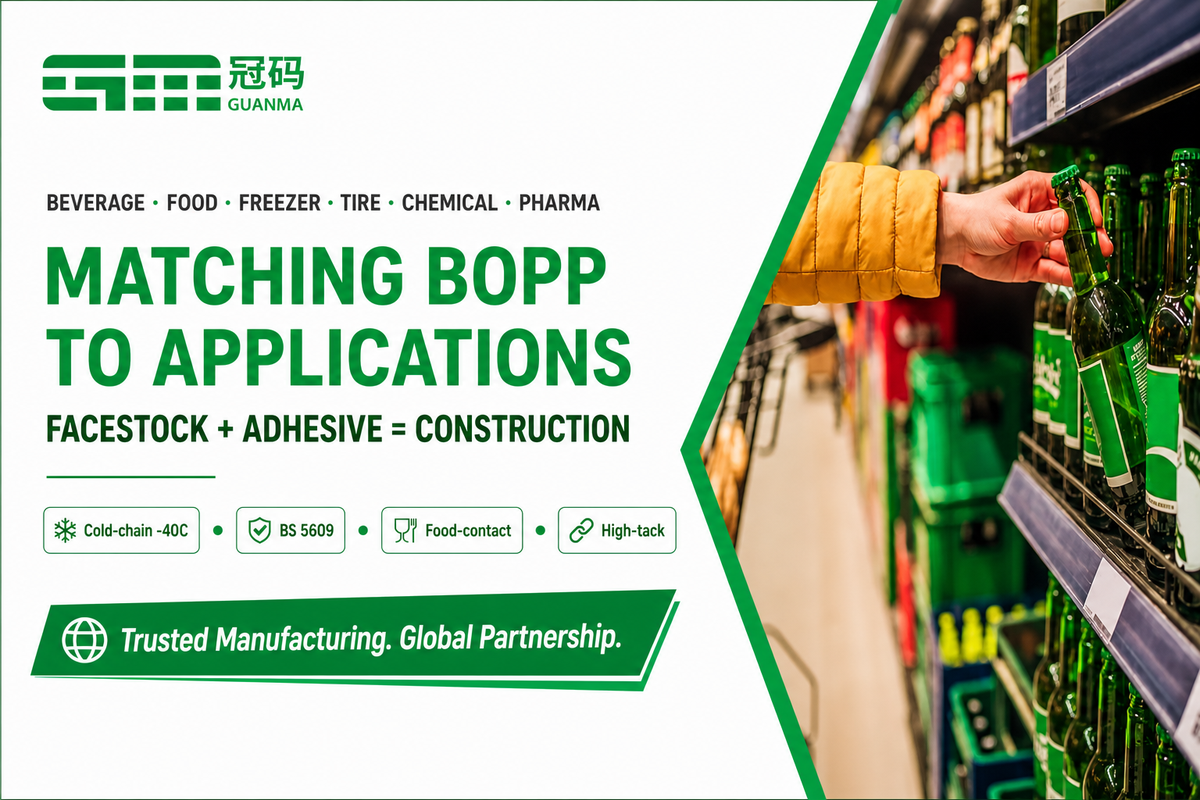
Quando você pensa em um material de rótulo BOPP, sempre o defina como um forro de construção (facote de construção), adesivo e Aqui está um guia para o que é normalmente especificado pelo ambiente de aplicação, desde etiquetas de cuidados pessoais e produtos domésticos até produtos oleosos, ácido para alimentos com baixo pH e produtos químicos e luz UV em tambores industriais, onde o BOPP é muitas vezes o melhor rótulo para embalagens de marca, mantido em padrões de qualidade rígidos:
| Aplicação | Construção | Requisito que resolve |
|---|---|---|
| Bebidas e vinho | BOPP transparente ou perolizado + acrílico de resistência úmida | Sobrevive à condensação e à imersão do gelo-balde, olhar premium |
| Embalagem alimentos | BOPP branco/claro + água com contato com alimentos | Resistência à umidade e à luz com adesivo compatível |
| Congelador/cadeia fria | Branco ou transparente BOPP + acrílico ultracongelado | Aplica-se e mantém-se até cerca de -40 °C sem elevação de canto |
| Pneu | Branco BOPP + acrílico permanente de alta aderência | Adere à borracha de baixa energia superficial por meio de abrasão e empilhamento |
| Químico /tambor | Branco BOPP + acrílico resistente a solventes, BS 5609 build | Dever de imersão marítima; levar informações do GHS/HazCom |
| Farmacêutico | Branco BOPP + acrílico controlado por migração | Fidelidade de impressão, rastreabilidade, removibilidade limpa quando necessário |
| Durável /exterior | Branco BOPP + acrílico permanente UV-estável | Resistência ao clima e UV para serviço externo estendido |
| Removível | Branco BOPP + acrílico removível | Peeling limpo sem resíduos em ativos retornáveis |
(Nota importante: Duas notas específicas sobre aplicações não podem ser determinadas apenas pela construção: para rótulos de alimentos, é apenas o adesivo aprovado para alimentos (não o material facial) que requer conformidade com FDA 21 CFR 175.105 sob uso prescrito, e para recipientes químicos, apenas o rótulo acabado é submetido ao teste BS5609 Sec 2 e carrega mensagens compatíveis com GHS/HazCom separadamente do desempenho)
Como ler uma folha de especificações BOPP e qualificar um fornecedor
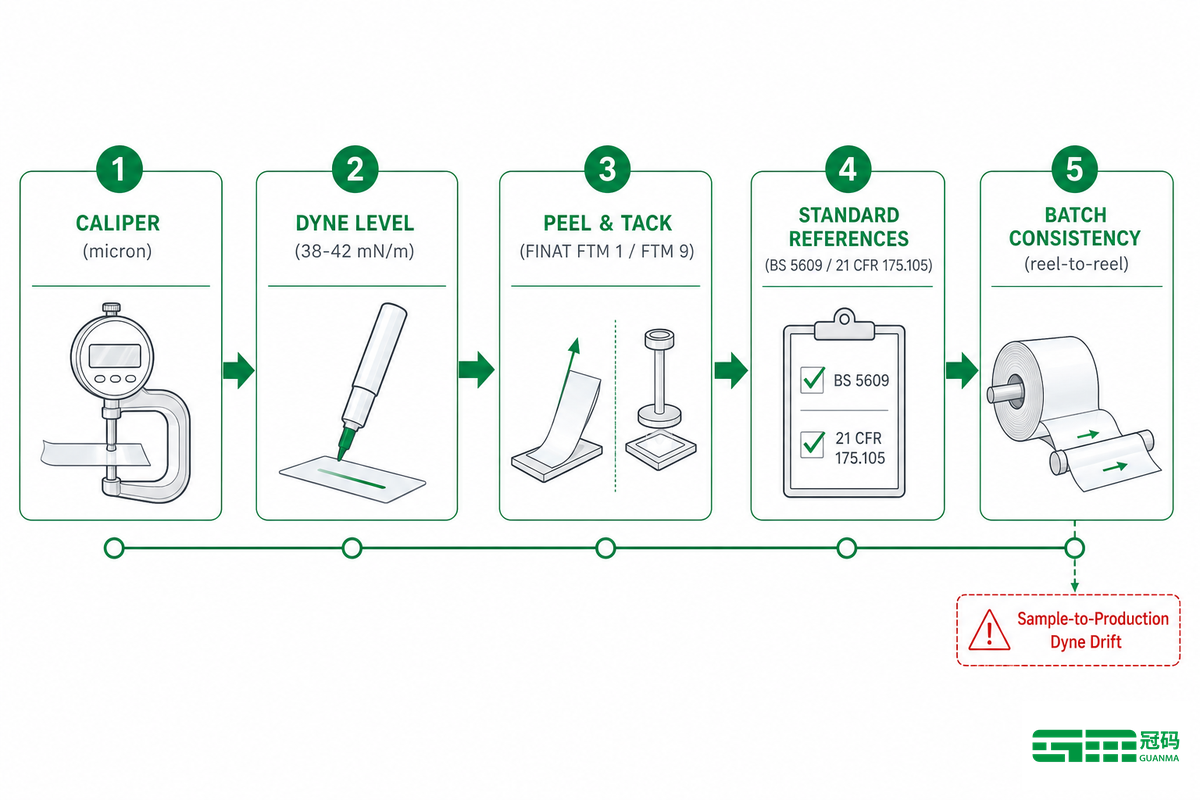
Como definir seus números (Em definir um material de rótulo BOPP, você precisa de mais do que a descrição do material; entender o que os números publicados significam ajudará você a evitar falhas na aplicação Testes comuns em materiais de rótulo relacionam-se à adesão, muitas vezes definida como: FINAT FTM 1 (Peel Adhesion @ 180 graus) e FINAT FTM 9 (Loop Tack), ambos da ordem de Newtons. A adesão muitas vezes também será publicada na ASTM D3330 (Peel adhesion of pressure sensitive materials).Esses números dão uma ideia de ordem de grandeza Um exemplo um: A adesão acrílica à base de água tem 24 hr Peel @180 deg FINAT FTM 1 = 11 N (180), Loop Tack FINAT FTM 9 = 14 N. Lembre-se do aviso da ASTM sobre D3330 para informações de design.
A Sequência de Qualificação de Fornecedores 5-Check BOPP
- Pinça 0 facestock espessura em micrometro Verifique contra o seu cortador e distribuindo especificações de equipamentos.
- Nível de Dyne (Ask) para uma energia superficial Corona de 38 mN/m com um método para garantir estabilidade e retenção.
- Peel /Tack 'Você verá resultados publicados em padrões Finat como FTM 1 (Peel) e FTM 9 (Loop Tack) Você também pode ver ASTM D3330. pergunte como esses números estão para o seu substrato real, não em algum substrato fictício genérico em um laboratório.
- Uso final Referências (Fim do uso), se uma etiqueta de tambor químico, pedir a conformidade BS5609 Parte 2 e testar Para um rótulo de alimento, quais são as conformações regulatórias específicas do adesivo (FDA 21 CFR 175.105 (FDA 21 CFR 175.105).
- Consistência (What measures) para garantir a consistência do tratamento de superfície, peso do revestimento adesivo, revestimento, etc. bobina para bobina, em oposição à amostra única.
O último é provavelmente o ignorado pela maioria dos compradores e provavelmente arrependido por todos eles O erro de sourcing mais caro não é pagar muito um metro quadrado 'ele validando material para uma execução de aprovação e, em seguida, tê-lo carretel para carretel deriva na produção Você amarrar sua construção à sua receita validada e perguntar a qualquer fornecedor como eles mantêm a consistência lote a lote você avalia lances Guanma fornece valores do método FINAT mediante solicitação e mantém os pesos de tratamento de superfície e revestimento para uma receita definida e validada, que é como nós estreitamos o Sampe para Produção Dyne Drift Complete suas especificações com Guanma's construtor RFQ do filme da etiqueta BOPP.
O BOPP é a escolha sustentável? Reciclabilidade monomaterial e as perspectivas de 2026
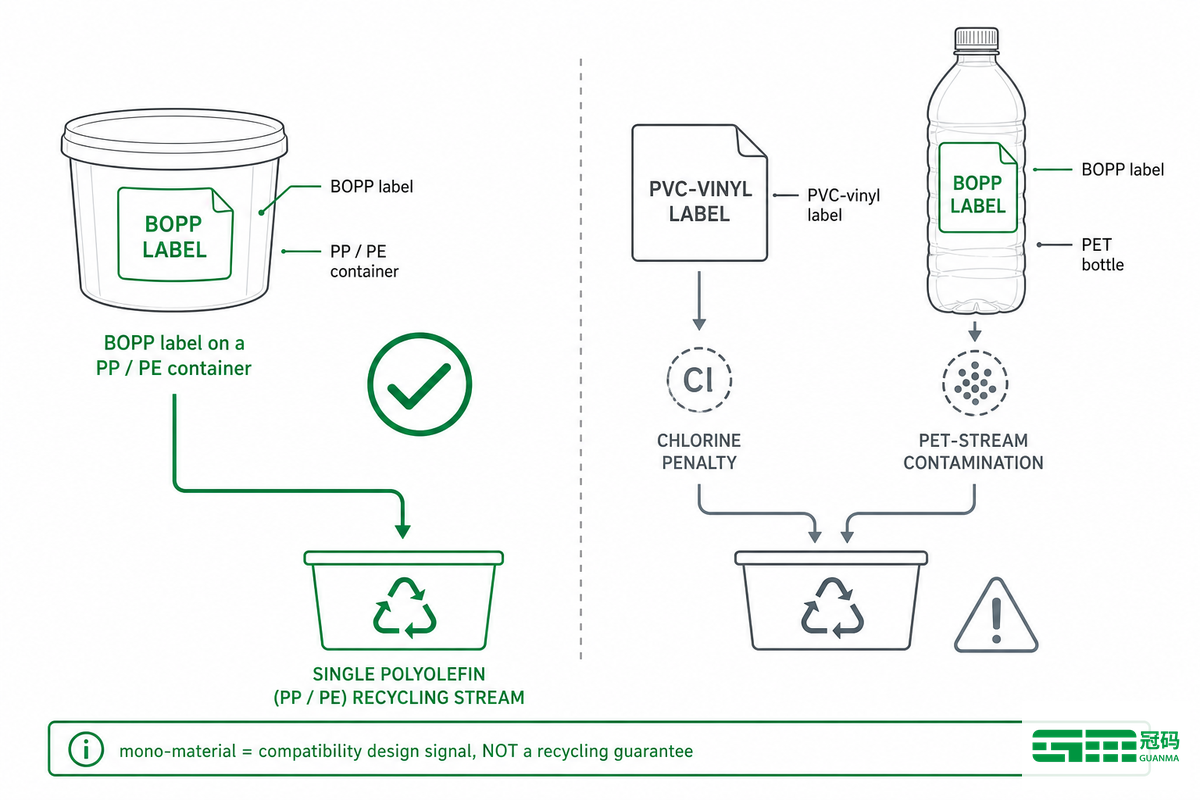
No momento, a maior tendência que molda as escolhas de estoque faces é o movimento em direção a projetos de monomateriais. As perspectivas da indústria para 2026 concordam consistentemente com isso filmes monomateriais estão em alta demanda: Embalagens feitas com polímero alinhado a etiquetas e embalagens podem ser classificadas e recicladas muito mais facilmente Esta facilidade está ajudando iniciativas de sustentabilidade e configurações mono-materiais a impulsionar a evolução de embalagens e filmes flexíveis Na embalagem o driver de material primário continuará a ser a reciclabilidade Aplicações de rotulagem com projetos mono-materiais podem incluir etiquetas BOPP em recipientes de polipropileno ou polietileno garantindo que ambos os componentes estejam dentro da mesma família de materiais (uma estrutura facilmente processada pela indústria comum de reciclagem de poliolefinas versus uma etiqueta de vinil que pode incluir cloro, o que requer seu próprio conjunto de equipamentos de fluxo de processamento para remover de forma eficaz.
“A recibração é decidida por se todos das características de uma embalagem, incluindo etiquetas, tintas, adesivos e metalização, são compatíveis com um determinado fluxo de reciclagem, não apenas pelo polímero facestock.”
Associação de Recicladores de Plástico, Guia de Design APR
Há dois esclarecimentos importantes que impedem que esta discussão se torne lavada de verde: O primeiro é entender que o design ‘monomaterial’ realmente só atua como uma bandeira para compatibilidade, não uma garantia para o processamento real de fim de vida útil (o mais recente) contabilidade da EPA dos EUA Coloca os plásticos reciclados nos EUA tão baixos quanto 8,7%, indicando que as questões práticas em torno da coleta, classificação e até mesmo escolha de material adesivo são tão importantes quanto a química básica do polímero Em segundo lugar, filmes BOPP metalizados, fortemente cavitados ou com aparência metálica podem criar desafios durante a classificação Nos Estados Unidos, as diretrizes APR fornecem melhores práticas e alertam que certos aditivos, como aqueles que alteram a densidade e metalização de um filme, podem exigir testes adicionais ou impedir a reciclagem adequada do item Escolher um BOPP de prata para impacto estético, portanto, é intrinsecamente uma escolha de sustentabilidade de embalagem para marcas focadas na reciclabilidade Embalagem, incluindo rótulos, faz parte do ecossistema maior, portanto, uma abordagem conjunta para o design de embalagens ("pacote") filme BOPP especificado com reciclabilidade em mente e emparelhado com um recipiente projetado para o mesmo objetivo (") deve testar todo o pacote, não apenas o facestock.
Perguntas frequentes
Q: Que é filme do BOPP da etiqueta-categoria?
Ver Resposta
Um filme de polipropileno orientado biaxialmente que serve como um facestock autoadesivo Esta estrutura autoadesiva inclui uma camada tratada com corona que permite a adesão da tinta, uma camada anexada de adesivo sensível à pressão e um substrato de revestimento removível O filme BOPP de grau de rótulo é diferente do filme de embalagem BOPP ou fita BOPP, pois é projetado especificamente para os altos níveis de precisão, capacidade de corte e facilidade de distribuição associados à produção e uso de rótulos Esses filmes de rótulo estão disponíveis em uma variedade de aparências, incluindo acabamentos transparentes, brancos, foscos, brilhantes, pérolas e metálicos.
Q: É BOPP mais barato do que PET?
Ver Resposta
Geralmente, sim. é um filme de valor médio enquanto PET representa um produto de valor médio a alto Enquanto BOPP e PET são ambos inerentemente resistentes à umidade, o PET de grau de filme superior se levanta muito melhor para contato prolongado com altas temperaturas, soluções químicas severas e condições intensas de uso interno e externo a longo prazoDadas as demandas típicas de desempenho colocadas nos rótulos de produtos de varejo (o que para a grande maioria não encontra condições extremas como estas (O BOPP fornece funcionalidade suficiente a um preço reduzido do material, tornando-o a escolha ideal para a maioria dos alimentos, bebidas, cuidados pessoais e aplicações cosméticas.
Zegbrk_0005
Q: É filme da etiqueta de BOPP reciclável?
Ver Resposta
Poderia ser, mas a reciclabilidade é uma função de todo o pacote, não o filme isoladamente Um rótulo BOPP em PP ou PE manterá o aspecto mono-material da embalagem e fornecerá uma separação “cleaner” Se usado em uma garrafa PET, dependendo da cola e do nível de metalização/cavitação pesada, pode comprometer esse fluxo de reciclagem.
Verifique sempre a combinação embalagem a filme em relação ao fluxo pretendido.
Q: O BOPP pode ser impresso sem tratamento corona?
Ver Resposta
Não geralmente. é 29-32 mN/m mas as tintas e os adesivos terão a tensão de superfície de ~38 mN/m antes que molhem o material, fazendo a tinta rastejar e as bordas descascar afastado O processo do tratamento da corona aumenta a energia de superfície até ~ 38-42 mN/m.
Q: Que espessura o filme da etiqueta de BOPP vem dentro?
Ver Resposta
Os cal da Facestock variam amplamente entre 150 µm. Os estoques claros são os mais finos, com 23 µm, para embrulhar garrafas curvas; estoques mais brancos com revestimento superior rodam aproximadamente 47 60 µm para contraste de impressão e opacidade; enquanto os estoques cavitados perolizados de menor densidade podem variar de 255 8 µm.
Q: É o BOPP branco à prova d'água?
Ver Resposta
White BOPP resistente à água em vez de prova é a frase técnica correta, se a comercialização ‘menos vendável’. Como a água não penetrará no facestock, os rótulos irão com respingos de umidade do suporte, suor, condensação, banheiro fumegante e condições úmidas, daí seu uso generalizado em recipientes de cozinha e bebidas e para aplicações de ‘ambiente úmido’. Mas não tente usá-lo em um submersível!
Os ambientes reais de imersão em água dependem da laminação total (facestock + adesivo + overlay (s) e marinho (s) se um padrão BS 569 estiver sendo solicitado se o rótulo for para qualquer coisa a bordo de uma embarcação ou tambor químico, solicite especificamente rótulos de ‘grau marinho’.
Q: Qual é a diferença entre os rótulos BOPP e vinil?
Ver Resposta
BOPP é um tipo de filme de polipropileno; é mais fino, menos caro de produzir e pode ser reciclado como uma mono-poliolefina com embalagem PP/PE. O filme de vinil (PVC) é mais espesso e é capaz de assumir os contornos de cantos apertados com relativa facilidade, embora incorra em uma sobretaxa de reciclabilidade relacionada ao cloro No entanto, para a maioria das etiquetas, o BOPP oferece a robustez que os clientes precisam sem os custos ambientais e econômicos do vinil (vinyl) e que só chega a aplicações premium quando são necessárias ultraconformabilidade e extrema durabilidade externa.
Sobre Este Guia
As barreiras de energia de superfície, referências a FINAT e BS 5609, e corona dyne-control neste guia documentam a forma como Guanma aplica e laminam filme de etiqueta bopp em nossas instalações Tailândia & Vietnã Facestock, Adesivo e forro são todos juntos fornecidos e gerenciados como uma receita documentada, lote por lote Revisão e aceito pela equipe de tecnologia Guanma.
Referências e fontes
- Quebrando o Código de Filmes Multicamadas para Promover a CircularidadeDepartamento de Energia dos EUA (OSTI)
- Plásticos: Dados Específicos de MateriaisAgência Proteção Ambiental dos EUA
- 21 CFR 175.105, Adesivos (aditivos alimentares indiretos)Código de Regulamentações Federais dos EUA
- ASTM D3330/D3330 M, aderência de descascamento da fita sensível à pressãoASTM Internacional
- Métodos de teste FINAT (descascamento FTM 1, aderência em loop FTM 9)FINAT
- Teste de etiqueta de uso marítimo (BS 5609), revisão de 2024Soluções UL
- Guia de Design APR, Orientação Flexível PPAssociação de Recicladores Plásticos
- Diretrizes de projeto para reciclagemClasse Recy
- Polipropileno Orientado Biaxialmente, referência de engenhariaScienceDirect
- US7144542B2, filme de etiqueta com adesão melhoradaUSPTO
Artigos Relacionados
Procurando uma construção de filme de etiqueta personalizada para o trabalho (o seu substrato BOP, seu acabamento, suas metas de reciclagem)?