Ponte en contacto con Guanma

Actualizado junio 2026 · Revisado por el equipo técnico de Guanma.
La película de etiquetas BOPP es una cubierta de etiquetas autoadhesiva hecha de polipropileno orientado biaxialmente. Es el material en el que están impresas la mayoría de las etiquetas de los productos, pero las mismas tres letras ocultan una serie de decisiones (acabado, tratamiento de superficies, adhesivo, forro) que decide silenciosamente si una etiqueta sobrevive a un congelador de cofre, una cocina aceitosa o una prensa flexográfica que funciona a gran velocidad. Esta guía explica qué es realmente la película de etiquetas BOPP, cómo leer sus especificaciones, por qué fallan las etiquetas cuando los números son incorrectos y cómo elegir una construcción tu producto en lugar de un SKU de catálogo.
Especificaciones rápidas: Película de etiqueta BOPP
| Polímero | Polipropileno orientado biaxialmente (BOPP); gravedad específica ~0,90 g/cc (blanco cavitado ~0,71-0,76) |
| Grosor frontal | 15-50 µm (transparente 23-38; blanco con recubrimiento superior 47-60; perlado 25-58) |
| Energía superficial | 29-32 mN/m sin tratar → 38-42 mN/m tratado con corona |
| Acabados | transparente, blanco, mate, brillante, plateado/metálico, perlado |
| Adhesivos | caucho termofusible, acrílico a base de agua, acrílico modificado/solvente |
| Métodos de prueba de referencia | FINAT FTM 1 (pelar), FTM 9 (virar en bucle), ASTM D3330, BS 5609 Sección 2, FDA 21 CFR 175.105 |
¿qué es la película de etiqueta BOPP?
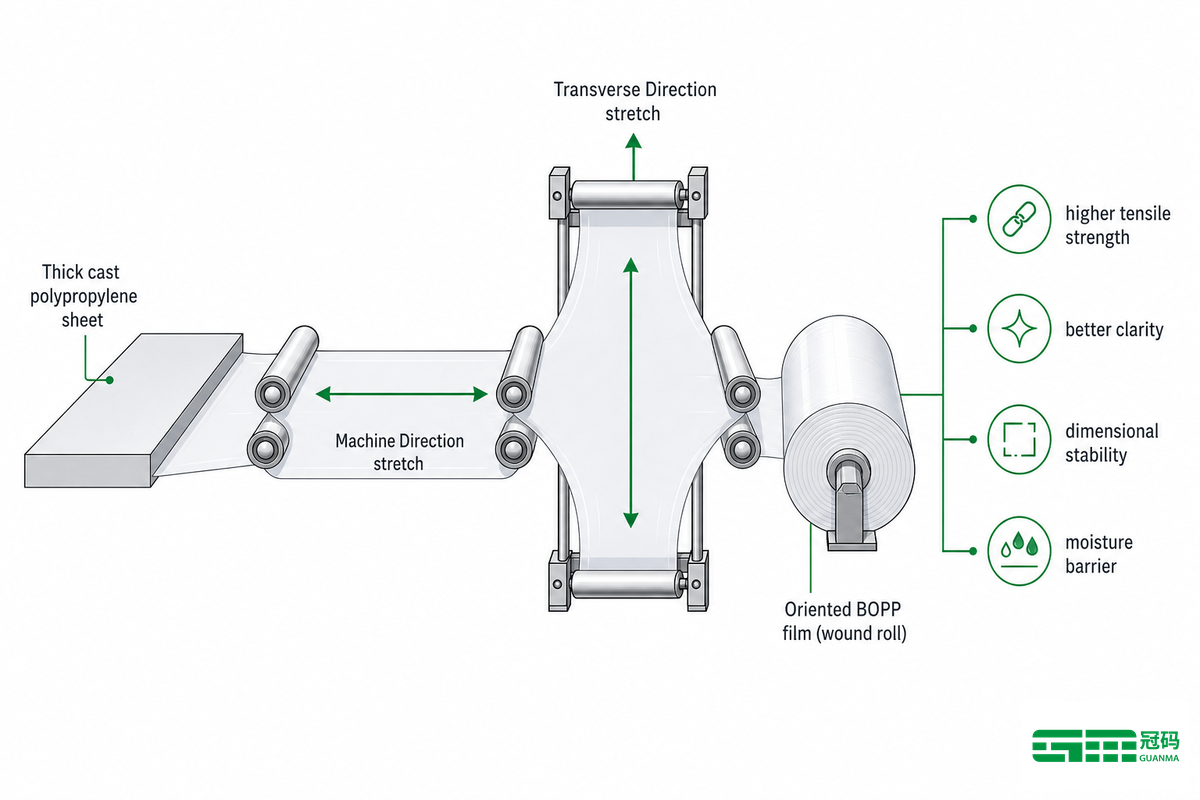
La película de etiquetas BOPP es una cubierta de etiquetas autoadhesiva hecha de polipropileno orientado biaxialmente – una lámina de polipropileno estirada tanto en la dirección transversal como en la máquina, luego recubierta con un adhesivo sensible a la presión sobre un revestimiento antiadherente para que pueda imprimirse, troquelarse, y dispensado como un material duradero y húmedoresistente etiqueta.
Ese estiramiento biaxial es el punto: orientar el polímero en dos direcciones aumenta la resistencia a la tracción, la resistencia a la perforación, la claridad y la estabilidad dimensional, y mejora la barrera de gases y humedad en comparación con el polipropileno fundido (no orientado) Investigación del Departamento de Energía de EE. UU. sobre películas multicapa documentos.
Una aclaración ahorra muchos recursos desperdiciados. Si buscaste “BOPP” y aterrizaste en el sellado de cartón cinta, ese es un producto diferente: la cinta BOPP es un consumible de embalaje, mientras que la película para etiquetas BOPP es un material para etiquetas sensible a la presión diseñado para brindar fidelidad a la impresión y vida útil. Comparten un polímero; no comparten un propósito. El material de calidad para etiquetas es lo que Guanma recubre tal como está terminado Facesco de película con etiqueta BOPP. Este material de película, suministrado como película plástica en rollos, se comercializa según la resistencia y claridad que una etiqueta de papel no puede igualar, razón por la cual las marcas usan BOPP para etiquetar productos que tienen que durar.
P: ¿Qué significa BOPP?
Esas cuatro letras significan polipropileno orientado biaxialmente. “Orientado biaxialmente” describe el paso de producción que estira la película en dos direcciones; El “polipropileno” es el polímero termoplástico. La mayoría de las etiquetas de productos descritas simplemente como “polipropileno” o “poli” son, de hecho, BOPP. Una construcción patentada de película de etiquetas BOPP (USPTO US7144542B2) muestra la construcción típica: una capa base orientada biaxialmente más una capa de cubierta recubierta diseñada para anclaje de tinta y adhesivo.
Acabados frontales BOPP: transparente, blanco, mate, brillante, plateado y perlado
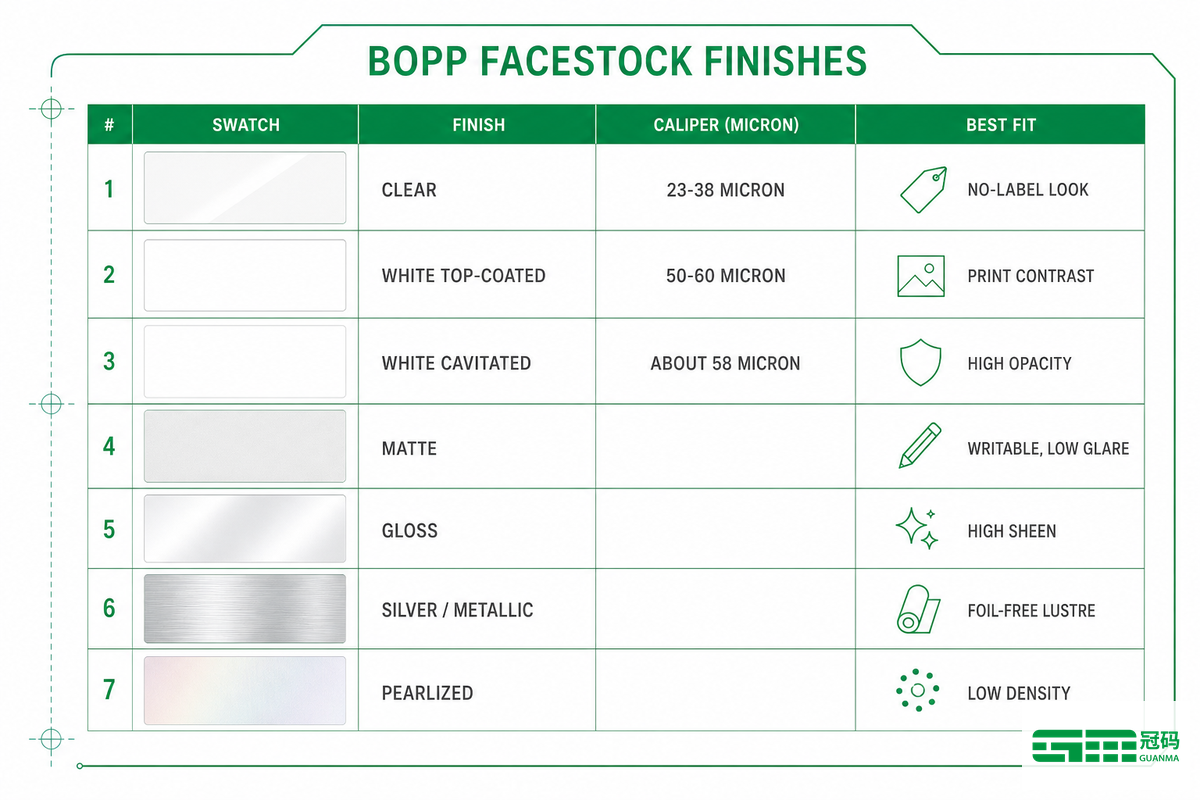
Un frontal BOPP no es una mirada. Un acabado establece la opacidad, el calibre y el atractivo del estante, y se combina de manera diferente con cada adhesivo. Los anclajes BOPP blancos se imprimen para marcas de alimentos y bebidas, mientras que el BOPP plateado y metálico agrega un impacto llamativo en el estante sin el costo del estampado de láminas. Las mediciones independientes ayudan aquí: un estudio de 2023 de calibradores comerciales perlados (cavitados) registrados por BOPP de 25, 30 y 38 µm a densidades de aproximadamente 0,71-0,76 g/cc con opacidad 70%, mientras que los datos de referencia para BOPP transparente/brillante muestran una gravedad específica cercana a 0,90, brillo alrededor de 95% y neblina de 1-2%.
| Tipo de acabado | Pinza típica | Propiedad clave | Mejor ajuste |
|---|---|---|---|
| Claro transparente | 23-38 µm | “Aspecto ”sin etiqueta”, alta claridad (neblina 1-2%) | Bebidas, cosméticos, venta premium |
| Revestimiento superior sólido y blanco | 50-60 µm | Base opaca, alto contraste de impresión | Salud y belleza, alimentación, hogar |
| Blanco, semisólido | ~47 µm | Mayor rendimiento que el blanco sólido, buena opacidad | Comercio minorista general, corridas de valor |
| Blanco, cavitado | ~58 µm | Anulado de baja densidad, opacidad ~91% | Venta al por menor premium, lácteos |
| Mate | ~50 µm | Superficie grabable y de bajo deslumbramiento | Etiquetas de vino, artesanales, instrucciones |
| Brillo | ~50 µm | Alto brillo, color vivo (brillo ~95%) | Embalaje promocional, minorista |
| Plata/metal | ~50 µm | Lustre metalizado sin coste de lámina | Bebidas espirituosas, electrónica, decorativas |
| Perlado (cavitado) | 25-58 µm | Blanco perla suave, baja densidad (~0,71-0,76 g/cc) | Bebida premium, lácteos |
P: ¿Qué acabados están disponibles para las etiquetas BOPP?
Las facestocks principales de BOPP son transparentes, blancas, mate, brillantes, plateadas/metálicas y perladas; encima de estos puede agregar laminación suave al tacto, barniz puntual o lámina fría. Dos precauciones: el BOPP transparente necesita un revestimiento de poliéster transparente y los acabados metálicos o cavitados conllevan una compensación de reciclabilidad (que se cubre a continuación).
Los compradores suelen comprar por acabado “etiquetas BOPP blancas, etiquetas BOPP transparentes, etiquetas BOPP mate o etiquetas BOPP plateadas « y etiquetas BOPP personalizadas combinan el acabado elegido con el adhesivo y el forro adecuados, enviándose en rollos troquelados o hojas de etiquetas BOPP. Guanma's selector de facestock y adhesivo BOPP asigna cada acabado a un adhesivo.
Las películas blancas y los grados de blanco brillante dominan las opciones de etiquetas, mientras que las etiquetas BOPP doradas y los acabados metálicos plateados añaden brillo; Las etiquetas personalizadas combinan cualquiera de ellas con el adhesivo adecuado. La etiqueta BOPP más común es blanca, pero la gama de materiales BOPP va desde transparente hasta metalizado. El BOPP blanco es también la base de la mayoría de las marcas para productos para la salud, la belleza y el hogar.
Por qué la energía superficial y el tratamiento Corona deciden si su etiqueta se pega y se imprime
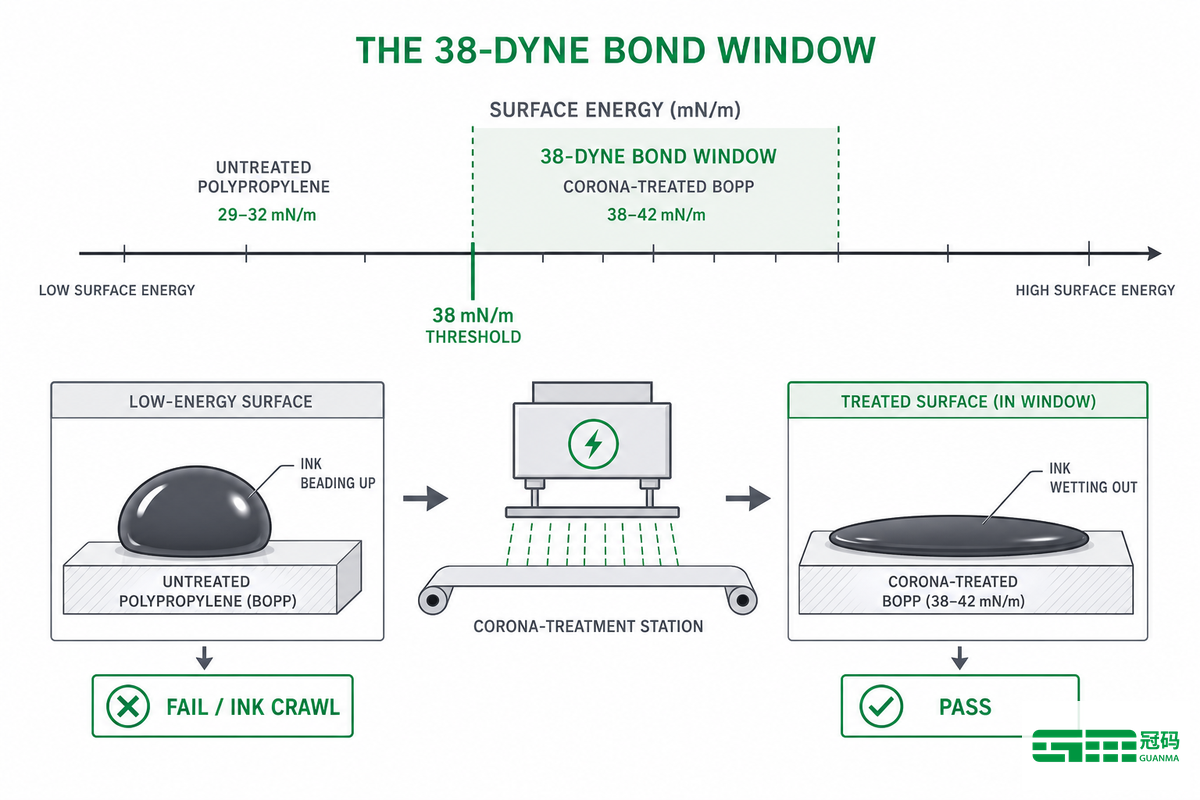
La impresión y la adhesión fallan cuando la energía superficial se encuentra debajo de la ventana de unión; Los PP sin tratar oscilan entre 29 y 32 mN/m y los adhesivos de tinta/PS requieren 38 mN/m para humedecerse y mantenerse adecuadamente. Corona aumenta la energía superficial del PP a 38-42 mN/m para permitir que la tinta y el adhesivo se extiendan en lugar de formar cuentas.
Un método patentado BOPP corona documenta el mismo efecto, alcanzando 38-40 dinas en la película tratada (patente CN116021808B). Bajo esa marca, la tinta se “rasga” y los bordes se levantan.
El polipropileno, un material de “baja energía superficial” (LSE) tal como fue diseñado, es la causa del fenómeno “los materiales LSE se ven bien, pero se abren al entrar en servicio, según informes de servicios de campo sobre aplicaciones de etiquetas fallidas”
A esto lo llamamos el Ventana de enlace de 38 dinas, y es el número más útil que un comprador puede llevar a una discusión sobre BOPP. El tratamiento Corona no durará para siempre ñones se pierden con el tiempo y durante la manipulación. Una película con una lectura de 40 dinos en el carrete de aprobación podría quedar por debajo de la marca de 38 cuando se procesa en línea para volúmenes de producción reales.
📐 Nota de ingeniería « trabajando la ventana de enlace
Una botella de HDPE dice unos 31 mN/m en la superficie. Eso está debajo de la ventana de 38-42 mN/m, por lo que un acrílico estándar no se moja y la esquina de la etiqueta se levanta en cuestión de horas. La reparación requiere dos movimientos: corona-tratar el material frontal BOPP a 38-42 mN/m y combínelo con un acrílico a base de agua o termofusible de alta adherencia clasificado para ese sustrato. Mapee la lectura de dina de su propio contenedor con la línea de 38 mN/m antes de especificar el adhesivo; la superficie, no el grado de la película, generalmente decide la falla. Guanma mantiene el nivel de dina corona dentro de la ventana de 38-42 mN/m como una receta documentada, lote a lote, en lugar de volver a tratar carrete por carrete.
Aquí hay una experiencia de conversión para llevar esto a casa: un taller que administra BOPP pretratado informó problemas de adhesión intermitente y una tasa de rechazo de carrete de aproximadamente 15%, porque el problema no era el grado de la película sino más bien la falta del nivel de dina que se había deslizado a través del inspección entrante; a eso lo llamamos el Deriva Dyne de muestra a producción. Califique para un solo carrete de muestra y descubra que el problema está en toda la ejecución.
BOPP frente a PET, vinilo y papel: una escalera de compensación frontal de 4 películas
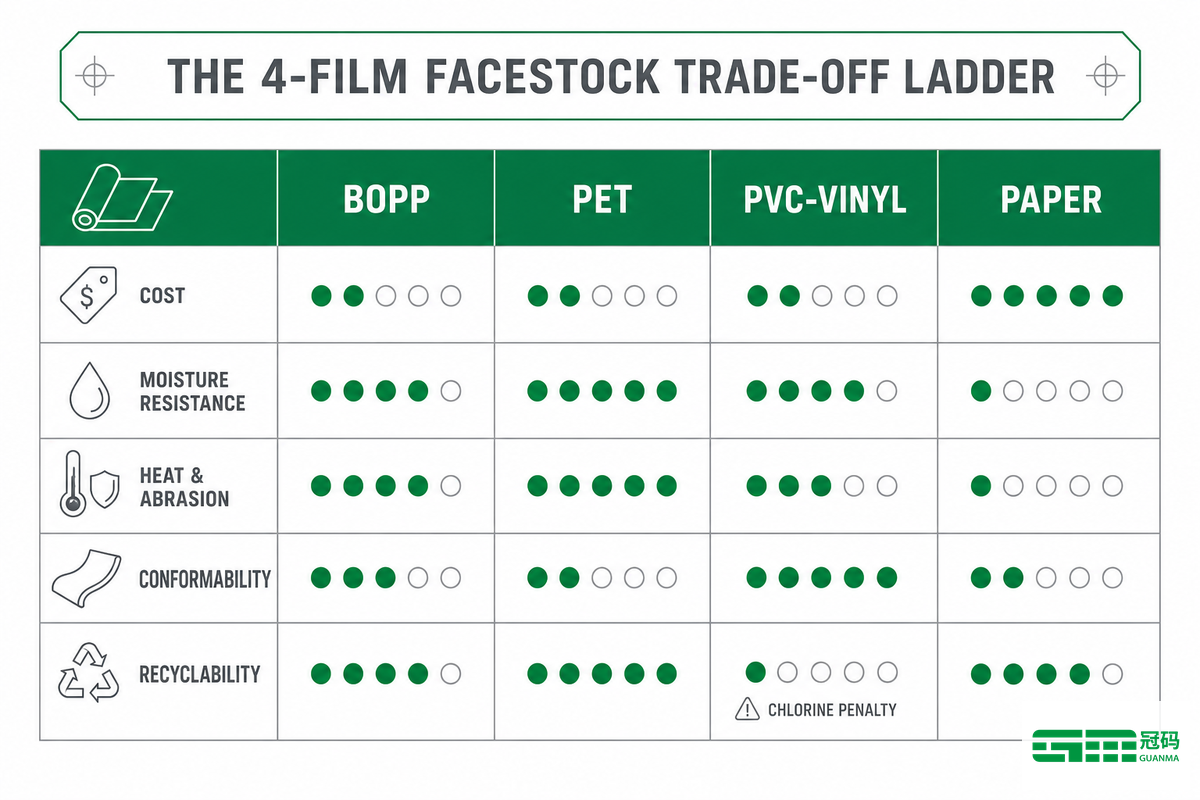
Para la mayoría de las etiquetas de productos, BOPP es el valor predeterminado, pero ese valor predeterminado no es para siempre. Más honestamente, la comparación es un continuo en el que se equilibran el costo, la conformabilidad y la sostenibilidad. Como película plástica, BOPP ofrece una excelente durabilidad en vidrio y plástico donde falla una etiqueta de papel, lo que la convierte en una etiqueta duradera en la mayoría de las líneas; Sin embargo, para los tubos de compresión, las etiquetas BOPP semicampillables todavía siguen a la poliolefina, que sigue siendo la etiqueta preferida allí.
| Propiedad | BOPP (PP) | PET (poliéster) | PVC/vinilo | Papel |
|---|---|---|---|---|
| Costo relativo | Bajo-moderado | Alto | Moderado-alto | Más bajo |
| Resistencia a la humedad | Excelente | Excelente | Excelente | Pobre (sin recubrimiento) |
| Calor/abrasión/disolvente | Bien | Mejor | Bien | Bajo |
| Conformabilidad a curvas | Bueno (no completamente comprimible) | Más rígido | Más flexible | Bien |
| Historia de la reciclabilidad | Compatible con mono-PP en contenedores de PP/PE | Reciclable en flujo de PET | Penalización a base de cloro | Reciclable (fibra) |
| Claridad de impresión (“sin etiqueta”) | Excelente (claro) | Excelente | Bien | n/a |
Las reglas generales tienden a venir en sólo dos. Primero, opte por a Faces de PET-en lugar de BOPP-, si la aplicación es realmente extrema: temperaturas constantemente altas, solventes corrosivos o exposiciones duras a largo plazo a la radiación ultravioleta y la abrasión. En segundo lugar, el vinilo se ve muy bien envuelto en contornos, pero como un plástico de cloruro de polivinilo conlleva una penalización para el cloro en los esquemas de reciclaje, una penalización que los propietarios de marcas están empezando a evitar en favor del perfil BOPP más limpio y generalmente más barato, una monopoliolefina.
Si se va a exprimir 'lociones o botellas de queso', la poliolefina o el polietileno pueden ser los mejores, mientras que para obtener una combinación de buena durabilidad y el precio correcto, BOPP es el de facto. Y normalmente se encuentra en alimentos, bebidas y artículos de cuidado personal.
Impresión y conversión de BOPP: Flexo, UV, transferencia térmica y cubiertas superiores
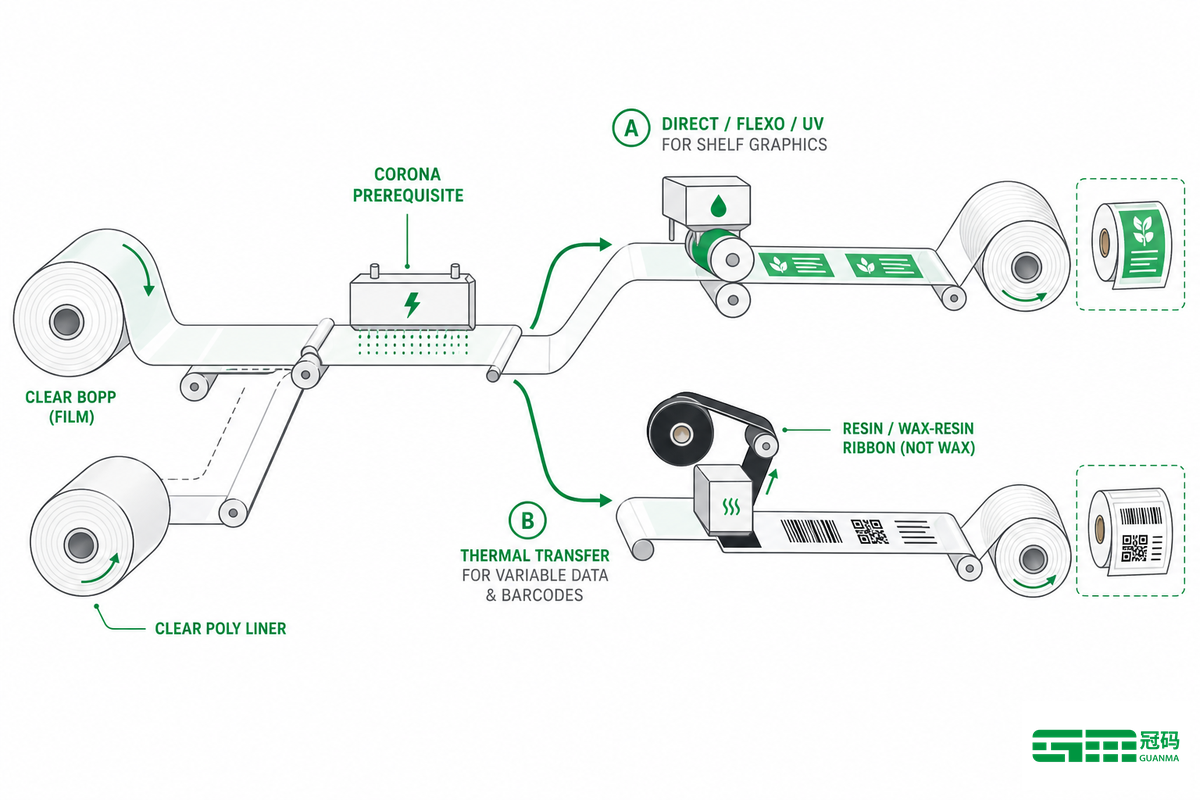
En la prensa, la película de etiqueta BOPP toma tinta a base de agua y disolvente y se ejecuta en impresoras flexográficas, offset, UV y de transferencia térmica, cuando se trata con corona y, opcionalmente, se recubre con tapa para manejar tintas desafiantes. Literatura técnica sobre modificación de superficie de BOPP aclara el mecanismo: el tratamiento corona eleva la baja energía superficial y hace que la tinta se ancle, no se manche. El material frontal con revestimiento superior blanco permite un buen anclaje de tintas de transferencia térmica, flexográfica y UV, con grados claros que optimizan la superficie de impresión para la transparencia de tintas y películas transparentes.
Dos campos de impresión cubren la película de etiquetas BOPP: directa, flexográfica y UV para gráficos de estantes, y transferencia térmica para datos variables. En estas técnicas de impresión, la película toma tintas a base de agua y solventes, por lo que la impresión de etiquetas BOPP cubre tanto gráficos vívidos de estantes como códigos de barras duraderos. Si está ejecutando etiquetas térmicas BOPP para uso duradero o logístico, la elección de la cinta es clave. Una cinta de resina o cera-resina ofrece una unión mucho mejor a BOPP que las cintas de cera construidas para papel, que pueden desprender polipropileno de baja energía superficial en unas semanas y dejar caer un código de barras por debajo del contraste de grado de escaneo. No vuelva a ejecutar el trabajo: si es un BOPP transparente, necesita un revestimiento de poliéster transparente para su planitud, y la mejor manera de garantizar la imprimibilidad es verificar el nivel de dina del carrete entrante en su prensa, no la muestra original. No caiga en grados genéricos « Guanma coincide con cada uno facestock y capa superior a la prensa y tintas.
Un error de impresión común es calificar la tinta o cinta en el carrete de aprobación y omitir la verificación de la dina del carrete entrante. En la práctica, un conversor que lo hace puede perder un cambio de producción completo para frotar la tinta antes de rastrearla hasta un material frontal que pasó de 40 a 36 dinas/cm almacenado «por debajo de los 38 mN/m de tinta necesaria. Una lectura de dinosaurio de 60 segundos en el desenrollador lo atrapa antes que la prensa.
Combinación de construcciones BOPP con aplicaciones: bebidas, alimentos, congeladores, neumáticos y productos químicos
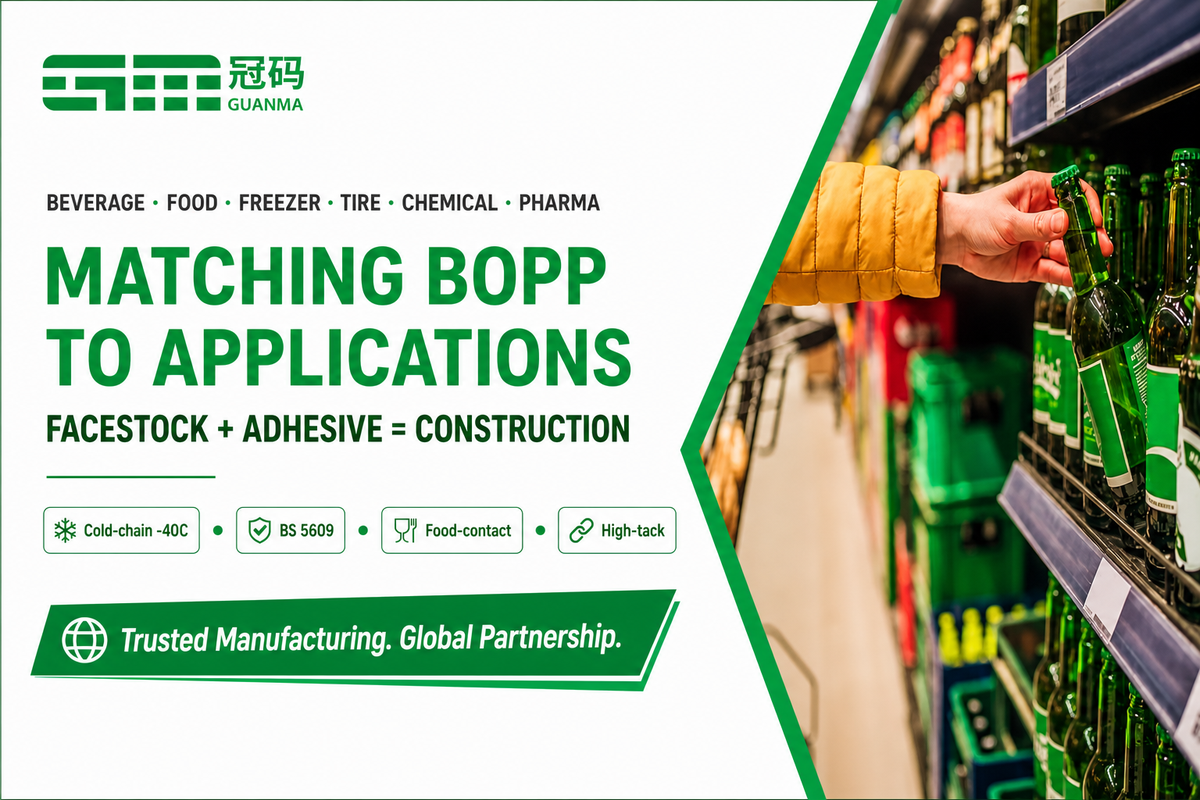
Cuando piense en un material de etiqueta BOPP, defínelo siempre como una construcción (faces, adhesivos y revestimientos). Aquí hay una guía para lo que normalmente especifica el entorno de aplicación, desde etiquetas de cuidado personal y productos para el hogar hasta productos aceitosos, resistencia a los ácidos para alimentos con bajo contenido de pH y productos químicos y luz ultravioleta en tambores industriales, donde BOPP suele ser la mejor etiqueta para envases de marca sujetos a estrictos estándares de calidad:
| Aplicación | Construcción | Requisito que resuelve |
|---|---|---|
| Bebida y vino | Bopp transparente o perlado + acrílico resistente a la humedad | Sobrevive a la condensación y la inmersión en cubos de hielo, aspecto premium |
| Envases de alimentos | Bopp blanco/transparente + a base de agua en contacto con alimentos | Resistencia a la humedad y a las grasas ligeras con un adhesivo compatible |
| Congelador/cadena de frío | Bopp blanco o transparente + acrílico ultracongelado | Se aplica y mantiene presionado hasta aproximadamente -40 °C sin elevación de esquina |
| Neumático | Bopp blanco + acrílico permanente de alta adherencia | Se adhiere al caucho de baja energía superficial mediante abrasión y apilamiento |
| Químico/tambor | Bopp blanco + acrílico resistente a disolventes, construcción BS 5609 | Servicio de inmersión marina; llevar información GHS/HazCom |
| Farmacéutico | Blanco BOPP + acrílico controlado por migración | Fidelidad de impresión, trazabilidad, removibilidad limpia cuando sea necesario |
| Durable/exterior | Blanco BOPP + acrílico permanente estable a los rayos UV | Resistencia a la intemperie y a los rayos UV para un servicio exterior prolongado |
| Extraíble | Bopp blanco + acrílico extraíble | Cáscara limpia sin residuos sobre activos retornables |
(Nota importante: dos notas específicas sobre aplicaciones no pueden determinarse únicamente por la construcción: para las etiquetas de los alimentos, es solo el adhesivo aprobado para los alimentos (no el material frontal) el que requiere conformidad con FDA 21 CFR 175.105 según el uso prescrito, y para los contenedores de productos químicos, solo la etiqueta terminada está sujeta a las pruebas BS5609 Sec 2 y transporta mensajes compatibles con GHS/HazCom por separado del rendimiento)
Cómo leer una hoja de especificaciones de BOPP y calificar a un proveedor
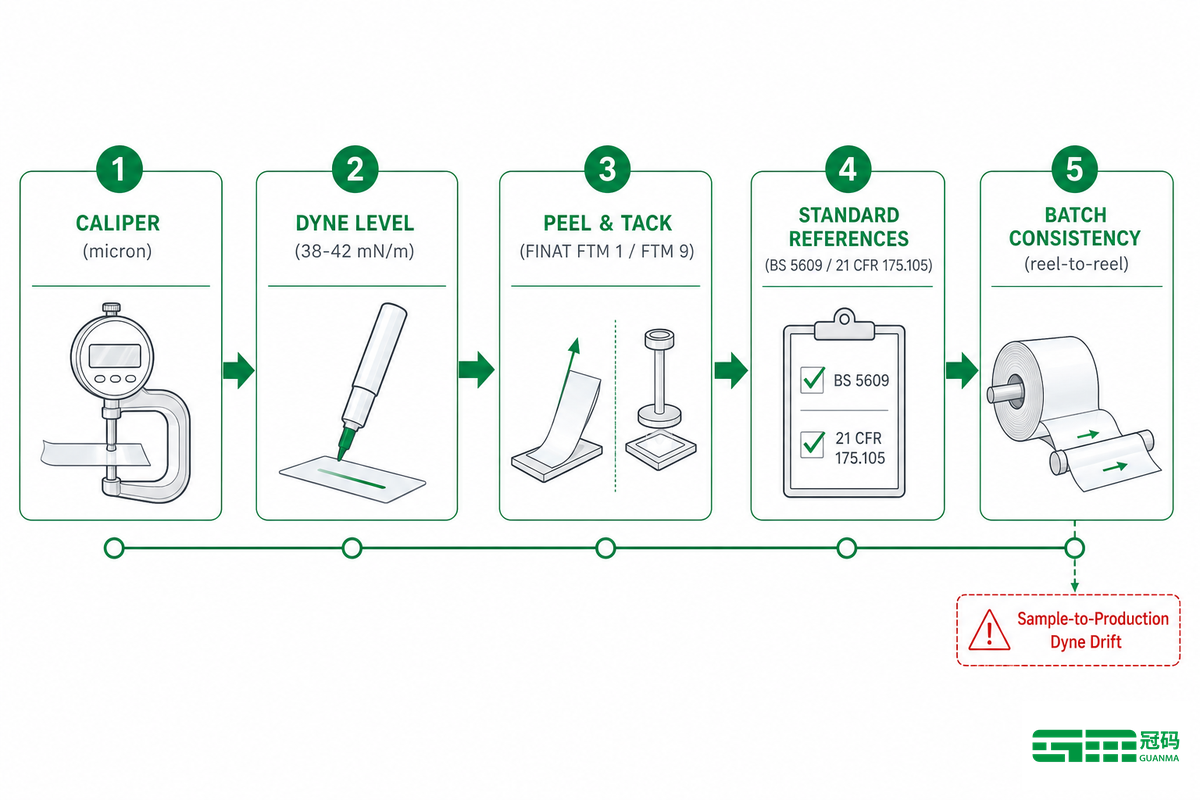
Cómo definir sus números «confinando un material de etiqueta BOPP, necesita más que la descripción del material; comprender lo que significan los números publicados le ayudará a evitar fallas en la aplicación. Las pruebas comunes en materiales de etiquetas se relacionan con la adhesión, a menudo definida como: FINAT FTM 1 (peel Adhesion @ 180 grados) y FINAT FTM 9 (Loop Tack), ambas del orden de Newtons. La adhesión a menudo también se publicará en ASTM D3330 (peel adhersion de materiales sensibles a la presión). Estos números le dan una idea del orden de magnitud. Un ejemplo: la adhesión acrílica a base de agua tiene 24hr Peel @ 180deg FINAT FTM 1 = 11 N (180), Loop Tack FINAT FTM 9 = 14N. Recuerde el descargo de responsabilidad de ASTM en D3330 para obtener información sobre el diseño.
La secuencia de calificación de proveedores de BOPP de 5 controles
- Calibrador - El espesor del material frontal en micrómetro. Consulte las especificaciones de su cortador y equipo dispensador.
- Dyne Nivel -gnol Solicite una energía superficial Corona de 38-42 mN/m con un método para garantizar la estabilidad y el mantenimiento.
- Peel / Tack -ñales Verás resultados publicados en estándares Finat como FTM 1 (Peel) y FTM 9 (Loop Tack). También puede ver ASTM D3330. Pregunte cómo son esas cifras para su sustrato real, no para algún sustrato ficticio genérico en un laboratorio.
- Referencias de uso final «Si es una etiqueta de tambor químico, solicite documentación de pruebas y cumplimiento de BS5609 Parte 2. Para una etiqueta de alimento, ¿cuáles son las conformidades reglamentarias específicas del adhesivo (FDA 21 CFR 175.105 ).
- Consistencia – qué medidas existen para garantizar la consistencia del tratamiento de la superficie, el peso de la capa adhesiva, el revestimiento, etc. carrete a carrete en lugar de una muestra única.
El último es probablemente el que la mayoría de los compradores omiten y probablemente todos se arrepienten. El error de abastecimiento más caro es no pagar demasiado un metro cuadrado 'es validar el material para una ejecución de aprobación y luego tenerlo de carrete a carrete en producción. Vincula su construcción a su receta validada y pregunta a cualquier proveedor cómo mantienen la consistencia de lote a lote antes de evaluar las ofertas. Guanma proporciona valores del método FINAT a pedido y mantiene los pesos de tratamiento y recubrimiento de superficies según una receta definida y validada, que es como limitamos Sampe a Production Dyne Drift. Completa tus especificaciones con Guanma's Creador de RFQ de película de etiqueta BOPP.
¿es BOPP la opción sostenible? La reciclabilidad de monomateriales y las perspectivas para 2026
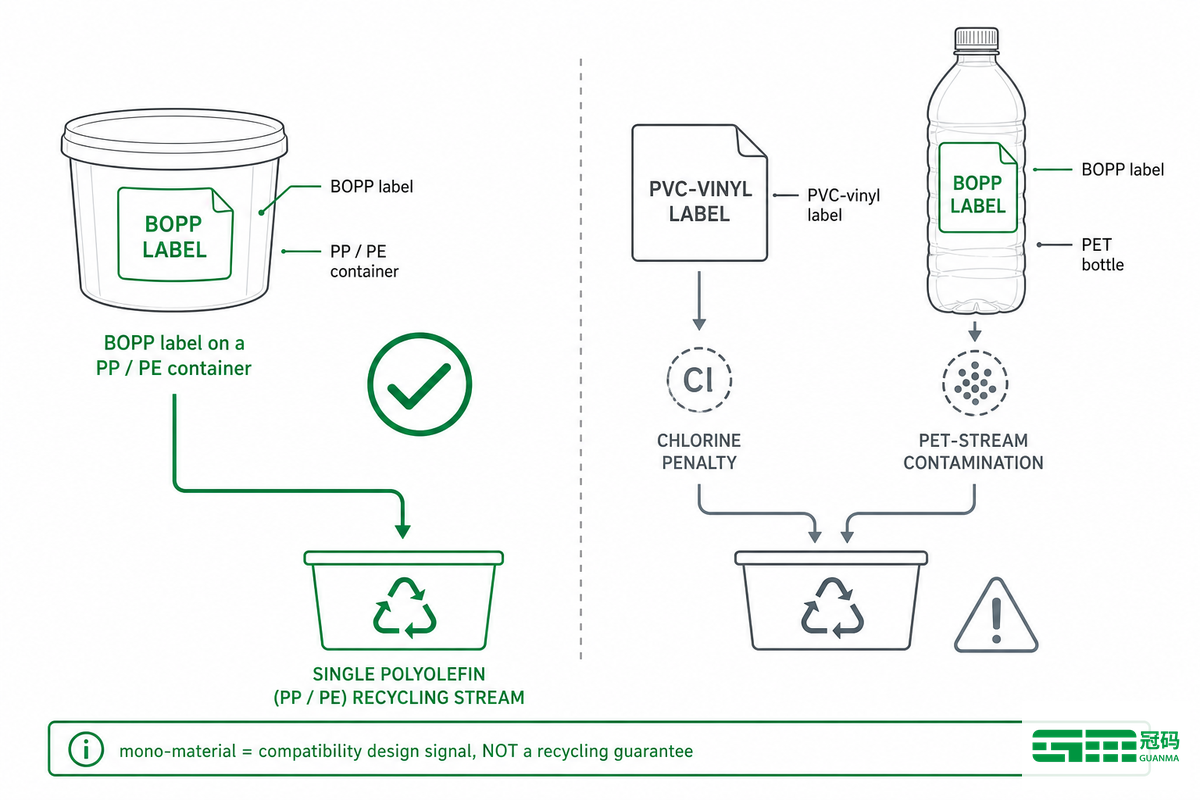
En este momento, la tendencia más importante que da forma a las opciones de facestock es el movimiento hacia diseños monomateriales. Las perspectivas de la industria para 2026 coinciden constantemente en eso las películas monomateriales tienen una gran demanda: Los envases fabricados con polímeros alineados con etiquetas y los envases se pueden clasificar y reciclar mucho más fácilmente. Esta facilidad está ayudando a que las iniciativas de sostenibilidad y las configuraciones de monomateriales impulsen la evolución de los envases y películas flexibles. En el embalaje, el factor principal seguirá siendo la reciclabilidad. Las aplicaciones de etiquetado con diseños de monomateriales pueden incluir etiquetas BOPP en contenedores de polipropileno o polietileno, lo que garantiza que ambos componentes estén dentro de la misma familia de materiales (una estructura fácilmente procesada por la industria común de reciclaje de poliolefinas versus una etiqueta de vinilo que puede incluir cloro, que requiere su propio conjunto de equipos de flujo de procesamiento para eliminar eficazmente.
“La reciclabilidad se decide por si todo las características de un paquete, incluidas etiquetas, tintas, adhesivos y metalización, son compatibles con una corriente de reciclaje determinada, no solo con el polímero frontal”
Asociación de Recicladores de Plástico, Guía de Diseño APR
Hay dos aclaraciones importantes que impiden que esta discusión se vea ecologizada: la primera es comprender que el diseño ‘monomaterial’ en realidad sólo actúa como indicador de compatibilidad, no como garantía de un procesamiento real al final de su vida útil : la más reciente contabilidad de la EPA de EE. UU Coloca los plásticos reciclados en los EE. UU. en tan solo 8,7%, lo que indica que las cuestiones prácticas relacionadas con la recolección, clasificación e incluso la elección del material adhesivo son tan importantes como la química básica del polímero. En segundo lugar, las películas BOPP metalizadas, muy cavitadas o con apariencia metálica pueden crear desafíos durante la clasificación. En Estados Unidos, las directrices APR proporcionan mejores prácticas y advierten que ciertos aditivos, como los que alteran la densidad y metalización de una película, pueden requerir pruebas adicionales o impedir el reciclaje adecuado del artículo. Por lo tanto, elegir un BOPP plateado para lograr un impacto estético es intrínsecamente una opción de sostenibilidad del embalaje para marcas centradas en la reciclabilidad. El embalaje, incluidas las etiquetas, forma parte de un ecosistema más amplio, por lo que un enfoque conjunto para el diseño de envases “la película BOPP se especifica teniendo en cuenta la reciclabilidad y se combina con un contenedor diseñado para el mismo objetivo “debe probar todo el paquete, no sólo el material frontal.
Preguntas frecuentes
P: ¿Qué es la película BOPP con etiqueta?
Ver respuesta
Una película de polipropileno orientada biaxialmente que sirve como revestimiento autoadhesivo. Esta estructura autoadhesiva incluye una capa tratada con corona que permite la adhesión de la tinta, una capa adherida de adhesivo sensible a la presión y un sustrato de revestimiento antiadherente. La película BOPP de calidad para etiquetas es diferente de la película de embalaje BOPP o de la cinta BOPP, ya que está diseñada específicamente para los altos niveles de precisión, capacidad de troquelado y facilidad de dispensación asociados con la producción y el uso de etiquetas. Estas películas para etiquetas están disponibles en una variedad de apariencias, incluidos acabados transparentes, blancos, mate, brillantes, perlados y metálicos.
P: ¿BoPP es más barato que PET?
Ver respuesta
Generalmente sí. Es una película de valor medio, mientras que el PET representa un producto de valor medio a alto. Si bien el BOPP y el PET son inherentemente resistentes a la humedad, el PET de calidad superior resiste mucho mejor el contacto prolongado con altas temperaturas, soluciones químicas duras y condiciones de uso intensas en interiores y exteriores a largo plazo. Dadas las demandas típicas de rendimiento impuestas a las etiquetas de los productos minoristas, que para la gran mayoría no encuentran condiciones extremas como estas, el BOPP proporciona suficiente funcionalidad a un precio de material reducido, lo que lo convierte en la opción preferida para la mayoría de las aplicaciones de alimentos, bebidas, cuidado personal y cosméticos.
Zegbrk_0005
P: ¿Es reciclable la película de etiqueta BOPP?
Ver respuesta
Podría serlo, pero la reciclabilidad es función de todo el paquete, no de la película aislada. Una etiqueta BOPP en PP o PE mantendrá el aspecto monomaterial del embalaje y proporcionará una separación “más limpia”. Si se utiliza en una botella de PET, dependiendo del pegamento y el nivel de metalización/cavitación intensa, puede comprometer ese flujo de reciclaje.
Siempre verifique la combinación de embalaje y película con la transmisión prevista.
P: ¿Se puede imprimir BOPP sin tratamiento corona?
Ver respuesta
Generalmente no. Son 29-32 mN/m pero las tintas y adhesivos tendrán una tensión superficial de ~38 mN/m antes de mojar el material, lo que hará que la tinta se arrastre y los bordes se despeguen. El proceso de tratamiento corona aumenta la energía superficial hasta ~ 38-42 mN/m.
P: ¿Qué espesor tiene la película etiquetada BOPP?
Ver respuesta
Los calibradores frontales varían ampliamente entre 15 y 50 µm. Las culatas transparentes son las más delgadas, 23 y 38 µm, para envolver en botellas curvas; las culatas con revestimiento superior blanco más grueso cuestan aproximadamente 47,60 µm para el contraste y la opacidad de la impresión; mientras que las culatas cavitadas perladas de menor densidad pueden oscilar entre 25 y 58 µm.
P: ¿El BOPP blanco es resistente al agua?
Ver respuesta
White BOPP resistente al agua en lugar de prueba es la frase técnica correcta, si se comercializa ‘menos vendible’. Debido a que el agua no penetrará en el material frontal, las etiquetas tendrán salpicaduras de humedad, sudor, condensación, baño humeante y condiciones de humedad, de ahí su uso generalizado en recipientes de cocina y bebidas y para aplicaciones en ‘ambientes húmedos’. ¡Pero no intentes usarlo en un sumergible!
La inmersión en agua real y los ambientes marinos dependen de la laminación total ‘Facestock + adhesivo + superposición(es) - y si se solicita una norma BS 5609 o si la etiqueta es para cualquier cosa a bordo de un barco o un tambor químico, solicite específicamente ’marino etiquetas de grado.
P: ¿Cuál es la diferencia entre BOPP y etiquetas de vinilo?
Ver respuesta
BOPP es un tipo de película de polipropileno; es más delgada, menos costosa de producir y se puede reciclar como monopoliolefina con embalaje de PP/PE. La película de vinilo (PVC) es más gruesa y puede soportar los contornos de las esquinas estrechas con relativa facilidad, aunque incurre en un recargo por reciclabilidad relacionado con el cloro. Sin embargo, para la mayoría de las etiquetas, BOPP ofrece la robustez que los clientes necesitan sin los costos ambientales y económicos del vinilo – y eso solo se abre paso en aplicaciones premium cuando se requiere ultraconformabilidad y durabilidad extrema en exteriores.
Acerca de esta guía
Las barreras de energía superficial, las referencias a FINAT y BS 5609 y el control de dina corona en esta guía documentan la forma en que se aplica Guanma y laminan la película de etiquetas bopp en nuestras instalaciones de Tailandia y Vietnam. El frontal, el adhesivo y el revestimiento se suministran y gestionan juntos como una receta documentada, lote por lote. Revisado y aceptado por el equipo técnico de Guanma.
Referencias y fuentes
- Descifrando el código de las películas multicapa para promover la circularidadDepartamento de Energía de EE. UU. (OSTI)
- Plásticos: datos específicos del materialAgencia de Protección Ambiental de EE. UU
- 21 CFR 175.105, Adhesivos (aditivos alimentarios indirectos)código de Regulaciones Federales de EE. UU
- ASTM D3330 / D3330M, Adhesión al pelado de cinta sensible a la presiónASTM Internacional
- Métodos de prueba FINAT (despegue FTM 1, tachuela de bucle FTM 9)FINAT
- Pruebas de etiquetas de uso marino (BS 5609), revisión de 2024Soluciones UL
- Guía de diseño APR, guía flexible PPAsociación de Recicladores de Plástico
- Directrices de diseño para el reciclajeRecyClass
- Polipropileno Orientado Biaxialmente, referencia de ingenieríaCienciaDirecta
- US7144542B2, Película etiquetada con adhesión mejoradaUSPTO
Artículos relacionados
- Película para etiquetas BOPP, especificaciones de material frontal recubierto a medida
- Película adhesiva autoadhesiva, PET, BOPP y material facial de papel sintético
- Alternativa al material frontal, desgarrador y resistente al agua del papel sintético
- Convertidor de espesor de película de etiqueta BOPP (μm/medidor)
¿busca una construcción de película de etiqueta BOPP personalizada diseñada para el trabajo (su sustrato, su acabado, sus objetivos de reciclaje)?