Liên hệ với Guanma

![How to Choose Removable Label Material [2026 Guide]](https://guanmalabel.com/wp-content/uploads/2026/08/how-to-choose-removable-label-material-featured.png)
How to choose removable label material is a specification process: match the surface, dwell time, removal target, exposure, print method, regulated-use status, and end-of-life stream before naming a facestock or adhesive. Only after those inputs are clear should you compare coated paper, BOPP synthetic paper, PET film, removable adhesive, and liner choices.
Selection rule
No removable label is a single material; it is a construction: facestock, adhesive, liner, ink, surface, and use condition. Even the same label that removes cleanly from glass after two days may leave residue on low-energy plastic after heat, moisture, or longer dwell.
Quick Answer: Choose by Surface, Dwell Time, and Removal Target
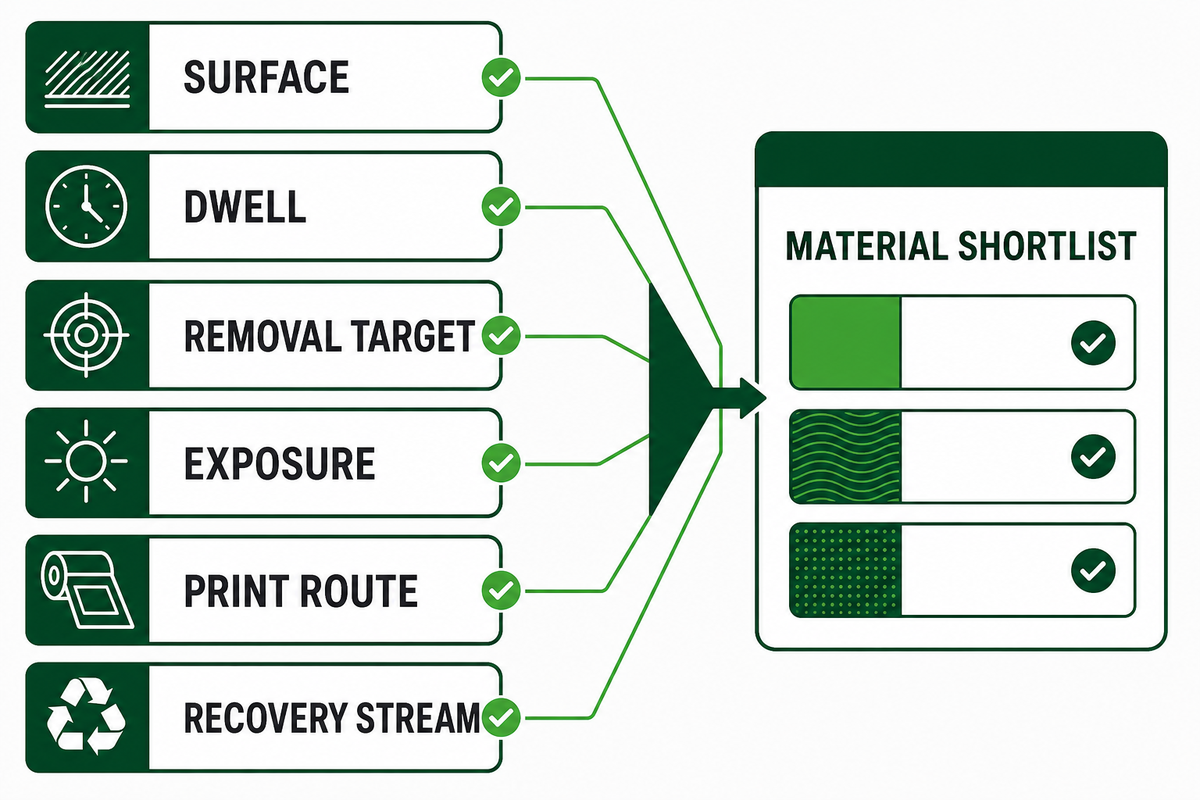
Choose removable label material by defining the job before naming the material. Surface, dwell time, removal target, exposure, print method, regulated use, and recovery stream tell you whether to test coated paper, BOPP synthetic paper, PET film, a low-tack adhesive, a repositionable adhesive, or a wash-off system; for food-contact pressure-sensitive adhesive boundaries, use 21 CFR 175.125 as a regulated-use checkpoint.
| Question | Why it changes the material | What to send for sampling |
|---|---|---|
| What surface will receive the label? | Glass, PET, PP, PE, coated carton, metal, and textured surfaces all change peel behavior. | Photos plus a real container, lid, pouch, carton, or panel. |
| How long must it stay on? | Adhesive bonds can build over time, so a short trial may hide long-dwell residue risk. | Expected dwell time: hours, days, weeks, months, or seasonal storage. |
| What must happen at removal? | Clean release, repositioning, relabeling, recycling, and wash-off are different goals. | Removal target: no residue, no tearing, no surface stain, wash removal, or controlled peel. |
| Is there a regulated or recycling stream? | Food-contact adhesive limits and PET recycling guidance can override a generic paper-versus-film choice. | Food-contact path, market jurisdiction, and PET/HDPE/PP/paper recovery requirement if known. |
Define the Label Job Before You Choose Material
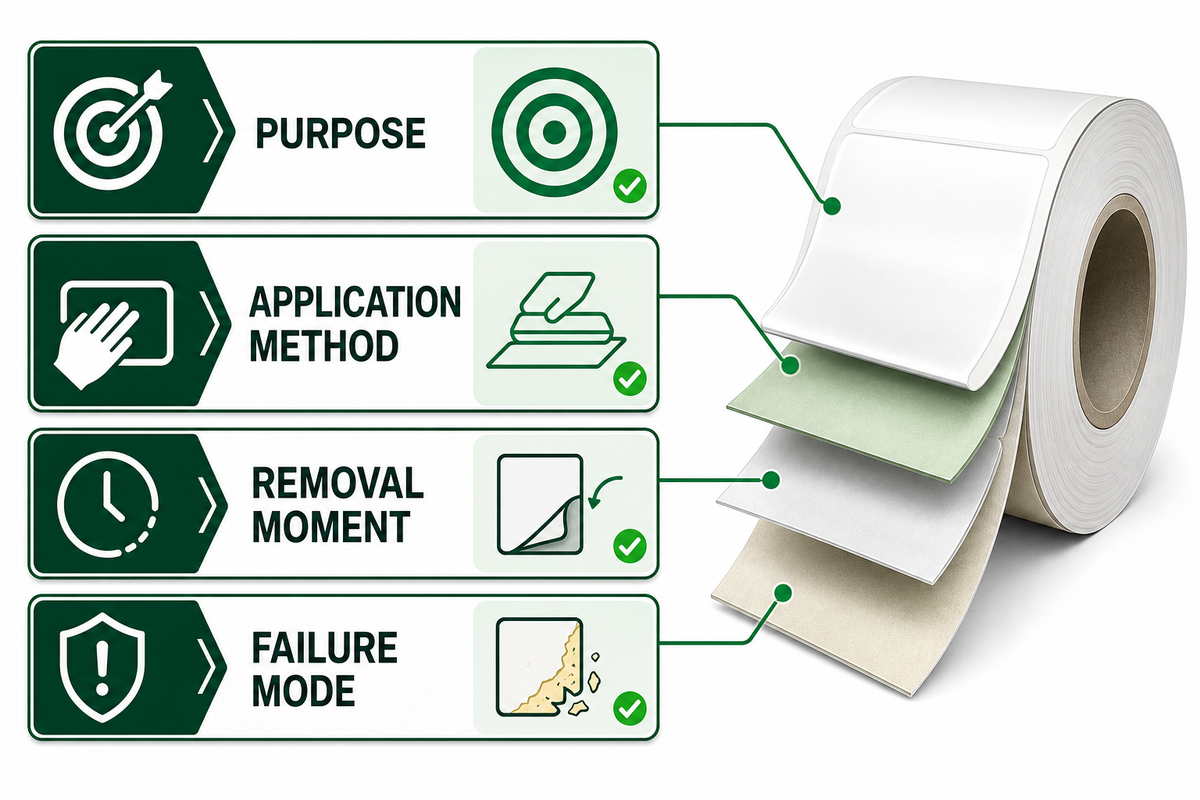
Material choice becomes clearer when the label job is separated from the label name. Temporary price labels, promotional stickers, wet-wipe lid labels, reusable container labels, inspection labels, and durable temporary markings can all be removable, but they do not need the same facestock or adhesive.
Define the job by stating what the label must survive before removal. For a dry retail sticker, print clarity and low cost may matter most; a wet-wipe lid label must resist moisture and repeated handling, while a warehouse inspection label may need scannability and a clean removal window after routing or quality control; NIST peel-test research is a useful reminder that peel behavior changes with material and test conditions.
Job-definition fields
- Label purpose: price, promotion, closure, tracking, instruction, inspection, or relabeling.
- Application method: hand-applied sheet, automatic labeling roll, thermal transfer roll, inkjet, laser, or flexographic print.
- Removal moment: immediately repositioned, removed by the buyer, washed off during reuse, or stripped before recycling.
- Failure mode to avoid: residue, edge lift, facestock tearing, ink rub, liner release issues, or substrate damage.
This job-first approach also protects the article from becoming a generic removable-label explainer. In product labeling, labels are designed around a job: choose the right construction to hold long enough, then remove without leaving unacceptable residue or surface damage.
Choose the Facestock: Coated Paper, BOPP Synthetic Paper, or PET Film
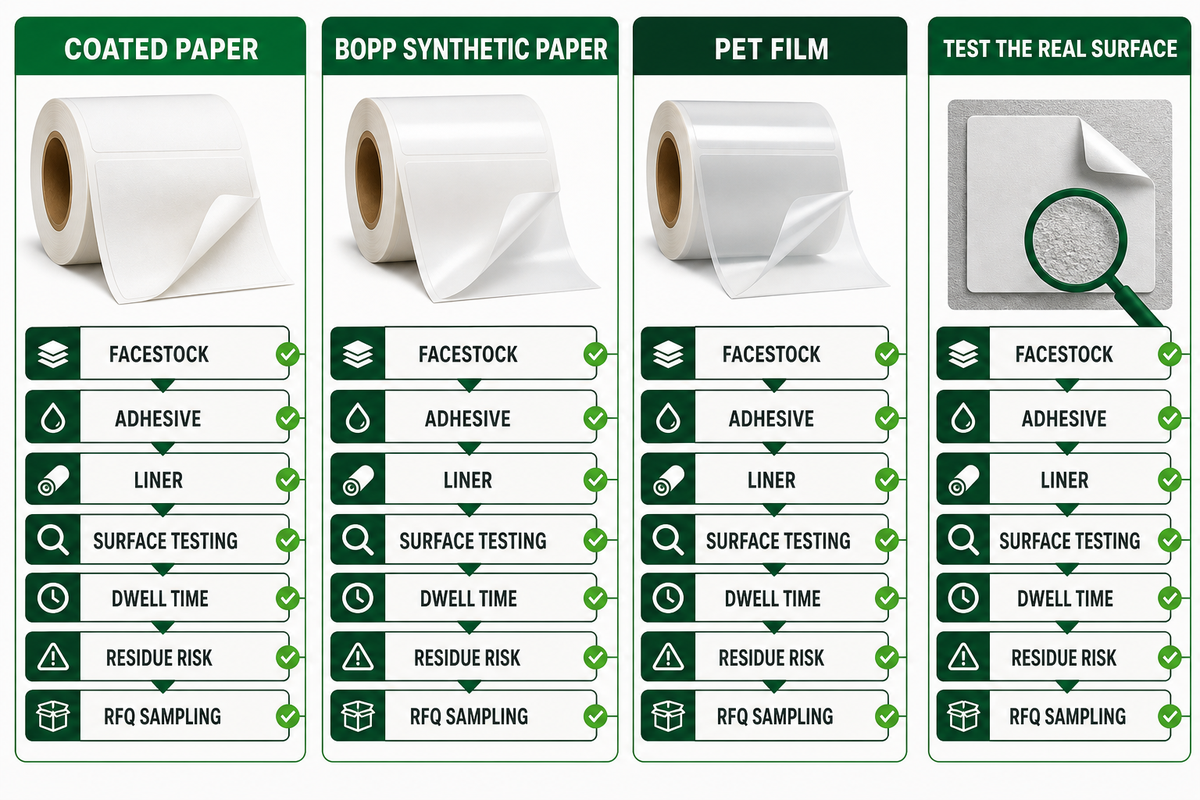
Facestock carries the print and sets the first durability boundary. Coated paper is often the first sample for dry, short-life labels. BOPP synthetic paper gives better moisture and tear resistance. PET film is a stronger starting point when dimensional stability, clarity, or durable temporary marking matters.
| Facestock | First sample path | Giới hạn để kiểm tra | Recovery-stream caveat |
|---|---|---|---|
| Giấy tráng | Dry retail labels, short-life promotions, indoor cartons, and price stickers. | Moisture, tearing at peel, ink rub, carton-fiber damage, and paper dust. | For PET recycling streams, paper labels need extra caution because paper can be detrimental in PET reclamation, as noted in APR PET thermoform guidance. |
| BOPP synthetic paper | Moisture-prone goods, wet-wipe lids, cosmetics, flexible containers, and handled products. | Surface energy, curl, static, print method, and whether a low-density film behavior is desired. | Low-density PP or PE film labels can separate from denser PET in water-based recycling steps when paired with suitable adhesive behavior. |
| Phim PET | Dimensional stability, durable temporary labels, clear labels, or tougher handling. | Stiffness on tight curves, cost, print anchorage, and removal from the actual substrate. | PET film is not automatically the best recycling answer; it depends on container stream, label density, ink, adhesive, and testing. |
Guanma’s removable-label material examples include coated paper, BOPP synthetic paper, PET film, removable adhesive, and glassine or CCK liner. Treat those as practical starting builds, not as proof that one construction will remove cleanly from every customer’s surface.
For adjacent base-stock context, compare Guanma’s giấy tự dính category with its Màng dính PET page before deciding whether paper economy or film stability is the better first sample.
Choose the Adhesive: Removable, Low-Tack, Repositionable, or Wash-Off
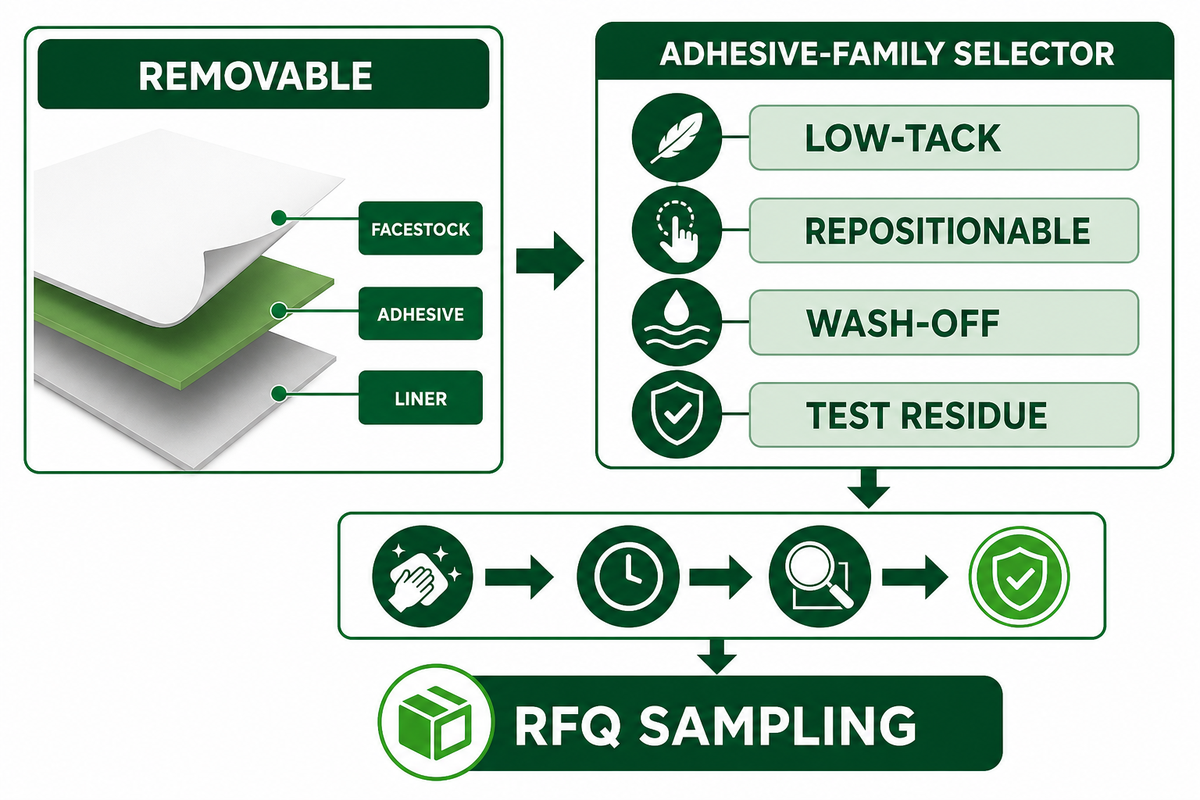
Adhesive type should be chosen by the hold-and-removal target, not by the word removable alone. Low-tack labels may release easily but lift too soon; repositionable adhesive must tolerate correction, and wash-off adhesive is a recovery or reuse choice, not simply a weaker adhesive. For controlled peel comparisons, ASTM D3330/D3330M-04(2025) is a method reference, not a clean-removal guarantee.
| Adhesive goal | Use when | Đừng giả sử |
|---|---|---|
| Keo dán có thể tháo rời | It must hold through normal handling, then peel away with controlled force. | That it will be residue-free on every surface after long dwell. |
| Low-tack adhesive | Sensitive surfaces, short dwell, and easy removal matter more than ultimate hold. | That low tack will resist moisture, oil, flexing, or curved-package stress. |
| Keo dán định vị lại | Operators need correction time during hand application or early placement. | That it will stay repositionable after weeks of dwell. |
| Wash-off adhesive | Reuse, bottle washing, PET recovery, or label removal during a wash step is part of the specification. | That wash-off behavior is proven without testing the complete label, ink, adhesive, and container stream. |
Practical warning: more tack is not always better. When a removable label grabs too hard, it can tear, stain, or turn into a near-permanent bond after a long dwell; when it starts too weak, edge lift can appear before the product reaches the shelf.
Match the Material to the Surface
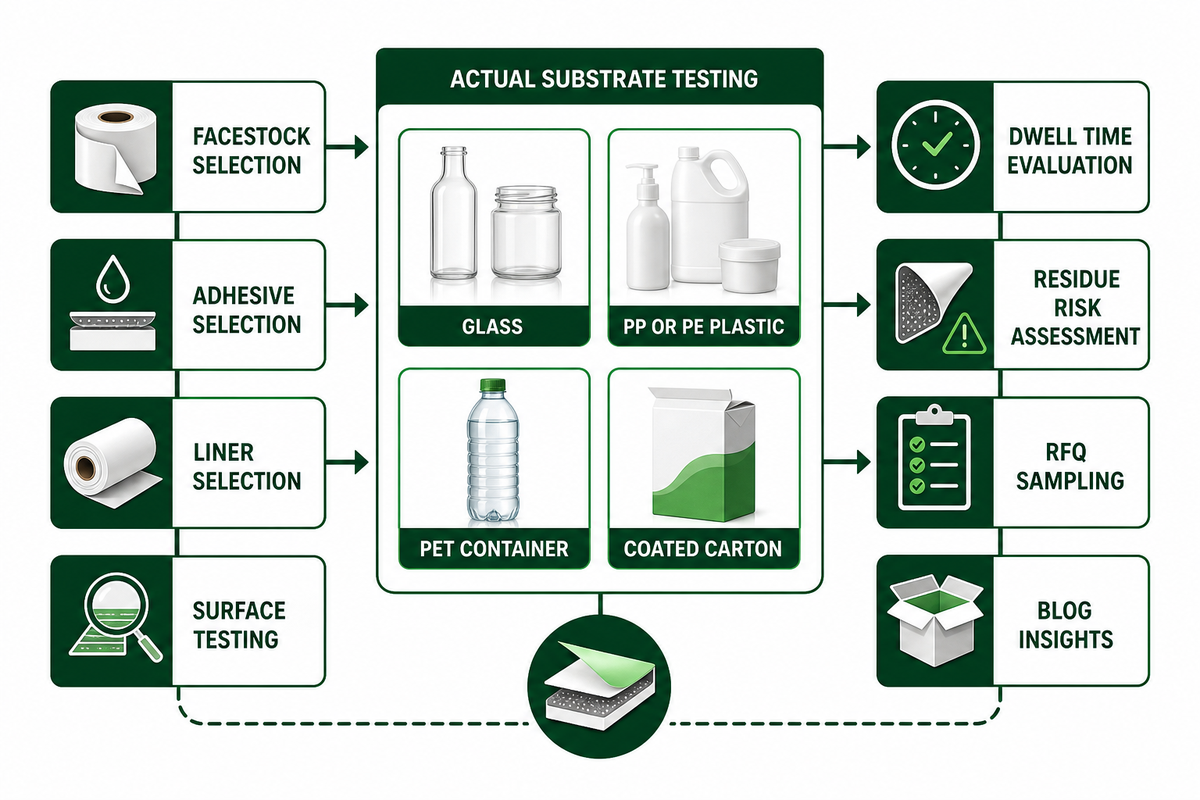
Surface behavior is the reason sample testing matters. Smooth glass, low-energy PP or PE, PET containers, coated paperboard, lacquered metal, and textured packaging give adhesives different contact areas and stress points. Test the label construction on the actual surface, not on a convenient substitute; NIST’s peel-test work specifically treats surface and material variables as part of the measurement problem.
| Bề mặt | Likely starting point | Test risk |
|---|---|---|
| Kính | Coated paper or clear film with removable adhesive. | Residue, water exposure, and label tearing during peel. |
| PP or PE plastic | BOPP synthetic paper or another film sample with adhesive chosen for low-energy surfaces. | Edge lift, weak wet-out, and bond growth after pressure or heat. |
| Thùng chứa PET | Film label construction, with recycling-stream review if recovery matters. | Sortation, wash-off adhesive behavior, ink bleed, and paper contamination in PET recycling. |
| Coated carton or paperboard | Coated paper or BOPP depending on moisture and print needs. | Fiber tear, coating lift, and uneven peel on rougher areas. |
Do not approve a removable label from a clean peel on a flat lab panel alone, because a bottle shoulder, wet-wipe lid hinge, matte carton coating, or oily handled surface can change the answer.
Account for Dwell Time, Temperature, Moisture, and Handling
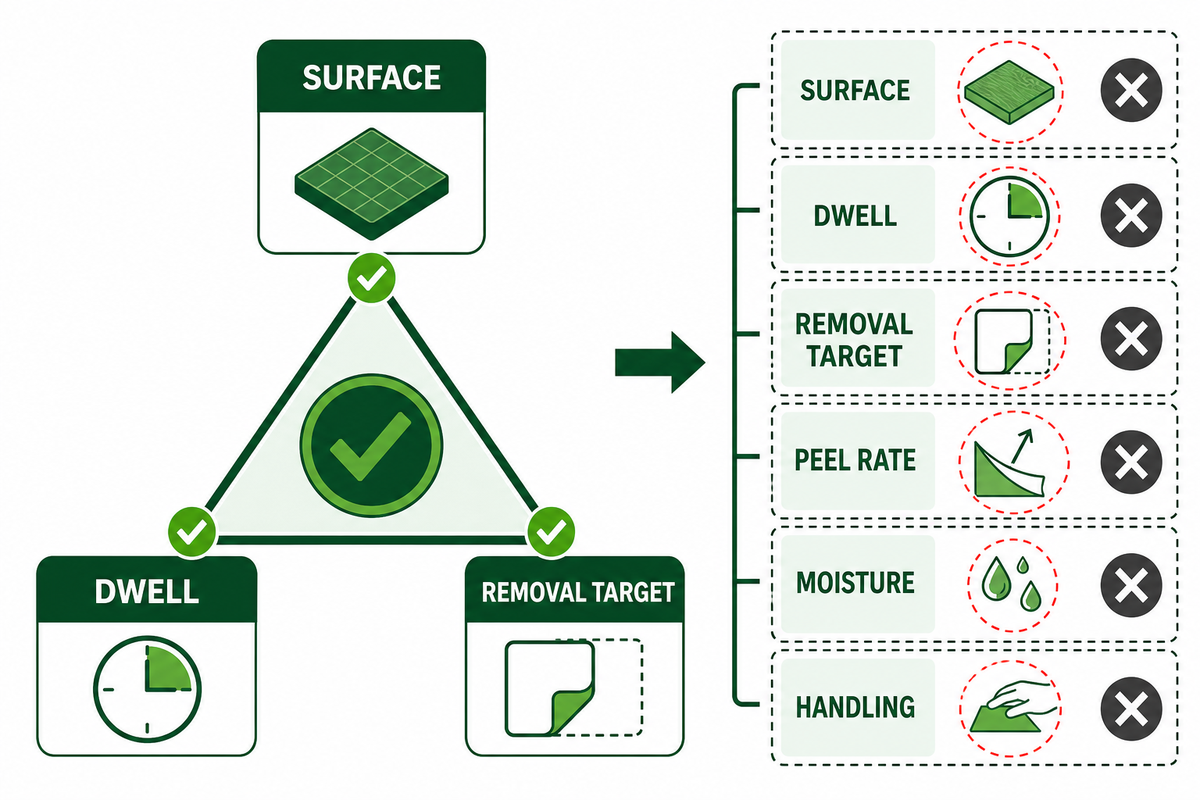
Removable performance is a condition-specific result. Dwell time, heat, cold, moisture, oil, pressure, handling, surface roughness, surface energy, adhesive thickness, backing thickness, conditioning, peel angle, and peel rate can all change peel force, residue, or damage risk. Catalog wording cannot replace a test record.
ASTM D3330/D3330M-04(2025) is useful as a pressure-sensitive tape peel-adhesion method reference, but it should not be treated as a universal performance promise. NIST peel-test research also shows why test geometry and material variables matter for pressure-sensitive adhesives. Guanma’s label durability testing standards guide can sit beside this method checklist when buyers need broader durability vocabulary.
Treat peel evidence as condition-bound: same facestock, adhesive, liner, surface, dwell, peel angle, and peel rate before carrying one approval into another job.
Method note based on ASTM D3330/D3330M and NIST peel-test research
Surface-Dwell-Removal Triangle
Use this as a quick validation rule: if surface, dwell time, or removal target changes, the material approval is no longer the same approval.
- Surface: actual substrate, coating, contamination, curvature, and texture.
- Dwell: realistic aging period under temperature, moisture, pressure, and handling.
- Removal: peel force, residue, tearing, surface mark, wash-off behavior, or recyclability outcome.
For higher-risk projects, ask the supplier or lab to record the test surface, surface preparation, dwell time, temperature, humidity, peel angle, peel rate, sample conditioning, adhesive and backing thickness, and observed failure mode. NIST’s high-throughput peel-test work specifically flags peel rate and statistical design limits as relevant.
Validation Record Template
| Record field | Example value to capture | Why it belongs in the approval file |
|---|---|---|
| Short dwell check | 24 hours and 72 hours, when the buyer wants a quick screen. | Early peel can miss bond growth that appears after storage. |
| Long dwell check | 7 days, 14 days, or the actual service window. | Longer contact can change residue and facestock-tear risk. |
| Temperature screen | Application temperature plus service temperature; if using Guanma’s listed adhesive-dependent range, test -10 C to +60 C. | Heat and cold can change wet-out, peel force, and edge lift. |
| Hình học bóc vỏ | 90 degree or 180 degree peel angle, named in the report. | A different angle can make the same construction look easier or harder to remove. |
| Tỷ lệ lột | 300 mm/min if that speed is used in the buyer’s method. | Rate changes the force profile and should travel with the approval. |
| Sample count | 3 labels per condition, or the buyer’s own QA sample count. | Replicates help separate a one-off peel result from a repeatable approval. |
| Roll conversion | Roll width, core, gap, unwind, die shape, and whether the width approaches 1530 mm. | The label may pass peel testing but fail on dispensing or stripping. |
| Small PET package context | Below 550 ml, record whether label coverage approaches 55% where sorting context matters. | Package size and coverage can affect recovery-stream review. |
| Large PET package context | Above 550 ml, record whether label coverage approaches 75% where sorting context matters. | Coverage should be documented as context, not as proof of compatibility. |
| Removal acceptance | 0 visible residue, no surface stain, or another buyer-defined pass/fail limit. | The result must say what clean removal means for this job. |
A compact test matrix might list T0, 24 hours, 72 hours, 7 days, 14 days, 30 days, -10 C, 23 C, 40 C, +60 C, 50% RH, 90 degree, 180 degree, and 300 mm/min as report columns. Treat those as record labels, not default pass/fail limits; NIST’s high-throughput peel-test design is a useful example of why test variables and statistics need to be named.
Check the Liner and Conversion Path Before Ordering Rolls
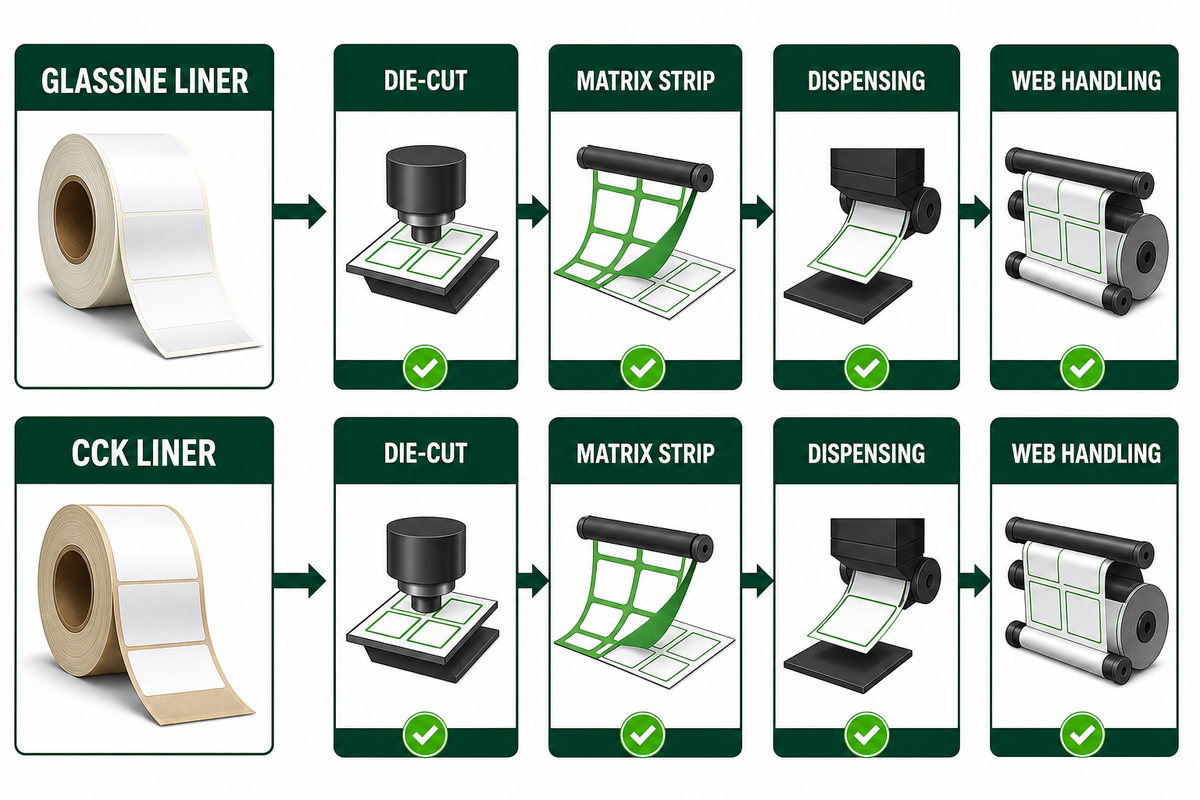
Before ordering rolls, check whether the chosen removable label stock can be printed, die-cut, stripped, rewound, and applied without waste. Even a good facestock and adhesive can still fail in production if release, roll width, unwind direction, or print method is wrong; peel-test methods such as ASTM D3330/D3330M-04(2025) should therefore be paired with conversion checks, not used alone.
Glassine liner is a common roll-label choice when stable release and die-cutting efficiency matter. CCK liner can be useful where stiffness and layflat behavior are more important. Final liner choice depends on label size, die shape, dispensing speed, print method, adhesive coat weight, storage conditions, and the broader phát hành giấy lót path.
Conversion checks before scale-up
- Roll width and machine limit; Guanma lists a standard maximum width of 1530 mm for removable-label materials.
- Print process: flexographic, offset, digital, inkjet, laser, thermal transfer, or preprinted roll.
- Die shape, matrix stripping, label gap, corner radius, and automatic dispensing direction.
- Liner release after humidity, heat, cold storage, and transport vibration.
This is also where procurement teams should prevent a common mistake: approving a sheet sample and then ordering rolls without checking the exact liner and converting route.
Use the Facestock-Adhesive-Liner Fit Matrix
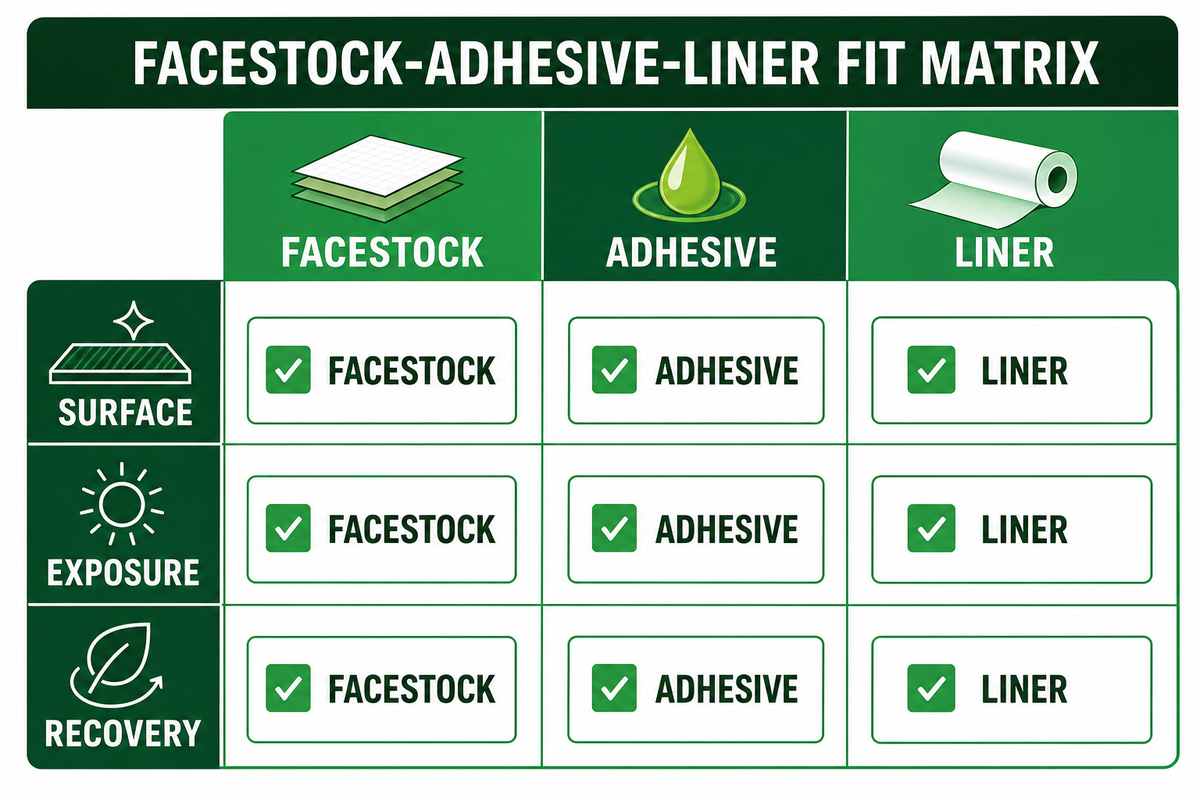
Use the Facestock-Adhesive-Liner Fit Matrix to turn the material choice into a shortlist instead of a guess. Each row should combine the visible label material, the adhesive goal, the liner or roll path, the real surface, and any regulated-use or recovery-stream checkpoint before sampling.
| Loại ứng dụng | Facestock | Adhesive goal | Liner / conversion | Regulated or recovery checkpoint |
|---|---|---|---|---|
| Short-life retail pricing | Giấy tráng | Removable or low-tack | Glassine liner, sheet or roll format | Check carton coating and paper-fiber damage risk. |
| Wet-wipe lid or handled plastic pack | BOPP synthetic paper | Removable with stronger moisture hold | Roll label with die-cut and dispensing check | Check low-energy PP/PE surface and repeated handling. |
| PET package with recovery goal | Low-density film construction under 1 g/cm3 where appropriate | Wash-off or PET-compatible adhesive system | Roll construction with ink and adhesive review | Check APR-style PET stream guidance, paper-label caveats, and label/ink/adhesive test needs. |
| Durable temporary inspection label | Phim PET | Controlled removable adhesive | CCK or glassine depending on die-cut and application | Check 14-day or longer dwell removal and surface mark risk. |
| Reusable glass container label | Coated paper or clear film | Wash-off or controlled removable adhesive | Roll label with water-resistance and ink check | Test removal after the planned wash cycle and inspect residue. |
| Cold-chain temporary label | BOPP synthetic paper or PET film | Removable adhesive with cold and condensation check | Thermal-transfer roll or preprinted roll | If using Guanma’s listed adhesive-dependent range, test from -10 C to +60 C on the real package. |
| PET bottle or thermoform recovery label | Film label that can separate from PET | Wash-off adhesive that does not redeposit on flake | Ink, adhesive, and label coverage reviewed together | For PET bottles, review 55% coverage below 550 ml and 75% above 550 ml as sorting context where relevant. |
| Lab validation sample | Same facestock as production | Same adhesive and coat weight as production | Same liner, die shape, and print method | Record 90 degree or 180 degree peel angle, 300 mm/min test speed if used, and 24-72 hours or actual dwell; use ASTM D3330/D3330M-04(2025) only when its method scope matches the sample question. |
8-Point Fit Matrix Checklist
Use the matrix to choose the first sample, not to skip testing. Its 8 points are facestock, adhesive, liner, surface, dwell, exposure, regulated use, and end-of-life stream. If any point changes, the row needs a new validation result.
When Removable Label Material Is the Wrong Choice
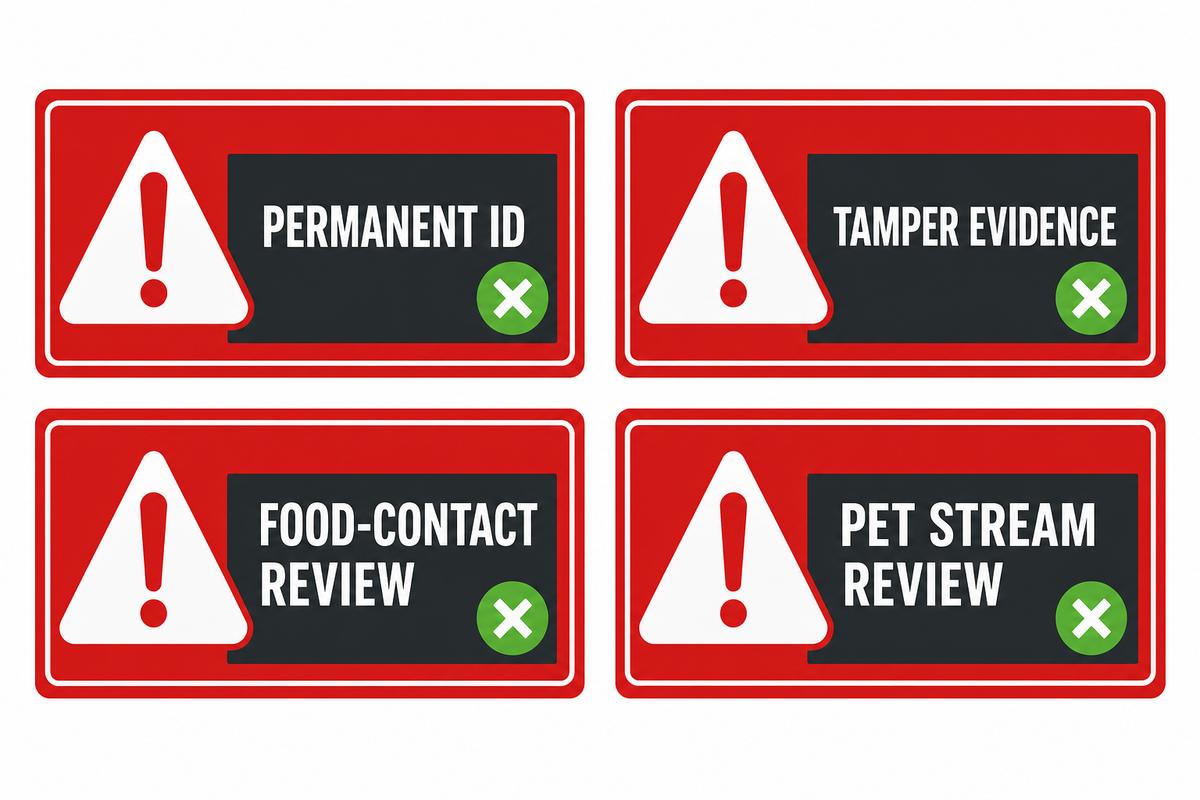
Removable material is the wrong starting point when the label must act as permanent identification, safety marking, tamper evidence, harsh outdoor marking, or a guaranteed residue-free claim. It can also be wrong when food-contact or recycling-stream requirements have not been reviewed; 21 CFR 175.125 is an example of why food-contact pressure-sensitive adhesive claims need specific conditions.
| If the buyer needs… | Consider instead | Reason |
|---|---|---|
| Permanent asset or safety identification | Permanent adhesive or durable industrial label family | Removal is not the priority; long-term legibility and bond strength are. |
| Bằng chứng giả mạo | Void, destructible, or security label material | Clean removal conflicts with visible tamper indication. |
| Unqualified food-contact use | Construction reviewed against the applicable food-contact route | 21 CFR 175.125 permits pressure-sensitive adhesives only under specified composition and use conditions. |
| PET recycling compatibility without testing | Complete label/ink/adhesive system checked for the PET stream | Facestock alone does not prove recycling compatibility; the whole construction matters. |
This section is not meant to push buyers away from removable labels; it prevents the wrong promise. Narrower, verified removable claims are more useful than broad claims that break during production, removal, or regulatory review.
Sample Request and RFQ Checklist for Guanma
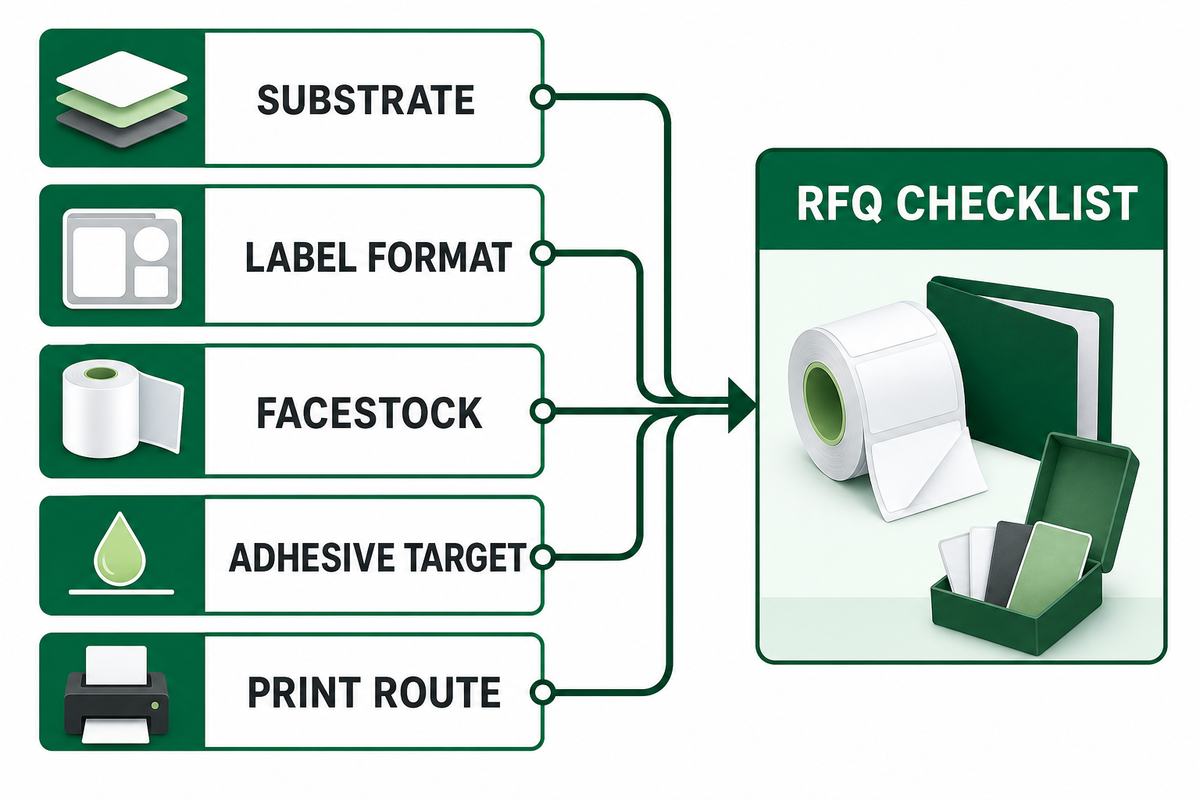
Strong sample requests give the supplier real use conditions instead of a material name alone. Send the substrate, environment, removal target, print method, label size, liner needs, dwell time, compliance limits, and recovery stream so the first sample is close to the actual job.
Search language can vary by buyer. Use the vocabulary map below to translate common phrases into RFQ fields, not to create separate material promises.
| Buyer wording | Map it to this RFQ field | How to keep the request specific |
|---|---|---|
| label adhesive, removable adhesive labels, adhesive residue, without leaving adhesive residue | Adhesive and removal target | Name the removable adhesive, initial tack, dwell window, and residue limit. |
| removable white matte, white matte material, matte labels, matte finish, glossy or matte finish | Facestock finish and print surface | State whether the surface of the label needs a label topcoat for print anchorage or rub resistance. |
| inkjet printers, laser and inkjet printers, printable labels, printed labels, custom printed | Print and conversion route | Confirm whether the label is applied by hand, machine, sheet, or roll after printing. |
| choosing the right label, help you choose the right, best label, label options, material options | Decision shortlist | Compare material effects, cost per label, and test risk before asking for a final label material. |
| using removable labels, removable labels are designed, label to be removed, need to be removed | Use case and removal moment | Explain when the label needs to stay in place and when it must release. |
| removable and permanent labels, permanent or removable, difference between removable, easily than permanent | Adhesive family choice | Specify whether easy removal without surface damage matters more than maximum bond. |
| labels for your products, applications where labels, product packaging, variety of surfaces | Application and substrate | List product packaging materials, coatings, curvature, and environmental factors. |
| durable label, safety labels, outdoor labels | Possible wrong-choice warning | Move toward permanent adhesive or another durable label family if removal is not required. |
| allow for easy removal, easy to apply, labels are made | Handling and construction notes | Ask how labels are made, die-cut, lined, and tested before treating ease-of-use language as proof. |
| label material specifications, sticker label material, PET label material, label material types, types of labels in packaging, types of labels for printing | Material vocabulary | Keep those phrases inside the same removable-label checklist when they describe the same job. |
RFQ checklist
- Surface: material, coating, texture, curvature, cleanliness, and whether it is glass, PET, PP, PE, carton, metal, or another substrate.
- Label format: size, shape, corner radius, roll direction, core size, gap, and order volume.
- Facestock preference: coated paper, BOPP synthetic paper, PET film, clear film, matte surface, or supplier recommendation.
- Adhesive target: low-tack, removable, repositionable, wash-off, no surface mark, no residue target, or removable after a defined dwell.
- Environment: application temperature, service temperature, moisture, oil, condensation, cold storage, heat, handling, and transport.
- Print and conversion: flexographic, digital, inkjet, laser, thermal transfer, barcode readability, liner preference, and machine application.
- Boundary conditions: food-contact path if applicable, PET or other recycling stream if applicable, and any customer-required test method.
After the technical criteria are defined, review Guanma’s removable label materials as the commercial handoff for coated paper, BOPP synthetic paper, PET film, removable adhesive, and liner options. Keep the sample approval tied to your own surface and dwell test, with method notes from ASTM D3330/D3330M-04(2025) or a lab-specific equivalent when peel data is requested.
If you can send real containers or panels, do it. Actual objects beat product-name-only recommendations.
Trend: Low-Residue Claims Need Better Test Evidence
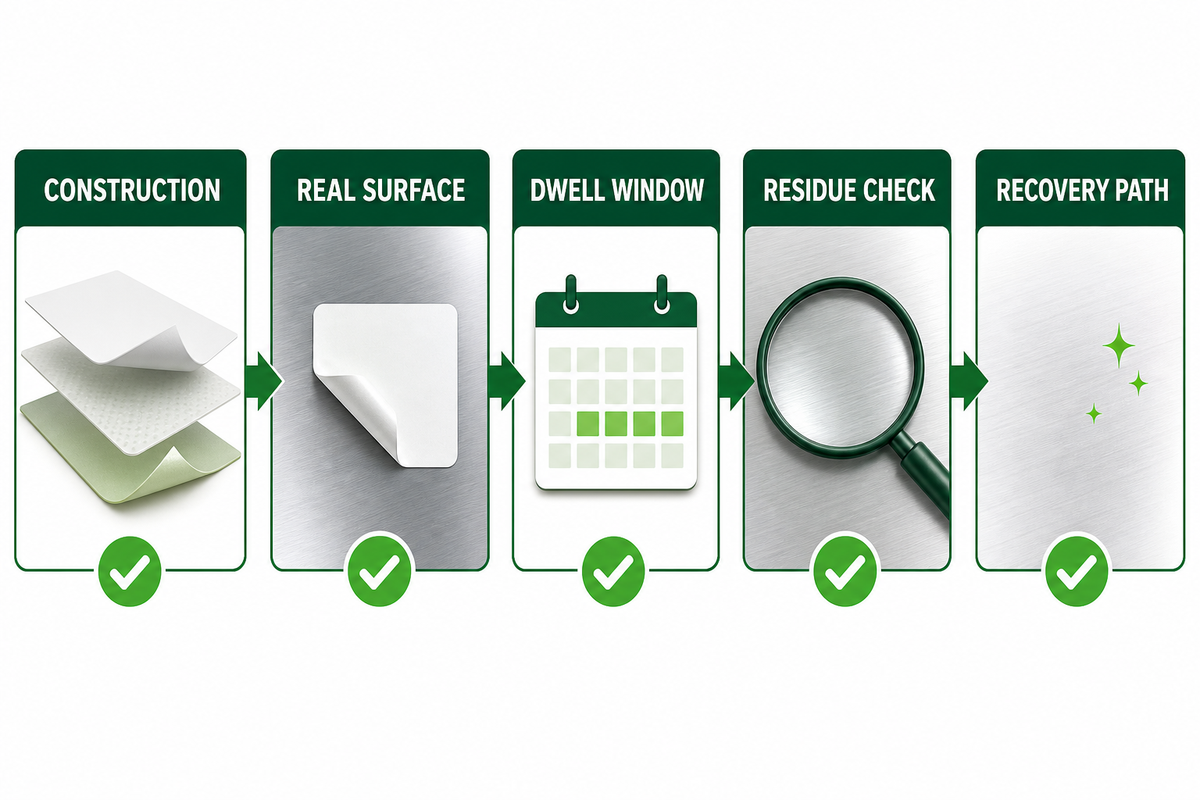
Low-residue claims are becoming more evidence-heavy because packaging buyers now connect removal to reuse, relabeling, washing, and recycling. Useful trend: every label does not need to be removable, but broad clean-removal wording does need a test condition and a construction boundary.
Market reports can show that pressure-sensitive labels and film materials remain commercially important, but market size does not prove that a specific adhesive removes cleanly. More useful evidence comes from test-method research, PET-stream design guidance, and supplier sample records that match the actual surface.
What stronger evidence looks like
- Name the sample construction: facestock, adhesive, liner, ink, and print process.
- Use a real test surface, not a generic panel.
- Match the dwell and exposure period to the buyer’s use.
- Record residue, peel force, label tearing, surface damage, and edge lift.
- For recovery claims, the container stream and relevant test guidance are named.
This is why the best removable-label specification is usually narrower than the first marketing phrase. “Clean removal from this PP lid after 14 days at the expected temperature” is more useful than “residue-free removable label” with no surface, dwell, or exposure data.
Câu hỏi thường gặp
These questions cover the buyer decisions that usually appear before sampling removable label stock. Answers stay conditional because removable performance depends on the full construction and the actual use condition.
What is the best material for removable labels?
There is no single best material for removable labels; the best starting sample depends on the surface, dwell time, print method, exposure, removal target, and any regulated or recovery-stream requirement.
For dry, short-life use, coated paper is often the first sample because it is economical and easy to print. For moisture, flexing, or repeated handling, BOPP synthetic paper or PET film is safer to test. Final choice depends on surface energy, dwell time, removal target, print method, and any regulated or recovery-stream requirement.
What is the difference between permanent and removable labels?
Permanent labels are built for lasting bond, while removable labels trade some ultimate hold for controlled release, clean peel, repositioning, relabeling, reuse, or recovery steps defined by the buyer.
That tradeoff is useful for temporary pricing, reusable packaging, inspection labels, promotions, and short-term routing under heat or moisture. It does not mean the label will remove cleanly from every surface. Test the proposed construction on the real substrate after the expected dwell time, then inspect residue, tearing, edge lift, and surface marks.
Will removable labels come off every surface cleanly?
No, clean removal is a test target rather than a universal promise, because substrate energy, texture, dwell time, temperature, moisture, oil, and peel method can all change the result.
Low-energy plastics, textured cartons, rough coatings, heat, moisture, oil, and long dwell time can change the adhesive bond. Define sample approval by surface, exposure, dwell, peel method, acceptable result, and inspection notes. If the label supports recycling or washing, the complete label, ink, and adhesive system also needs that pathway checked.
When should I choose removable labels over permanent labels?
Choose removable labels when later removal matters more than maximum bond strength, such as temporary pricing, promotions, inspection routing, reusable containers, relabeling, or controlled removal before washing or recycling.
Use removable labels for temporary pricing, promotions, reusable containers, inspection routing, or relabeling. Avoid them for safety marking, tamper evidence, or permanent identification.
What should I send before asking Guanma for a removable label material sample?
Send the real surface, expected use conditions, label size, print method, liner needs, dwell window, compliance limits, recovery stream, and removal target before asking for a material name.
Include surface photos, sample containers, label size, dwell time, service temperature, moisture or oil exposure, print method, roll width, liner preference, application method, and food-contact or recycling-stream constraints if they apply. Add whether the label will be hand-applied, machine-applied, removed by a consumer, removed during washing, or removed before recycling. Those details help narrow coated paper, BOPP synthetic paper, PET film, adhesive, and liner options for testing, and they help avoid a sample that looks fine on a flat panel but fails on the real container.
About This Material-Selection Guide
This guide is written for buyers comparing removable label material constructions, not for general label definitions. It uses Guanma’s listed removable-label materials as first-party examples and separates them from independent method, recycling, and regulatory sources. Its main recommendation is deliberately practical: shortlist a construction, then validate it on the actual surface before production.
Tài liệu tham khảo & Nguồn
- ASTM D3330/D3330M-04(2025) – ASTM International.
- Kiểm tra Peel được xem lại bằng các phương pháp thông lượng cao mới – National Institute of Standards and Technology.
- A New Design for High-Throughput Peel Tests – National Institute of Standards and Technology.
- 21 CFR 175.125 – Pressure-sensitive adhesives – Electronic Code of Federal Regulations.
- PET Thermoform Packaging Design Resource Document – The Association of Plastic Recyclers.
![How to Choose Removable Label Material [2026 Guide]](https://guanmalabel.com/wp-content/uploads/2026/08/how-to-choose-removable-label-material-featured-150x150.png)